How buying a washing machine became an AI comedy: Why the AI customer service revolution is a failure
“We are repeatedly told that artificial intelligence will provide faster, more personalized and more efficient service, Stanford scholar Robert M. Kaplan writes after a series of chatbot misadventures. “Yet consumer frustration with AI interfaces has become commonplace, and many problems remain unresolved. “
Should coastal commission get more power over rebuilding after wildfire? Some lawmakers say yes

This story was originally published by CalMatters. Sign up for its newsletters.
$3.3 million.
That’s how much May Sung estimates it’ll cost to rebuild her Pacific Palisades home.
With her two-bedroom house atop a hillside abutting the Pacific Ocean, she had what she considered a quaint dwelling since 2005.
She doesn’t know if she’ll rebuild it on the empty lot there now.
“Because of all the expenses with building on the hillsides, on the coast, I don’t know if I’m going to rebuild or not,” she said. “I may have to sell.”
More than a year after wildfires tore through Los Angeles, state lawmakers are weighing a new proposal that would give the powerful California Coastal Commission more oversight over homes destroyed by future natural disasters. New buyers would need approval from the commission to rebuild, a reversal from current state law that allows homes ruined by fires or other catastrophes to sidestep the controlling state agency.
Buyers today can rebuild homes without commission review as long as they are largely the same as before the disaster and are no more than 10% larger than the original home.
Gov. Gavin Newsom last year broadened these exemptions to include rebuilds that aren’t similar to their original design when he suspended the commission’s authority over rebuilding efforts in L.A. to speed up what so far has been a grueling slog for the city.
In Malibu and the Pacific Palisades, where many homes hug the Pacific Coast, dozens of parcels of land have been purchased by developers from owners who can’t afford to pay what could be millions of dollars to remake their houses from scratch.
More than 40% of homes sold in the Palisades last summer were bought by investors, according to real estate company Redfin, which defined investors as buyers with “LLC,” “Inc,” “Corp” or “Homes” in their names.
Some residents have questioned what expanses of investor-owned lots could mean for the character of fire-torn communities, said Sen. Ben Allen, who authored Senate Bill 1229 and represents the Palisades area.
The legislation is one of few bills this session that would broaden the authority of the commission rather than weaken it, bucking a trend of longstanding disdain among top state and federal leaders about how the agency has controlled development along California’s invaluable coastline.
The potential law would not apply to homes destroyed by last year’s fires.
 State Sen. Scott Wiener speaks at the Capitol in Sacramento in January 2024. Credit: Fred Greaves for CalMatters
Senate Democrats overwhelmingly supported the bill when it passed the chamber last month. San Francisco Sen. Scott Wiener was the sole Democrat to join Republicans in voting against it in a 29-9 vote.
“It could set a troubling precedent that we’re more focused on only empowering the original owner to build,” Wiener said. “I thought it was a very, very dangerous precedent and that’s why I felt the need to vote ‘no.’”
A long road aheadRebuilding after disaster has never been easy in California.
Fewer than 40% of homes destroyed in the state’s most destructive fires from 2017 to 2020 have been rebuilt, according to a 2025 Los Angeles Times investigation. Low insurance payouts, rising construction costs and permitting requirements are some of the reasons.
For many in L.A., the decision not to rebuild comes down to affordability and practicality, between skyrocketing mortgage rates and a lack of stamina to endure what could be a monthslong, byzantine permitting process.
Before the fire, Sung’s property was valued at $2.5 million. She said she received $700,000 in Mercury insurance payments after the home was destroyed on Jan. 7, 2025. Although her land isn’t up for sale, nearby lots go for around $1 million. She’s considering selling it to a developer.
“There’s already so much burden for these properties,” Sung said of rebuilds. “People can’t afford to build because of all these requirements,” such as the higher fire safety and fire codes common in wildfire-prone areas, she said.
A muddy reputation on housingCritics, including Newsom, accuse the commission of not permitting enough affordable housing or doing so too slowly for years, as lawmakers have gutted numerous housing laws to make it easier to build more apartments quickly.
In the Palisades, where affordable housing was already scant, affordability critiques carried a sharper edge. Just a few hundred units in a town of roughly 28,000 were deemed affordable and local mandates post-fire to build more have become their own flashpoint, separate from the coastal commission.
The 12 voting-member commission is governed by the California Coastal Act, a 50-year-old statute created in the wake of the 1969 Santa Barbara oil spill to protect the coast and its natural habitats.
It is one of California’s most scrutinized state agencies, as federal and local officials have questioned how it has used its authority over nearly 900 miles of coastline to block certain projects, such as rejecting billionaire Elon Musk’s request to increase the number of Space X rocket launches off the Santa Barbara coast.
Newsom and other top Democrats appointed three pro-development officials to the commission last year to help get more housing approved along the coast.
Wealthy Los Angeles real estate developer Jaime Lee was appointed by Newsom last October to replace Effie Turnbull Sanders, an attorney lauded by environmentalists for championing environmental justice issues at the agency.
Last May, Democratic Assembly Speaker Robert Rivas – whose district includes part of Santa Cruz County – selected Chris Lopez, a Monterey County supervisor, and Chula Vista Councilmember Jose Preciado to the commission, both of whom are seen as pro-development. Lopez replaced Santa Cruz County Supervisor Justin Cummings on the commission.
Newsom and President Donald Trump have found common cause in attacking the commission. The governor has publicly chided the agency and issued a sharply worded mandate when suspending its authority over rebuilding efforts in the Palisades.
“The scope of destruction of these fires has created a need for immediate shelter and temporary housing that will require unlocking every available strategy to house displaced individuals,” he wrote.
Both Democrats and Republicans in the state Legislature have pushed to curb the commission’s authority, including an attempt to exempt the entire city of Santa Monica from the commission’s purview.
Last week, Newsom’s office briefly considered a proposal that would have exempted mixed-use and multi-family housing projects along Santa Monica’s coast from the Coastal Act.
The proposal would have assumed all those projects complied with the act unless the commission could prove otherwise within just 30 days, according to a copy of the plan obtained by CalMatters.
Trump has also repeatedly scolded the commission for blocking projects it views as environmentally dangerous. Longstanding tensions between the president and the commission have accelerated in the president’s pursuit to extract more oil from the coast. Those tensions accelerated last week when the federal government announced it was investigating the agency.
‘People are already stuck’Allen, the bill’s author, said the governor’s orders created an opening that investors can misuse to circumvent coastal rules and build projects harmful to the environment.
“We just want to make sure that we’re not rolling back these important protections too far,” Allen, who is running for insurance commissioner, said about his legislation, and that it would not apply to homes destroyed by last year’s fires, but to future natural disasters.
The bill aims to filter out investors by only allowing the owner of a property before disaster struck to skirt the coastal commission approval.
Environmentalists who support the bill have said the governor’s actions put key issues the commission works to protect — natural habitats and public access to the beach — in jeopardy by allowing developers to take advantage of fewer rules.
“An outside developer who buys, say, a burned lot for the low market value, they get the same fast-tracking as a displaced family,” said Jennifer Savage, associate policy director at Surfrider Foundation. “And that’s not what the law was designed for.”
The commission, which had briefly contested Newsom’s orders, supports the bill for similar reasons.
“It closes a loophole that could be misconstrued as allowing larger replacement structures to be located in hazardous or environmentally sensitive areas when rebuilding after disaster,” spokesperson Joshua Smith said in an emailed statement.
Neither the coastal commission nor Allen could provide examples of investor-owned projects that have misused the law.
“We don’t have any record or knowledge of this having happened, although since most disaster rebuilds are handled by local governments, we don’t know for certain the extent to which this has been going on,” Smith said.
California YIMBY, a pro-housing group, said legislation focused on rebuilding should address why so many fire survivors are opting to sell their land in the first place.
“I’m not sure the emphasis on the Coastal Act makes a ton of sense,” spokesperson Matthew Lewis said, saying the problem lies with insurance, construction and permitting costs that make it too expensive for most people to rebuild.
The group, which has endorsed Allen for commissioner, doesn’t have an official stance on the bill. Lewis said he doesn’t know enough about the issues Allen is trying to address to say if the legislation could make it harder for owners to rebuild.
Sung worries such changes would intimidate developers worried about falling under the commission’s authority, making it harder for her and her neighbors to sell.
“If anything, it just makes the landowner stuck. Because you can’t afford to sell, and you can’t afford to build. And so you’re stuck with this property that has absolutely no use to anybody.”
CalMatters reporter Yue Stella Yu contributed reporting.
Have something to say? Lookout welcomes letters to the editor, within our policies, from readers. Guidelines here.
The post Should coastal commission get more power over rebuilding after wildfire? Some lawmakers say yes appeared first on Lookout Santa Cruz.
Letter to the editor: Supreme Court victory for girls’ sports – a clear choice for the Central Coast
In a letter to the editor, Shannon Kessler, the Republican nominee in the race for the District 30 seat in the California Assembly, applauds the Supreme Court’s recent ruling allowing states to ban transgender student-athletes from playing on girls’ and women’s teams.
Stuff the Bus campaign returns to help students facing homelessness

United Way Santa Cruz County and the Santa Cruz County Office of Education have launched the 17th annual Stuff the Bus campaign, with a goal of providing 2,500 backpacks filled with school supplies to students experiencing homelessness, housing insecurity and other hardships.
The campaign, which began July 1, is seeking donations and corporate sponsors to help provide backpacks to students before the start of the school year. A $30 donation covers the cost of one backpack stocked with school supplies.
This year also marks the first time the campaign will include smaller backpacks designed specifically for Transitional Kindergarten and early childhood students.
According to the Santa Cruz County Office of Education, 2,866 TK-12 students were identified as experiencing homelessness during the 2024-25 school year under the federal McKinney-Vento Act.
That includes 2,322 students who were living doubled up with other families, 308 who were unsheltered, 171 living in shelters and 65 staying in hotels or motels.
“The first day of school should be a moment of excitement and belonging for every student,” Santa Cruz County Superintendent of Schools Faris Sabbah said. “For families facing homelessness, housing instability or other hardships, basic school supplies are one more financial burden. Stuff the Bus is one way our community helps students start the year with confidence, knowing they are seen, supported, and have what they need to succeed.”
United Way Santa Cruz County CEO Yvette Lopez Brooks said the annual campaign helps remove one barrier for students and families already facing significant challenges.
“A backpack filled with school supplies can help a student walk into class feeling prepared, confident and supported,” she said. “Stuff the Bus reflects what is possible when our community comes together around children and families, and we are grateful for the donors, volunteers, sponsors and partners who make this campaign possible each year.”
The campaign will culminate with the Stuff-A-Thon on Aug. 1 from 10am-1pm at Kaiser Permanente Arena in Santa Cruz, where volunteers will fill backpacks for distribution to students throughout the county.
The event is held in partnership with the Santa Cruz Warriors and supported by UPS.
People interested in donating, volunteering or becoming a sponsor can find more information at unitedwaysc.org/stb.
California to institute Bruce Lee Day, a first for a Chinese American in the state’s history
Martial arts icon Bruce Lee, who was born in San Francisco, will become the first Chinese American in California history with an annual namesake day – May 17.
Fairgrounds to demolish sheep and pig livestock barns

The upcoming Santa Cruz County Fair will look different this year, as the sheep and pig livestock barns are slated for demolition in July, nearly four years after the initial board vote on the plans, and only a few months before the county fair returns on Sept. 16 – 20.
The barns will be replaced with tents during the fair, said Dori Rose Inda, the Santa Cruz County Fairgrounds CEO and fair manager. The tents will be similar to the ones elsewhere on the fairgrounds.
California Construction Authority—the governing body overseeing the demolition— says that the reason for the demolition is that “the existing Livestock Barn has outlived its usefulness and has become a danger for the fairgrounds, anyone inside or near the structure. The State Fire Marshall wants the full structure demolished before the next (2026) or fully secured with no admittance.”
The two barns were built in the 1950s and sit on the east side of the fairgrounds, parallel to livestock road, in the livestock area of the fair.
They now pose a safety concern, said Ron Haedicke, the marketing director for the fairgrounds, citing the structures’ age and ability to withstand earthquakes and strong winds.
“This year, we had to move forward either with rebuilding or demolition,” said Inda, “we couldn’t plan and rebuild quickly enough, so we are moving forward with demolition.”
According to Inda, the current estimate for the demolition cost is around $430,000, adding that the total could change as the demolition is still in the planning stage.
The demolition is planned to begin in late July, said Haedicke, who added that this will follow approval of the contractor’s bids, which are due July 20. The demolition is planned to begin immediately after, clearing the area before the fair begins in September.
The fairgrounds are also used as an evacuation center during county emergencies. While the fairgrounds are without replacements for the sheep and swine barns, according to Haedicke, anything that normally has been housed in those barns would be moved to the beef barn.
The barns “have served the fair quite well all these years,” said Haedicke, “and it’s this time that they are going to have to be replaced.”
To honor the old barns, the sign that hangs above the swine barn has been preserved, “and it will be used in whatever new construction is done,” said Haedicke.
In 2022, the Pajaronian reported on the demolition plans when the board originally approved them in a 6-2 vote.
The final decision following the vote regarding the barns went to the California Construction Authority, because the fairgrounds are state property, said Haedicke.
The goal is to hopefully preserve some part of the old barns, such as the cement horse racks in both the swine and sheep barns, said Haedicke, “and then the tents will somehow work around that.”
The tents are planned to go in approximately the same place as the old barns, but it depends on the fair’s planning, Haedicke added. “It’ll all come together when the fair opens.”
Nonetheless, the demolition will leave the fairground without a permanent structure to replace the barn until they can afford to build new barns. This process, Haedicke believes, will take two to three years, adding that they are considering reimagining the livestock area and building a larger, multi-use building for year-round events and livestock.
“It’s a very exciting to have the prospect of what will be the future buildings there,” said Inda, “we’ll do a very thorough process of engaging with community, and making sure that we are thinking through what we are replacing at the barns to be the best use for the community that we serve.”
Japanese cultural school Kokoro no Gakko marks 37th year

Kokoro no Gakko, an annual one-week program dedicated to the culture and arts of Japan, wrapped up its 37th year Friday during an open house at the Watsonville Buddhist Temple.
Formed in 1989, the school, which translates to School with a Heart, welcomed 53 students, grades kinder through six.
Five days of lessons covered traditional Japanese activities, including bonsai, ikebana, origami, calligraphy, cooking, language arts and music.
 CULTURE TODAY Kindergarten students perform a Japanese dance at the close of the week-long Kokoro no Gakko classes Friday. (Tarmo Hannula/The Pajaronian)
One highlight of the course was a visit from 97-year-old Janice Tao, who—along with her family—was rounded up with Pajaro Valley people of Japanese descent and sent to a detention camp during World War II.
Around 120,000 people were relocated and incarcerated in 10 concentration prisons, with at least two-thirds of them being American citizens.
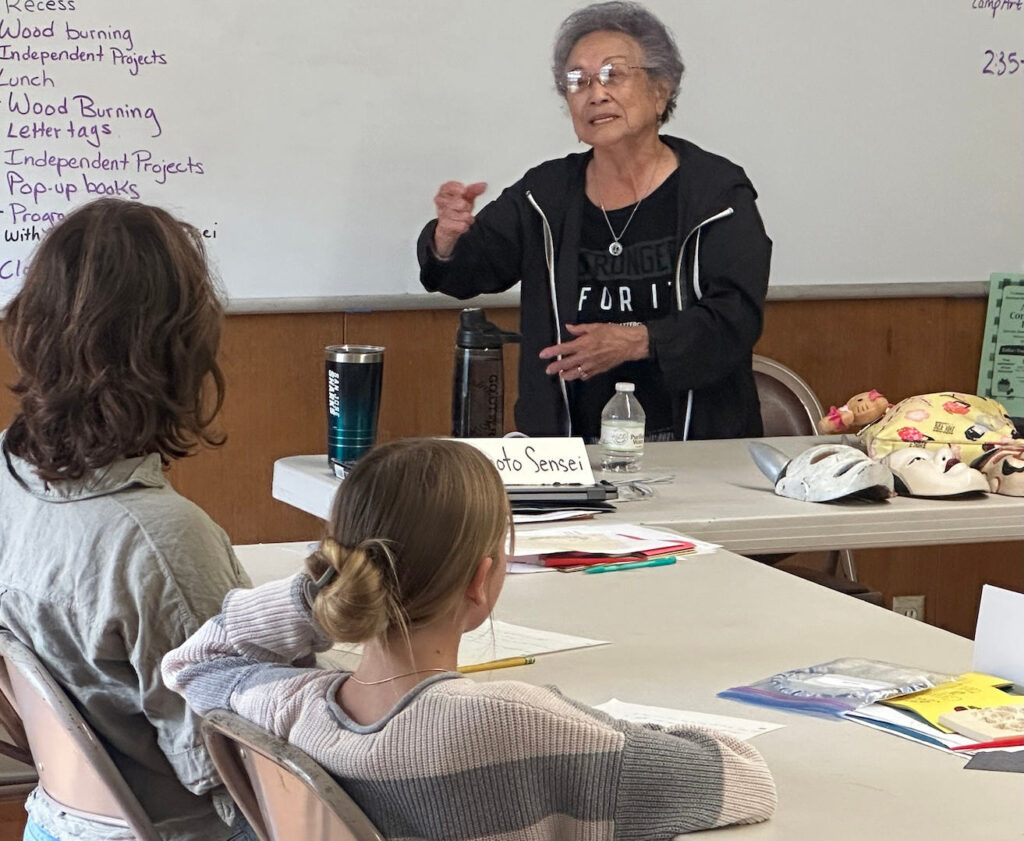 SPEAKING HISTORY Janice Tao, 97, answers questions from students about her years in a detention camp in Poston, Arizona during World War II. (Tarmo Hannula/The Pajaronian)
Tao told a group of fifth graders that she was a grade school student at Pajaro School when her family rented and ran a strawberry farm where Aladdin Nursery now stands on Freedom Boulevard.
Tao said the news of the Pearl Harbor attack was blaring over a radio on the streets of Pajaro the day after the event.
“When I went to school the kids were calling me Jap; it was one of the worst days of my life. And I know there’s some of this still going on today. One thing I’ve learned is that you have to fight for your life.”
When her family and others were rounded up and shipped off to the detention centers, she said, “We could only take what we could carry.”
In the camps she said, “There was nothing to do. My enjoyment was reading books; I love to read. There were arts and crafts; there was a lot of talent there. But overall, there was not much to do.”
 YOUNG ART A student named Mika created this traditional sumi-e, or black ink painting. (Tarmo Hannula/The Pajaronian)
After internees were released four years later, Tao’s family first moved to Los Angeles, then Watsonville.
Friday’s event treated a crowd of more than 250 people to choral works and dances punctuated with theatrics and more. The gathering, headed up by principal Melissa Eguchi-Song, included a raffle and potluck meal.
Gakko is a parent-cooperative that is largely fueled by the students’ families and facility support of the Buddhist Temple.
Performance directors Denise and Bob Gómez have taught at Gakko for years and have traveled to Watsonville’s sister city in Japan, Kawakami, seven times. The couple helped orchestrate and choreograph, through guitar playing, poetry and singing, and six stage works that represented each grade.
Meeting explores BESS facility objection process

Around 150 people gathered June 28 at Pinto Lake City Park to learn of the next steps on a proposed Battery Energy Storage System (BESS) in Watsonville from Executive Director of the California Energy Commission, Drew Bohan.
The public meeting, hosted by Stop Lithium BESS in Santa Cruz, featured several guest speakers and members of the public who addressed concerns about what organizers described as “the proposed hazardous, flammable, explosive BESS right next to homes at 90 Minto Road.”
The project on Minto Road, a short distance from Pinto Lake, was proposed in January 2025 by Massachusetts-based New Leaf Energy. The CEC is the lead agency reviewing New Leaf’s application and will be the deciding factor in whether a BESS can be built at 90 Minto Road.
Back in May New Leaf Energy said it will bypass Santa Cruz County’s permitting process and instead seek state approval for its storage system.
In a May 1 letter to the county, the company said it would withdraw its application for the Seahawk project at 90 Minto Road and pursue the California Energy Commission’s “opt-in” permitting process under Assembly Bill 205.
“Your voice matters; don’t ever let anyone tell you it doesn’t matter,” local activist Becky Steinbruner told the crowd. “The ordinance that was written was severely flawed. We need to demand that the ordinance prohibit any BESS facility on agricultural land.”
Protesters are calling for a buffer zone of 1,000 meters between the facility and residents, schools, daycare centers and care facilities.
“This project was filed on June 8th,” Bohan said. “My staff and I have 30 days to determine whether the project is complete.” Bohan went on to explain that his team welcomes all input.
“Every comment that gets filed gets published in what we call the docket,” he said. He added that the file is typically not complete and involves a “back-and-forth process” that can take 10 or 11 months.
Once the project is complete, Bohan said he and his bosses will come to Watsonville and interview the community formally after presenting their findings about the application.
In a statement provided to The Pajaronian, New Leaf Project Lead Max Christian said that the project will meet or exceed the safety regulations included in Santa Cruz County’s draft BESS ordinance, which he described is “the strongest ordinance in the U.S., if not the world.”
Christian said that the project will include approximately 200 double-walled steel, sealed containerized batteries that will use lithium-iron phosphate (LFP) chemistry, as opposed to the more volatile, heavy-metal lithium-ion nickel-manganese-cobalt (NMC) chemistry that was used in first-generation systems like Moss Landing.
Much of the concern stems from the Jan. 16, 2025 fire at the Moss Landing Vistra Power Plant that led to hazardous toxic fallout and a thermal runaway at the edge of the Monterey Bay Sanctuary and ignited concern in Monterey and Santa Cruz counties about battery storage systems.
Santa Cruz County Supervisor elect Tony Nuñez offered words as well about assuring safety for the community.
“Public safety is what I ran on,” he said.
Organizers said the incumbent supervisor, Felipe Hernandez, was invited but was not present.
Scores of people expressed concern about why a BESS plant was being considered in a tightly packed residential area on the narrow Minto Road with one way in and out, and about lack of appropriate training for firefighters should a fire erupt inside the facility. Appropriate evacuation routes and centers were also discussed.
To file a comment, go to efiling.energy.ca.gov/Ecomment
Local author shines light on notable California woman

For years, Rose Ann Woolpert heard stories from her mother-in-law about a remarkable woman in the family’s history.
The woman was Mary Catherine “Molly” McIntyre Pacheco, a playwright and novelist who married Romualdo Pacheco, the only Latino to serve as governor of California.
But while Romualdo Pacheco’s place in history was well documented, his wife’s story had largely faded from view.
That changed this year with the release of Mrs. R. Pacheco, Woolpert’s first novel, a work of historical fiction that blends extensive research with imagination to recreate the life of a woman whose accomplishments were largely forgotten.
“I’ve always loved history,” Woolpert said. “One of the things that I’m finding at this point in my life is I’m really interested in learning about not only California history, but the people whose stories really haven’t been properly told—especially women.”
The novel follows McIntyre Pacheco as she arrives in California in 1859, marries the rising California politician and discovers her own creative voice amid the state’s rapidly changing social and political landscape.
Woolpert describes the book as family-friendly historical fiction based on real people and real events.
“It’s written for families,” she said. “It’s not written specifically as a children’s book, but it’s suitable for young people.”
The story began decades ago, when Woolpert married into her husband’s family and became intrigued by stories about his ancestors.
“My mother-in-law would talk about her great-grandmother, who came to California after she was widowed in 1859,” Woolpert said. “She had three teenage daughters, and the eldest, Mary McIntyre, married Romualdo Pacheco, who at the time was a very romantic California politician and eventually became governor of California. I just wanted to know, ‘How did this all come about?’”
That curiosity launched years of research.
Woolpert dug through books, historical articles and museum archives, including resources in San Luis Obispo and Santa Barbara, where the Pacheco family lived for a time. While there was ample material about Romualdo Pacheco, information about his wife was much harder to find.
“There was a fair amount of information about him,” she said. “But Mrs. R. Pacheco was a playwright. Her story was never really told, but there were articles written about her back in the 1800s because she was very well known at the time.”
McIntyre Pacheco wrote plays and books, and one of her works was adapted into the popular musical Three Twins.
Still, much of her life remained undocumented.
“When people’s stories aren’t fully told, you need to fill in the blanks,” Woolpert said. “That’s where fiction comes in.”
The research also uncovered lesser-known pieces of California history.
One detail that surprised Woolpert was the journey McIntyre’s family took west. Rather than crossing the continent by wagon train, they traveled by ship to Panama, crossed the isthmus by train and then boarded another ship for California—a route many travelers and the U.S. mail used before the transcontinental railroad.
“It wasn’t without danger,” she said. “But it was the way a lot of people traveled, and it was fun to learn about the adventures that could have happened that I was able to add to my story.”
The project also answered questions Woolpert had carried since childhood.
“I grew up in Southern California, and I never heard about those years between the Gold Rush and Hollywood,” she said. “I was always wondering what went on in those times. I was able to answer my own questions through this research.”
Mrs. R. Pacheco is Woolpert’s first novel, but not her first book. She has also written three children’s books: Engine Number 10, Big Bill and His Little Mixer Truck and Cauliflower Boulevard.
She said the historical novel is the first of several planned books centered on overlooked women in California’s past.
“I’ve got three more books—one getting close to finished, another in the works and a third that I’m still figuring out,” she said. “They’re all untold stories about fascinating California women.”
For Woolpert, those forgotten lives are where history becomes most compelling.
“Women were doing fascinating things, too,” she said. “They just weren’t getting their stories told. That’s what I’m really interested in right now.”
Mrs. R. Pacheco is available through major book retailers.
Booksellers, libraries, and event coordinators may order directly at bit.ly/4vHNsA5
PVUSD, teachers union enter fact-finding after mediation stalls
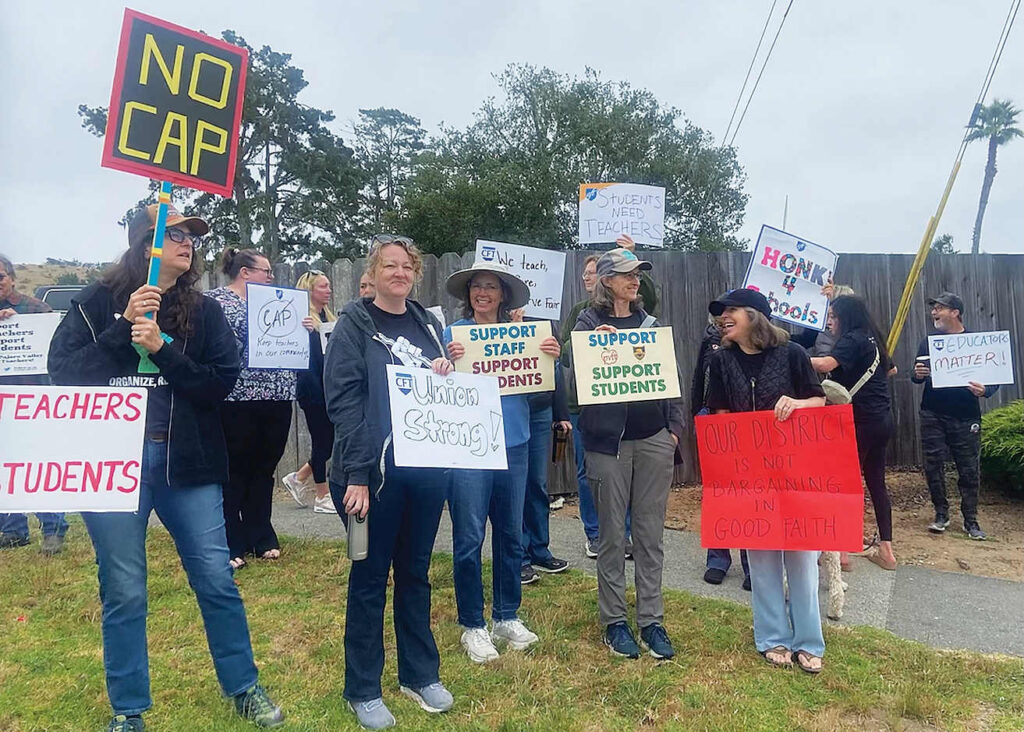
Contract negotiations between the Pajaro Valley Unified School District and the Pajaro Valley Federation of Teachers have reached another impasse, with both sides now entering the formal fact-finding process after mediation failed to produce an agreement.
Fact-finding is a dispute resolution process used after a union and employer reach an impasse in contract negotiations. A neutral panel reviews evidence and arguments from both sides before issuing non-binding recommendations aimed at resolving the dispute.
The process is the final formal step in California’s impasse procedures before additional legal options become available to both parties.
In a message to union members following mediation, PVFT President Brandon Diniz said the district remained unwilling to move away from its proposal to cap district contributions toward employee health benefits.
“A few hours into the second day of mediation, we were informed that Kit Bragg had spoken with our superintendent,” Diniz said. “The superintendent, via the district’s negotiation team, made it clear that despite the concessions we were willing to make on salary in order to preserve our benefits, the district is unwilling to show any movement without an agreement to place a cap on benefits.”
The union has consistently opposed the proposed cap, saying it would shift rising health care costs onto employees.
“Our membership has made it clear from the beginning of this process that health and welfare benefits must be protected,” negotiations team member Emily Halbig said. “We presented proposals that would have protected our benefits while mitigating the rising cost of health care, keeping the district fiscally solvent. We worked as hard as we could, but in negotiations, it takes both parties.”
Member Minc Brooker said the district’s latest proposal reduced its health benefit contribution even further.
“The district came to mediation with proposals that contribute even less to our benefits than what they proposed months ago when they first put the cap on the table,” Brooker said.
In an email sent to media, district officials said the fact-finding panel will include a neutral chairperson, one representative appointed by the district and one appointed by the union. The panel will review information from both sides and issue recommendations intended to move negotiations toward a resolution, the district said.
“Although we are entering this next phase, our commitment to reaching a fair and sustainable agreement remains unchanged,” the district said. “We value our certificated employees and deeply appreciate the dedication they bring to our students and families every day. The district remains committed to providing competitive compensation and benefits while maintaining the fiscal responsibility necessary to serve more than 14,000 students now and into the future.”
While the fact-finder’s recommendations are not binding, they mark the final step before the district could impose its last, best and final offer. Under California labor law, the union could then choose whether to strike, although negotiations may continue throughout the process.
The district and union have been at odds for months over wages and health benefits. The district has proposed a three-year salary increase totaling 7.77% while seeking to cap its contribution toward employee health insurance. The union has argued the cap would leave teachers responsible for increasingly expensive premiums and has made preserving current health benefits a central issue in negotiations.
PVFT leaders said they will hold a bargaining information session for members next week to discuss the fact-finding process and possible next steps.
10 reasons Gateway School’s Kindergarten is the perfect start for your child

“He comes home every day confident, happy and positive. It’s a bit of magic.” – Natascha, Gateway Parent
At Gateway School, magic happens daily in our Kindergarten program. With an emphasis on exploration, discovery, and hands-on learning, everyone at Gateway turns your child’s natural curiosity into a lifelong love of learning.

What makes Gateway’s Kindergarten so special?
Here are ten reasons parents and students fall in love with Gateway:
- The Gold Standard in Education
Gateway is the only K-8 school in Santa Cruz County accredited by both the National Association of Independent Schools (NAIS) and the California Association of Independent Schools (CAIS), ensuring a top-tier, well-rounded education. - Specialist Programs that Inspire
From Spanish and Art & Technology to Life Lab Science, Music, and Physical Education, our weekly specialist programs are taught by experts who bring their passions to life, sparking inspiration in every child. - Fluent Futures in Spanish
Our robust Spanish program starts in Kindergarten and continues through 8th grade, preparing graduates to excel in advanced high school courses and beyond. - Hands-on, Minds-on Learning
Imagine your child learning science by growing a garden or solving math problems through building projects. Gateway’s experiential approach helps students think critically, collaborate effectively, and retain knowledge with joy. - The Power of Play
At Gateway, play is more than fun—it’s essential. From creative free play to structured activities, our program fosters healthy brain development and essential life skills. As Zoe, class of 2031, puts it: “Play might actually be learning!” - Big Buddy, Little Buddy
Through our cherished Buddy Program, Kindergarteners are paired with 4th and 8th grade students for shared activities and mentoring. These connections build confidence, nurture empathy, and strengthen our school community. - Small Classes, Big Attention
With an average class size of just 15 students and a student-teacher ratio of 7:1, every child receives personalized support. Each classroom has both a full-time teacher and a full-time assistant, ensuring that every child feels seen and heard. - Kindy Island: A Place to Imagine
Kindergarteners have their own special space—Kindy Island—designed for safe, imaginative play. It’s a sanctuary where creativity knows no bounds. - Whole-Child Focus
Social-emotional learning is seamlessly woven into daily routines. From developing empathy to building resilience, we nurture the emotional well-being that underpins academic success. - A Community that Cares
Gateway is more than a school—it’s a family. With close-knit relationships among students, faculty, and families, we create an inclusive environment where every voice is valued.

Discover the Gateway Difference
When your child steps into Gateway’s Kindergarten, they’re stepping into a world of endless possibilities. From the first day, they’ll grow confident, happy, and curious, just like Natascha’s child. Come see the magic for yourself!
Learn more or register for a tour at gatewaysc.org, or admissions@gatewaysc.org

The post 10 reasons Gateway School’s Kindergarten is the perfect start for your child appeared first on Lookout Santa Cruz.
10 Hot Jobs in Santa Cruz County: Week of July 2
 Top 10 exciting job opportunities in Santa Cruz County – Apply today!
Are you searching for your next career move in Santa Cruz County? Look no further! We’ve curated a list of the top 10 job opportunities recently posted to our job board, spanning various industries and roles. Whether you’re a recent graduate, seasoned professional, or someone seeking a fresh start, Santa Cruz has something to offer for everyone.
- Pastry & Kitchen Manager at The Penny Ice Creamery
- Assistant Manager of Operations at The Quail
- Maintenance Engineer at The Quail
- Caregiver for Seniors – Part Time at Home Senior Care, Inc.
- Accounting Technician at County of Santa Cruz Human Resources Department
- Shop Manager at The Penny Ice Creamery
- Short Term Camp Bus Driver at Camp Ramah in Northern California
- Forest Stewardship Manager at Sempervirens Fund
- Project Manager 1 at MYNT Systems
- Residential Community Service Supervisor at UC Santa Cruz
Santa Cruz County boasts a vibrant community, picturesque surroundings, and diverse career opportunities. From academic roles at UC Santa Cruz to impactful positions in healthcare and local government, the perfect place to support both your professional growth and work-life balance.
Ready to take the next step?
Apply for these exciting job opportunities in Santa Cruz County today!
FIND MORE ON THE LOOKOUT JOB BOARD >> Looking to hire? Build your team with us- List your open positions: Amplify your job listings to reach engaged Santa Cruz County job seekers – post your job today.
- Save with job bundles: Purchase a job board bundle of 4 or 8 listings and save 25%. Redeem your jobs anytime. Bundles never expire. Get Your Bundles Here.
- Exclusive discounts for Marketing Partners: Are you a Lookout Marketing Partner? Contact your representative today to access your exclusive discount.
Questions about the job board? Reach out to Brittany at brittany@lookoutlocal.com.
The post 10 Hot Jobs in Santa Cruz County: Week of July 2 appeared first on Lookout Santa Cruz.
City of Santa Cruz wins lawsuit over sugary drink tax, but an appeal is likely
The City of Santa Cruz announced Tuesday that it has won a lawsuit brought by industry groups over Measure Z, the sugar-sweetened beverage tax that voters approved in November 2024. The city expects an appeal.
Wednesday morning traffic: Highway 9 closures, lane reductions for bridge work
This post is updated throughout the day to reflect the latest incidents. It was last updated at 10:02 a.m..
Here’s what’s happening on the roads this morning…

▼︎ new incidents ▼︎ long-term incidents
Road incidents as of 10 a.m. on July 1- Highway 9 is facing closures in both directions at Pool Drive in San Lorenzo Valley for bridge work. The closure is expected to end at 5:59 a.m. tomorrow.
- Highway 9 at Cascade Avenue in San Lorenzo Valley has one-way traffic due to ongoing work. This closure will last until August 31.
- Alternating lanes are closed on Highway 9 at Riverdale Park in San Lorenzo Valley because of bridge work. The closure is expected to end at 6:59 a.m. on April 30, 2027.
- A lane on North Highway 9 at Two Bar Road in San Lorenzo Valley is closed for bridge work. The closure will last until 6:01 a.m. tomorrow.
- A lane on westbound SR-152 at Clifford Drive/Ohlone Parkway in Watsonville and Pajaro is closed for asphalt paving. The closure will last until 5:59 a.m. on July 3.
- A traffic hazard was reported on Highway 1 near Wilder Ranch State Park at 9:54 a.m. today. A vehicle traveling southbound continued past the area, but the hazard was in the northbound lane. The incident happened near Bonny Doon and Davenport.
- CHP helped with construction at the intersection of Highway 9 and Alameda Avenue in San Lorenzo Valley today.
These have been going on for a while, but are still worth keeping in mind.
- A section of Coolidge Drive between High Street and Hagar Road is closed to northbound traffic from 8:30 a.m. to 4:00 p.m. from June 29 through today for pavement work by County crews. The closure is in the Westside / Downtown area.
- Soquel Drive between State Park Drive and Trout Gulch Road in Aptos will be closed on July 4 from 9:30 a.m. to 2 p.m. for the annual Aptos 4th of July Parade.
- Playa Boulevard will be closed between Palma Avenue and Benito Avenue in La Selva Beach on July 4 from 11:00 a.m. to 1:00 p.m. for the annual La Selva Beach 4th of July Parade.
- Pine St. (between Hwy 236 and Harmon St.) and Lomond St. (between Pine St. and Railroad Ave.) in Boulder Creek, San Lorenzo Valley will be closed for the Boulder Creek 4th of July Parade.
Disclosure: Traffic incidents are partially generated by artificial intelligence. We are constantly working to improve the accuracy and quality of our AI-generated content. However, there may still be errors or inaccuracies. If you have any questions or concerns, please contact us.
The post Wednesday morning traffic: Highway 9 closures, lane reductions for bridge work appeared first on Lookout Santa Cruz.
Supervisors shelve battery storage ordinance after Watsonville project moves to state
The Santa Cruz County Board of Supervisors voted unanimously Tuesday to shelve a local ordinance regulating battery storage systems following a decision by the developer of a project proposed for outside Watsonville to seek approval through the state.
Civil grand jury faults Santa Cruz transportation commission for decades of flawed rail planning
A new civil grand jury report faults the Santa Cruz County Regional Transportation Commission for decades of flawed planning on the coastal rail corridor. It says officials advanced proposals without adequately accounting for engineering, legal and financial realities, and recommends that the commission adopt stronger project evaluation and strategic planning processes.
Dominican Hospital nurses and staff rally against proposed cuts
Dozens of staff members and supporters rallied outside Santa Cruz’s Dominican Hospital on Tuesday to oppose proposed layoffs and reductions to part-time status affecting 22 nurse educators, monitor technicians and unit coordinators, arguing that the cuts would undermine patient safety and place additional burdens on front-line nurses.
Free Will Astrology

Letters

Street Talk