
Republicans Scramble After Trump Refuses to Sign Landmark Housing Bill
Republicans can’t catch a break at the minute, and it’s all due to their mad, senile king.
On Wednesday, President Donald Trump refused to sign a bipartisan housing bill, the 21st Century ROAD to Housing Act, which passed both the House and Senate with flying colors— catching members of his own party off guard.
The bill would create new homes and limit corporate investors’ ability to buy single-family residences. Members of the GOP have used it as an example of their concern for working people ahead of the November midterms.
The stage was quite literally set for the signing in the Capitol before Trump threw his hissy fit. With little over an hour before the public signing ceremony, the president said he wants to push through the SAVE Act, Republicans’ faulty voter ID bill, before doing anything about housing.
Republicans then rushed to remove the presidential seal from the podium, as Democrats began using the stage as a backdrop to highlight the president’s sudden flip-flop.
The Presidential seals are removed pic.twitter.com/LcenV4xLDE
— Scott MacFarlane (@MacFarlaneNews) June 24, 2026Following Trump’s public refusal, House Speaker Mike Johnson attempted some damage control in a press conference.
“The president, when we go through the details of the bill, he’s gonna understand that it’s a good product, and certainly something that fulfills his promises,” Johnson said.
The SAVE Act has passed in the House, but does not currently have the votes to pass the Senate. Nor should it—the bill will make it tougher for anyone lacking a paper copy of their birth certificate or passport to vote.
“The SAVE Act will make it exceedingly and unacceptably difficult for hundreds of thousands, if not millions of Americans, to be heard,” Democratic Senator Raphael Warnock told Politico. “If all the people in the election can’t be heard, who are eligible to vote, then that’s something other than democracy.”
“I don’t think the American public knows what is in store for them if [the SAVE ACT] passes,” Democratic Senator Mazie Hirono added. “Millions of people are going to need to re-register.”
Kyle Griffin of MS NOW called the legislation “designed to help rig elections.”
Despite the president’s refusal to sign the housing bill, it could still become law in 10 days if Congress remains in session.
SUPERGIRL Doesn’t Quite Fly High Enough (Review)
- Nerdist gives Supergirl starring Milly Alcock and Jason Momoa a 3 out of 5.
- The movie directly adapts Tom King and Bilquis Evely’s fantastic graphic novel Supergirl: Woman of Tomorrow.
- Supergirl is the second movie in James Gunn’s DCU.
Sophomore albums are hard. Just ask Weezer (or whatever other example you want). The DCU only kicked off with Superman last year and its success was both a blessing and a curse. A blessing because it proved James Gunn could run a whole cinematic universe. A curse because it means anyone not named James Gunn making movies in that space would be unfairly compared to him. (We’ll see what happens with Lanterns on the TV side.) Craig Gillespie is the director in that first post-Superman slot with Supergirl. While the movie is perfectly enjoyable enough, it could have (and probably should have) been much more.
 Warner Bros.
The movie directly adapts Tom King and Bilquis Evely’s fantastic graphic novel Supergirl: Woman of Tomorrow, which gives it a strong narrative to work from. That it doesn’t have many aspirations beyond adapting that book leaves the movie feeling smaller than its intergalactic setting would lead you to believe. Ultimately, Supergirl hits highs of its own, even if it feels like a bit of a lesser outing.
When we first met Milly Alcock as Kara Zor-El, alias Supergirl, in last year’s Superman, she came across as a drunk party girl who didn’t train her dog. That vibe largely carries over to the beginning of her own movie. Despite her cousin Clark (David Corenswet) trying to make her feel at home on Earth, Kara spends a lot of her time in space, heading to systems with red suns so she can get drunk. She and Krypto bounce around the galaxy, basically doing nothing else.
 Warner Bros.
Coincidentally, a young girl named Ruthye (Eve Ridley) happens into the same bar Kara’s in. She announces that she’s looking for a warrior to help her kill the vicious raider Krem of the Yellow Hills (Matthias Schoenaerts) who murdered her whole family. Though Kara really wants nothing to do with any of it, she ends up stepping in when a nasty alien guy attempts to steal from Ruthye. Badda bing, badda boom, Ruthye decides Kara is the warrior she’s looking for. While Kara wants nothing to do with her at first, a particular act of violence leads her to change her tune.
Kara becomes a reluctant protector figure for the girl but continually tells her not to kill Krem, but instead to bring him to justice. The trouble is, Krem and his band of baddies are also kidnapping the galaxy’s young girls for…nefarious purposes. This plot puts Kara and Ruthye in the path of boorish intergalactic bounty hunter Lobo (Jason Momoa). Lobo can only make things more chaotic, as is his way.
 Warner Bros.
Amid this narrative, we get flashbacks to Kara’s origin. Her father Zor-El (David Krumholtz) attempted to save a portion of Krypton from destruction and that is where Kara was born. But fate would make it so she, too, would have to leave the same way her cousin Kal-El did. She has the memory of her dying culture when she lands on Earth, making it much more difficult to assimilate into Earth society.
Supergirl, unlike Superman, has no intention of introducing six billion new DC characters or furthering a cinematic universe. It’s refreshing to have a comic book movie defiantly against Easter eggs. It’s not a cameo fest. The movie is just a movie, telling a story about these characters. I think that’s both Supergirl‘s biggest strength and potentially its biggest downfall. It means the movie has nowhere to hide when the story and characters aren’t hitting a chord with viewers, it’s likely they’ll tune out.
Woman of Tomorrow is one of my favorite comics of the past 10 years, so my hopes and expectations for this were very high. The story is so compelling and having Supergirl as the main character works in a very specific way. The comic is entirely from Ruthye’s point of view, where she sees Kara as this mythic figure while we, the reader, know she’s definitely not her cousin. The movie, conversely, is told from Kara’s point of view. So rather than have Kara as this often quiet, almost Spaghetti Western-style laconic heroine, whose actions speak louder than her words, she’s a quippy pseudo-Star Lord.
 Warner Bros.
This is my biggest issue with the film. Absent is the colorful space opera setting for a nigh-mythological adventure story. Instead we have loads of one-liners and exceedingly dreary space taverns while Kara, for some reason, listens to Earth music on a Walkman. It’s hard not to see Supergirl trying very hard to achieve that Guardians of the Galaxy tone without the vibrancy or, frankly, the level of character charisma. It should have felt like its own thing so much more than it does.
What we do get is perfectly fine. It’s enjoyable enough. The action is decent, the performances are all serviceable with Ridley as a bright spot. It follows the basic throughline of the comic very faithfully. But it’s not a great sign when the far and away best scenes in the movie are the few we have with Corenswet’s Superman. He’s just the most likeable person in the entire world and he really stands out opposite Alcock’s mix of mope and snark.
While I enjoyed the movie well enough and the third act was really well done, I can’t help but question why adapt such a singular and memorable comic if it was just going to end up watered down and homogenized. It’s nowhere near a bad movie, but I wanted Supergirl to bowl me over and it simply did not.
 DC Studios
⭐ (3 of 5)
Kyle Anderson is the Senior Editor for Nerdist. He hosts the weekly pop culture deep-dive podcast Laser Focus. You can find his film and TV reviews here. Follow him on Letterboxd.
The post SUPERGIRL Doesn’t Quite Fly High Enough (Review) appeared first on Nerdist.
Trump almost makes this horrible industry sympathetic
Leave it to President Donald Trump to make oil companies sympathetic. On Wednesday, the wannabe dictator ordered the Department of Justice to investigate oil companies because he’s angry they have not immediately lowered fuel prices following his surrender to Iran. “The big Oil Companies are not dropping their price at the pump commensurate with the sharply lower prices they are paying…
Pool party
A cartoon by Drew Sheneman. Related | Trump deflects from Reflecting Pool failure by arresting ‘vandals’…
Trump Puts Pregnant Dem Congresswoman on Trial For ICE Oversight
U.S. Representative LaMonica McIver could face up to 17 years in prison if the Justice Department gets its way.
McIver, 40, was charged with assaulting immigration agents outside the notorious Delaney Hall immigration detention center in New Jersey last May. On Wednesday, her case will be argued in a federal appellate court, and will be another test of the Trump administration’s power to go after political opponents, The New York Times reports.
Last year, McIver, who is now pregnant with her second child, was at the detention center with other Democratic leaders to conduct an oversight inspection. When agents attempted to arrest Newark Mayor Ras J. Baraka for tresspassing, McIver was allegedly involved in a confrontation where she used her arms to “assault, resist, impede and intimidate” two federal agents, government attorneys say.
No one was injured in the altercation. McIver’s lawyers argue that the DOJ is coming after her because of her political views, citing the many pardons that the Trump administration gave to the January 6 protestors who actually did injure police officers in the 2021 riot.
However, U.S. District Court Judge Jamel K. Semper rejected those arguments in November. She appealed the case, and it will be argued before a panel of three appellate judges Wednesday.
A bipartisan group of former members of Congress wrote a letter in support of McIver, arguing that a win for the DOJ would mean that the executive branch would be able to “behave in a more chaotic and unsafe fashion, and create new, unprecedented tools to block legitimate oversight.”
If she is convicted, McIver could face up to 17 years in prison, and $1 million in legal fees. She is currently running for reelection and her baby is due in the fall.
SHAUN THE SHEEP New Movie Trailer Is Incredibly Charming
- Shaun the Sheep: The Beast of Mossy Bottom has a new trailer, and its as charming as you’d expect.
Shaun the Sheep is one of the most hilarious and frankly adorable stop-motion animated characters to ever exist. We love his facial expressions, fear of many things, and general vibe for real. Now, it’s time for him and his flock to get their time to shine in a new film. We learned during Studio Canal’s panel at CinemaCon 2026 that the new film, Shaun the Sheep: The Beast of Mossy Bottom, is on target for its upcoming September 18, 2026, release date, and early footage shows a scary monster. Enjoy the film’s adorable latest trailer:
While the clip that we saw from it at CinemaCon is not online yet, we can tell you exactly what happened. In our sneak peek at Shaun the Sheep: The Beast of Mossy Bottom, the residents of Mossy Bottom Farm contend with a big old beast coming over the horizon. They go inside of a house in a panic and barricade themselves in, only for the beast to somehow get in.
 Aardman/Studiocanal
There are a few funny moments, like a cuckoo clock scaring everyone and the beast standing outside of the shower where they are hiding in a very Psycho-like manner. He reaches in, but thankfully everyone stays safe… for now. You can check out the Shaun the Sheep: The Beast of Mossy Bottom teaser trailer below, and maybe that clip will appear before its release.
It’s lovely to see classic characters continue to get new stories for generations to enjoy.
Originally published on April 13, 2026.
The post SHAUN THE SHEEP New Movie Trailer Is Incredibly Charming appeared first on Nerdist.
Why This Year Could Be a Massive Democratic Wave
You can watch this episode of Right Now With Perry Bacon above or by following this show on YouTube or Substack. You can read a transcript here.
The swing districts in the midterms this year aren’t just suburban areas with lots of white college graduates and rural and exurban places with lots of whites without degrees. Carrie Dann, managing editor of the Cook Political Report, says that districts with large numbers of minorities in states such as Texas and Florida could flip to the Democrats because of President Trump’s declining support among Latino voters in particular. Overall, Dann says that Democrats are favorites to flip the House, because of Trump’s deep unpopularity. The Senate will be much more challenging for the party, which must flip four seats in the chamber. She named Alaska, Maine, North Carolina, and Ohio as the places Democrats are mostly likely to flip a seat, arguing that Texas and Iowa will be more challenging. She said Democrats were strongest in North Carolina, because of their candidate, former Governor Roy Cooper.
Netflix’s GHOSTBUSTERS: SHIFT Series First Look and Synopsis
- Netflix announced Dan Aykroyd has joined the streamer’s upcoming 3D-animated Ghostbusters series, debuting in 2027, as an executive producer.
In the summer of 2024, Netflix announced it was officially developing a new 3D-animated Ghostbusters series. Since then we haven’t learned much more about the show, including when we would see it. But now we at least know what year it will debut. More importantly, we know the most important member of pop culture’s most famous specter hunters will be prominently involved. Netflix has revealed that Ghostbusters creator, Ray Stantz himself, Dan Aykroyd has joined the show, titled Ghostbusters: Night Shift, as an executive producer.
Netflix provided a rundown of what fans can expect from the streaming site at this summer’s Annecy International Animation Film Festival. We not only got a first look at Ghostbusters: Night Shift but also a logline to give us a synopsis about what will happen.
 Netflix
The streamer will debut footage from the show at the Théâtre Bonlieu on Wednesday, June 24. Jason Reitman and Gil Kenan, who have led the two recent sequels, will be in attendance. They are both executive producers on the series, which also comes from Sony Pictures Animation. Here’s the logline for this show:
New York City, 1994 — Five years after the Ghostbusters took the Statue of Liberty for a walk, a new wave of supernatural terror hits the Big Apple, forcing a group of scrappy, young New Yorkers — untrained, underappreciated, and kinda sorta responsible for the problem — to put on proton packs, face their fears, and bust some ghosts.
Now Netflix has shared that Aykroyd is also taking on an official positions. He will also fill an EP role on the show. Ben Hibon, Elliott Kalan, and Amie Karp also serve as executive producers. And that’s as much as we know beyond the small description Ntflix provided. It says the show is a “high end animated series based on the beloved Ghostbusters IP” that will arrive in 2027.
That’s still a long time to wait for a show that’s been in development for years. But maybe that’s a good thing. It gives Ghostbusters‘ creator more time to work on it.
Originally published on May 7, 2026.
The post Netflix’s GHOSTBUSTERS: SHIFT Series First Look and Synopsis appeared first on Nerdist.
Republican Rep. Caught Celebrating Housing Bill Trump Refuses to Sign
President Donald Trump abruptly canceled the signing of a bipartisan housing bill Wednesday, insisting that he would not make it law without his voter ID legislation, the SAVE America Act. But not everyone on Capitol Hill got the memo that the housing reform effort was a dud.
Arkansas Representative French Hill was already in a news conference when Trump axed the 21st Century ROAD to Housing Act. Hill unknowingly celebrated a dead proposal that Republicans had hoped would bolster their reelection efforts ahead of November.
Standing beside House Speaker Mike Johnson, Hill said it had been his “top goal” to lower the cost of housing.
“This bill does that, so I’m proud of the work that both chambers have struggled through,” Hill said Wednesday morning. “But it’s successful today, and I’m proud of the work of the House and Senate to get people to ‘yes’.”
LMAO -- GOP Rep. French Hill is literally right now during a news conference touting the bipartisan housing bill and the president's support for it, unaware that Trump moments ago angrily announced he won't sign it pic.twitter.com/NqizOMVDyR
— Aaron Rupar (@atrupar) June 24, 2026The 21st Century ROAD to Housing Act was drafted to address the U.S. housing crisis, which has entailed bottlenecked supply, stalled family growth, and surged home and rental prices across the country. The bill would have funneled resources toward increasing housing supply and streamlined environmental reviews, and would have forced the Department of Housing and Urban Development to address red-tape issues related to zoning and land-use that have historically posed barriers to housing development.
“This is a very rare occurrence to have successive bipartisan votes across both chambers on versions of this bill, and it finally seems to be reaching the finish line,” Francis Torres, housing and infrastructure director at the Bipartisan Policy Center, told TIME earlier this week. “This bill is the most serious that Congress has gotten about housing reforms in a generation.”
The House passed the bill by a vote of 358–32 on Tuesday. The day before, the Senate had passed it by a measure of 85–5. It only needed the president’s signature to become law—but that apparently won’t happen unless Congress caves to his unpopular voter ID demands.
The Save America Act sparked nationwide controversy earlier this year, particularly over a detail in the bill that would have made it more difficult for married women to vote. The backlash on Capitol Hill was grave, so much so that it gummed up efforts to fund Homeland Security for several months. Republicans eventually had to bail on the package to end the congressional gridlock.
The Save America Act suggests numerous amendments to the National Voter Registration Act of 1993, including line items that would abolish mail-in voting, require voters to bring proof of citizenship and proof of residency to register to vote, require voter ID, and mandate voter roll purges every 30 days, an enormous bureaucratic task that would place undue burdens on local election officials. The measure would also add a federal law to prevent men from competing in women’s sports and a ban on “transgender mutilation surgery.”
Deno project is going to add cross-platform desktop apps in next major update
“Bolshevik Revolution”: Republicans React to NY Democrats’ Primary
State and national Republican groups have developed a new midterm strategy after the left’s big wins in New York City on Tuesday: fearmongering about communism and the death of the nuclear family. (Oh, wait, that’s actually not a new strategy at all.)
The chair of the National Republican Congressional Committee, Representative Richard Hudson, reportedly compared the primary wins to “a Bolshevik revolution” on Wednesday, in a meeting with GOP House members. The NRCC also made a slightly cringy X post referring to the progressive winners as “America-hating Socialists.”
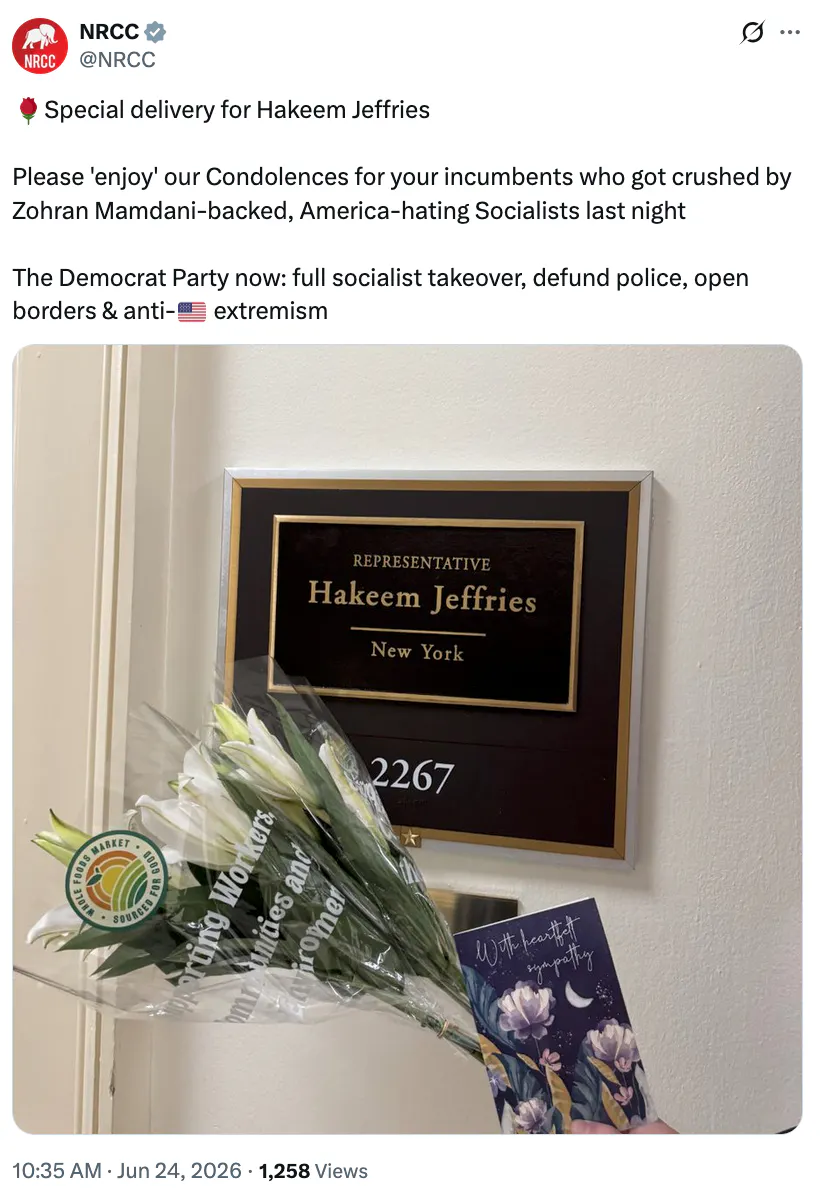
A few MAGA House members spoke out individually against the election results, including Randy Fine and Anna Paulina Luna of Florida.
“What is happening in New York tonight should scare every American,” Fine, who is no stranger to promoting hateful rhetoric, said. “The Democrat Party there no longer seeks to make America prosper. It seeks to destroy it.”
The fearmongering comes after New York’s democratic socialist mayor, Zohran Mamdani, proved his November victory was no fluke on Tuesday. The three progressives Mamdani endorsed all won their primaries, knocking off establishment Dems and sometimes other progressives.
Former City Comptroller Brad Lander knocked off incumbent Representative Dan Goldman in New York’s 10th district; Democratic socialist Claire Valdez, an artist and assemblywoman, defeated Brooklyn Borough President Antonio Reynoso in the 7th; and in possibly the biggest upset of the night, Darializa Avila Chevalier, a little-known democratic socialist, bested incumbent Representative Adriano Espaillat in the 13th.
“New York Democrats just elected three socialists in primaries,” raged the New York state GOP on X. “Their party has been taken over by radicals who support Islamic terrorism and want to dismantle the nuclear family.”
Centrist Democrats also felt a sense of foreboding on Wednesday upon seeing the success of leftists.
“Republicans will very quickly seek to elevate, as they always do, the most radical voices in the Democratic Party,” Howard Wolfson, a Democratic strategist and adviser to former NYC Mayor Michael Bloomberg, told The New York Times. “And after tonight, they will have more radical Democrats to choose from.”
Representative Greg Meeks, who chairs the Queens Democratic Party, was a bit more diplomatic. “It was a tough night,” he said.
Wednesday morning traffic: Low wires block trucks on Glen Canyon Rd; lane closures on Hwy 9
This post is updated throughout the day to reflect the latest incidents. It was last updated at 9:02 a.m..
Here’s what’s happening on the roads this morning…

▼︎ new incidents
Road incidents as of 9 a.m. on June 24- A traffic hazard was reported at Glen Canyon Rd and Glen Canyon Ct in Eastside / Live Oak on June 23 at 2:06 p.m. Low-hanging wires about 20 feet above the road were blocking trucks from passing. AT&T was notified and sent a technician. The incident was first reported as a possible collision with unknown injuries but was later identified as a traffic hazard.
- Defective traffic signals were reported today at the intersection of Green Valley Rd and Carnation Dr in Watsonville / Pajaro. The issue was reported to NETCOM and is being handled by the county.
- There are alternating lane closures on both northbound and southbound Highway 9 at Pool Drive in San Lorenzo Valley because of bridge work. This will continue until April 30 at 6:59 a.m.
- There is one-way traffic on Highway 9 at Cascade Avenue in San Lorenzo Valley because of ongoing work. This is expected to last until 7:01 a.m. on August 31.
- A lane on westbound SR-152 at Clifford Drive/Ohlone Parkway in Watsonville and Pajaro is closed for asphalt paving. The closure will last until 5:59 a.m. on July 3.
- CHP helped with construction work as part of the Safety Service Program at 11570 Highway 9, near 195 Capitola Rd Ext, San Lorenzo Valley. The work was scheduled from 7:30 a.m. to 3:30 p.m. today.
Disclosure: Traffic incidents are partially generated by artificial intelligence. We are constantly working to improve the accuracy and quality of our AI-generated content. However, there may still be errors or inaccuracies. If you have any questions or concerns, please contact us.
The post Wednesday morning traffic: Low wires block trucks on Glen Canyon Rd; lane closures on Hwy 9 appeared first on Lookout Santa Cruz.
Trump Cancels Signing of Biggest Housing Affordability Bill in Decades
President Trump has cancelled the signing of the largest housing affordability bill in decades unless Congress passes his voter-suppressing SAVE Act.
“Today’s Housing News Conference and Signing is hereby cancelled until such time as we pass the desperately needed SAVE AMERICA ACT, which I consider to be a National Emergency. Thank you for your attention to this matter!” Trump wrote on Wednesday.
This is a very last minute cancellation, as the signing presentation was set to happen Wednesday, an hour after his post.
“So…. Looks like they’re going to have to dissemble this stage here at Statuary Hall in the Capitol,” Scott MacFarlane of Meidas Touch wrote on X. “Trump has cancelled his signing of a housing bill… which truly jams up his fellow Republicans who wanted to campaign on it.”
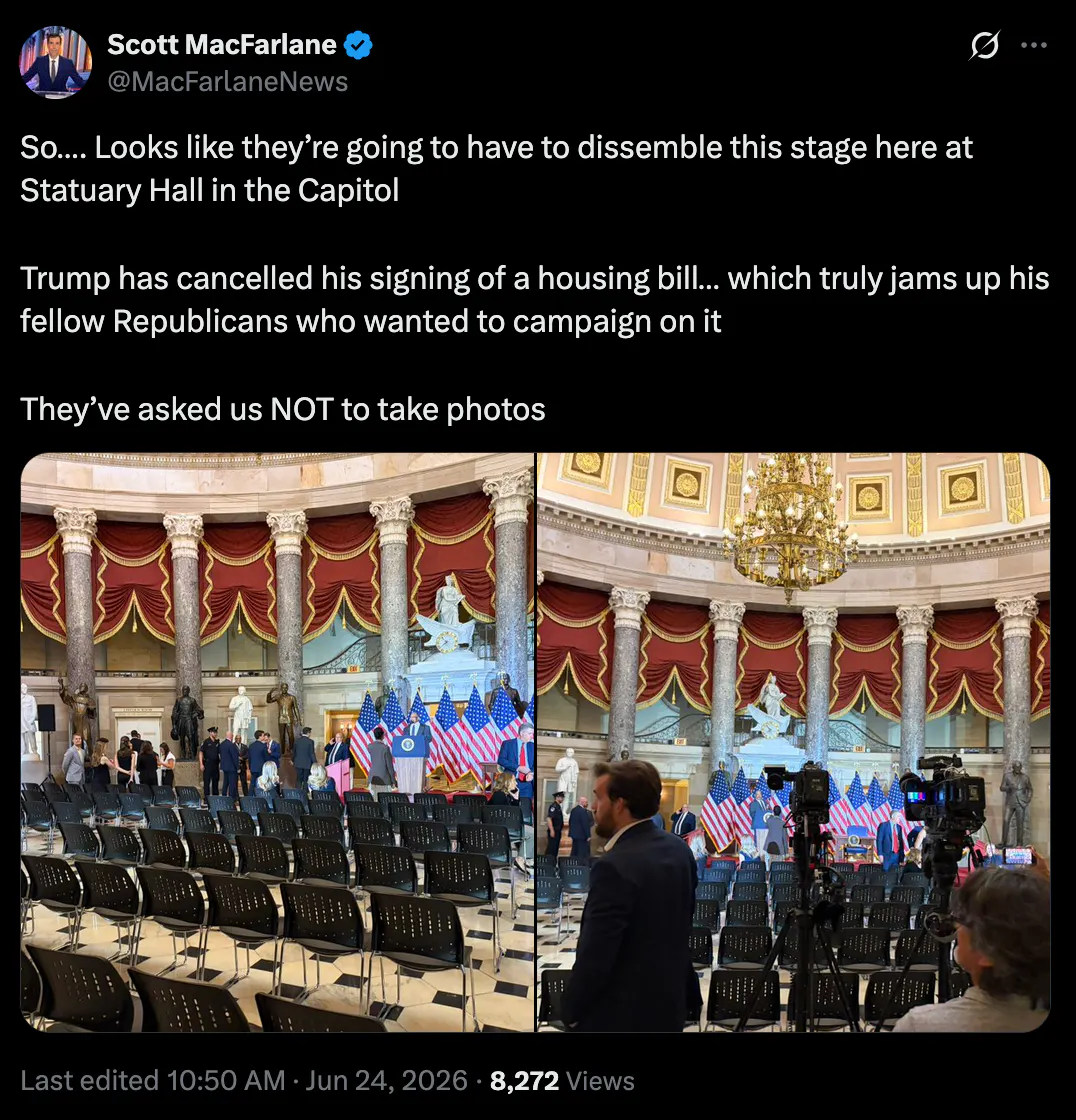
The 21st Century Road to Housing bill, sponsored by Democratic Senator Elizabeth Warren, passed with overwhelming bipartisan support in both the House and Senate. The legislation aims to make housing easier to build and more affordable by blocking corporate entities from buying up single family homes, among other methods. Trump, a former slumlord, has also downplayed the significance of this bill.
“The Elizabeth ‘Pocahontas’ Warren centric housing bill, which is of minor importance compared to lower interest rates, and even FISA, pales in comparison to passing THE SAVE AMERICA ACT. That is what Americans, both Dumocrats, Republicans, and everyone else, care about,” Trump wrote shortly before cancelling his signing of the bill. “Get the bad Republicans to approve it or, better yet, Terminate the Filibuster and approve it, AND EVERYTHING ELSE REPUBLICANS HAVE EVER DREAMED OF.”
This is a developing story.
Boffin claims Microsoft's supposed quantum leap does not compute due to 'basic Python errors'
Zoox upgrades its robotaxi as it prepares for commercial service
Medical diagnosis AIs can be tricked into telling whose data trained them
How the Supreme Court just made life tougher for tortured immigrants
Immigrants who experience human rights abuses by the U.S. government already face a mountain of challenges in seeking justice—but the Supreme Court just made that legal road even more difficult. In their ruling blitz to get out as many decisions as possible before taking off for their summer break, justices sided with Cisco Systems on Tuesday in a case filed on behalf of the Falun Gong…
This new tracking label could help solve cargo theft
Trump Says He Ordered DOJ to Target Oil Companies Over High Gas Prices
The U.S. lifted its naval blockade over the Strait of Hormuz last week, but the returning commercial trade has not been a return to normal—and Americans are still feeling it at the gas pump.
In a Truth Social post addressing the discrepancy, Donald Trump announced late Tuesday that he had directed the Department of Justice to investigate oil companies, accusing them of “gouging” customers based on the persisting inflated prices.
“The big Oil Companies are not dropping their price at the pump commensurate with the sharply lower prices they are paying for Oil,” Trump posted just after midnight. “Those prices are dropping like a rock! In other words, customers are being ‘gouged.’”
“I have instructed the DOJ to immediately start looking into this. Gasoline prices better start going down a lot faster than what I’m seeing!” he added.
While crude oil and gas prices have both fallen since Iran and the U.S. signed a tentative peace deal last week, the drop in gas prices has been relatively minimal. Crude was down over 5 percent between June 18 and 24, but gas was down by half of that—2.5 percent—in the same period, according to data from the AAA gasoline price tracker.
Trump had promised throughout the war that gas prices would plummet “like a rock” once the violence concluded, but that has clearly not been the case, much to the chagrin of his vulnerable Republican allies in Congress who will have to rationalize the dampened economy to voters come November. Trump and his team have also promised that Americans could expect lower gas prices than the average from even before the war began—around $2.98 per gallon. At the time of publication, the cost of gas is $3.92 per gallon across the country, though some areas in California such as San Luis Obispo are still seeing prices around $5.78 per gallon, according to the AAA tracker.
Over the last month, crude oil prices have dropped by 27 percent while gas prices were down by just 13 percent, reported Yahoo Finance.