
PVUSD approves $2.86 million water project at Renaissance High
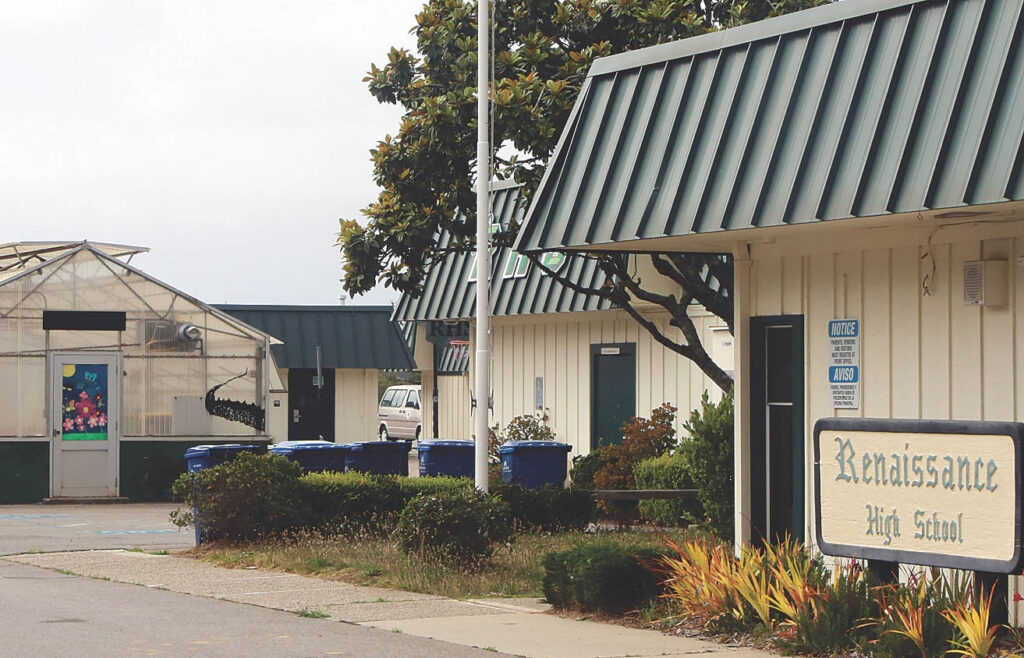
The Pajaro Valley Unified School District Board of Trustees on Saturday approved a $2.857 million state funding agreement that will connect Renaissance High School to the Soquel Creek Water District, replacing the campus’s groundwater system that has been plagued by elevated levels of hexavalent chromium.
The board held a special meeting to ratify a financial assistance agreement with the State Water Resources Control Board, allowing the district to move forward with the long-planned project.
The agreement provides $2.857 million in funding through the state’s Expedited Drinking Water Grant program. While structured as a loan agreement, the entire amount is designated as principal forgiveness, meaning the district will not have to repay the money if it completes the project and complies with the state’s reporting and funding requirements.
In a social media post, Trustee Gabe Medina praised the decision.
“This was an important vote because Renaissance High School students, staff, and families deserve access to safe and reliable drinking water,” he wrote on his Substack account. “Many students and staff have been asking the district to address this issue, and this project is one step toward meeting that responsibility.”
According to the agreement, the project’s purpose is to consolidate Renaissance High School’s water system with the Soquel Creek Water District “to address the hexavalent chromium maximum contaminant level violations” and provide “safe and reliable drinking water to the students and staff of the school.”
The project calls for extending a water main along San Andreas Road, installing a pipeline beneath the railroad tracks, constructing a booster pump station on campus and tying the new line into the school’s domestic water system. The project also includes installing a master meter and backflow prevention device and permanently abandoning the school’s two groundwater wells.
Construction is scheduled to be completed by Sept. 30, 2028, with the overall project wrapping up by Dec. 31, 2028. The district must submit its final reimbursement request by Feb. 28, 2029, and retain project records through Dec. 31, 2064.
State documents show the Water Resources Control Board determined the project will not create significant adverse water quality impacts. The agency relied on an Initial Study and Mitigated Negative Declaration prepared by PVUSD, which approved the project in 2025 and adopted a mitigation monitoring program addressing biological resources, cultural resources and noise.
Under the agreement, the district must comply with numerous grant requirements, including completing the project on schedule, documenting expenditures, submitting quarterly progress reports and obtaining state approval before advertising the project for construction bids or beginning construction. Failure to comply could jeopardize reimbursement or require repayment of funds.
The agreement also prohibits reimbursement for costs incurred before the eligible work start date and limits funding to approved project expenses. If project costs exceed the $2.857 million budget, the district must notify the state and seek additional funding or modify the project’s scope, although additional state funding is not guaranteed.
The project budget includes $1.1 million for construction, $364,000 for contingency costs, $739,000 for engineering and administrative costs, a $28,000 Soquel Creek Water District connection fee and $626,000 in conditional costs.
Letters to the Editor July 3-9
Regarding Cesar Chavez Middle School name change
Writing a letter to the editor to try to change or unchange something is a loser business. I’ve written a lot of letters and they’ve all ended up losers. Chalk up another loss with Cesar Chavez Middle School. Chavez has now been certified an evil rapist, forcer of abortions, and child molester. The worst of the worst, despite never being charged or convicted of said crimes. That said, The Pajaro Valley Unified School District trustees are going to allow Cesar Chavez images to remain on the school mural. So you are going to exterminate his name, but keep his image on the school. What’s with that? One trustee said the proposed name changes are “a no brainer.”
“No brainer.” indeed.
I propose this. Fusing both new school name recommendations. Jeff Tagami, is a poet who should be mentioned alongside those of Byron, Shelley, Keats, and Whitman, is a perfect addition. Mas Hashimoto, an excellent educator, who was also one of my history teachers. I did a report and speech on the Kaaba in Mecca and he liked it. Hashimoto is a great choice. Next name (Especially since you are keeping his image on the school) is none other than Cesar Chavez, with an asterisk * (for the aforementioned reasons) and finally Central Coast Middle School. So the name I propose is The Jeff Tagami, Mas Hashimoto, Cesar Chavez *(with an asterisk) Central Coast MIddle School. Or abbreviated The Tagami, Hashimoto, Chavez * Central Coast Middle School. Chalk up another loser.
Charles Birimisa
Watsonville
•••
LED street lighting needs changes
In the 1990s at Hewlett-Packard, we foresaw that white lighting for street lights could save money in two ways: overall energy reduction of 90%, and the ability to dim the lights during no traffic conditions. Our local LED street lighting does save on the overall energy, but misses out on the dimming.
During the night traffic is greatly reduced, especially during the late hours. The LED lights with motion sensing could be dimmed until there is traffic, making a huge savings. Why aren’t we doing that now? My wife and I visited Uzbekistan last fall and they are using dimming. It works great. Why not here?
Bill Beecher
Aptos
•••
Writer doesn’t want his tax money to fund ICE
Putin, Trump, Netanyahu, Hegseth, UFC fighter as head of DHS – “We’re good at bombing…”; “We like sinking ships”… How about “Killing people” to finish the sentence…? And we remember “Thou Shalt not Kill…”
I came from the 60s, Summer of Love, and this is not what we expected from the 21st century. I pay income taxes. I don’t really want my money part of the $70 Billion for ICE and its inhumane detention centers, or the $70 Billion to bomb other countries in “self-defense.”
But my few dollars are probably in there. All I can say is we must resist this takeover of what many of us are not supporting, and do what we can to bring Peace and Love to the World!
I don’t support a convicted felon, rapist and TV star to be having tantrums and ruling the world, like it was his little toy. The spineless Republicans, down on their knees, enabling him in lockstep.
Does anyone remember, “The Emperor has no clothes?”
Will it take some little child to speak out?
Sam Earnshaw
Watsonville
From Our Archives: New in Town
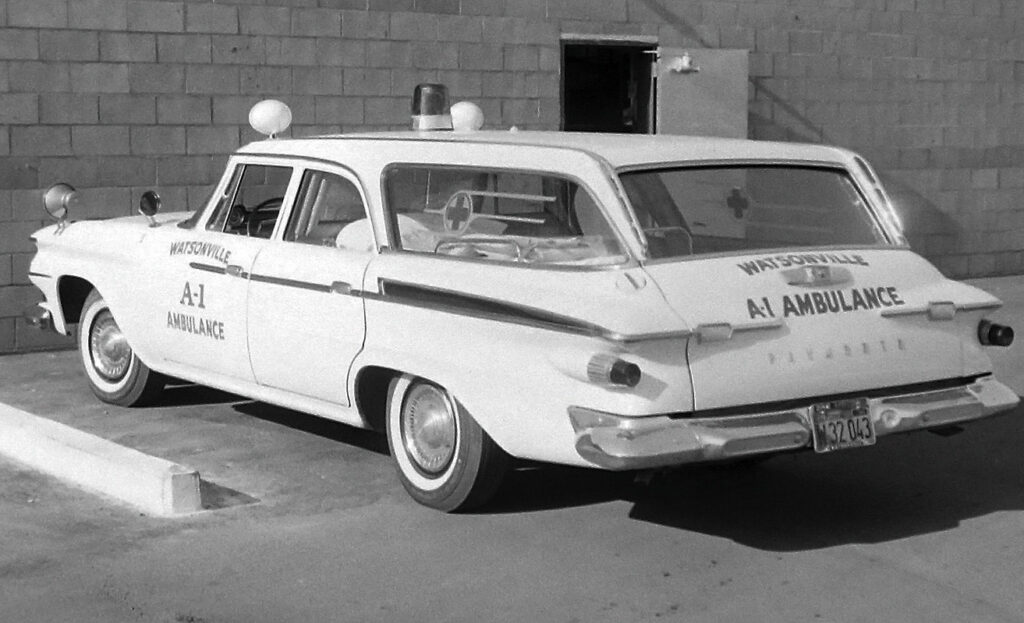
The city of Watsonville received this new Plymouth A-1 Ambulance in 1961. (photo by Sam Vestal, Pajaronian file)
Trump’s July 4 Event Is Coming Apart at the Seams—Literally
The sky is actually falling at the Great American State Fair.
The stage for Freedom 250’s July Fourth celebration fell apart during rehearsals Thursday, with a large component of the structure’s ceiling falling roughly two stories down and landing behind a group of dancers and musicians. Miraculously, no one appeared injured.
The stage is falling apart at the rehearsal for Freedom 250's July 4th celebration. pic.twitter.com/bPbg94hp6X
— Aaron Parnas (@AaronParnas) July 2, 2026Online commenters were quick to flame the stage’s apparently dangerous construction.
“That’s what happens when you don’t consider merit in hiring,” wrote one X user.
“This is why you never let Trump select the subcontractor based on percentage of kickback,” commented another.
Even a lawmaker joined in on the roast.
“Feeling more and more like the Hunger Games,” wrote Kentucky Representative Thomas Massie.
Practically every component of Trump’s wildly expensive plan to celebrate America’s 250th anniversary has turned out to be a dud. The $15 million renovation of the Lincoln Memorial Reflecting Pool failed to rid the iconic monument of algae; a multi-week lineup of music acts had to be cancelled after practically every artist pulled themselves from the program; and a fleet of buses carrying a contemporary retelling of American history have failed to make a splash in their journey across the country.
The Great American State Fair was supposed to be the centerpiece of the celebration, yet even it is more of a potemkin village than a sincere homage. The booths, which offer space for each state to represent its heritage and culture (pet a replica of a bison at the North Dakota pavilion, or walk away with a bag of chips from Maine), are ideologically pitted against the seismic presence of the federal government and Trump’s authoritarian expansion (banners featuring Trump’s grim face flank the event, while a small-scale replica of his proposed “Triumphal Arc” sits center stage). As The Atlantic’s Kelsey Ables put it, “the president is bringing down the mood.”
Pirro Reveals Reflecting Pool Indictment of U.S. Olympian Is a Sham
U.S. Attorney for the District of Columbia Jeanine Pirro announced Thursday that a grand jury had indicted former Olympic canoeist David Hearn on charges of vandalizing the Lincoln Memorial Reflecting Pool.
The indictment seems rather flawed, as Hearn, 67, maintains that all he did was dip his hand into the pool and touch a piece of peeling paint.
“I didn’t vandalize anything,” Hearn told The Washington Post the day after his arrest last month. “I didn’t destroy or break or peel anything. By the time I realized what was going on, I was being put in handcuffs.”
At a press conference Thursday, a reporter asked Pirro why Hearn was being charged with a felony over something so small, and she struggled to explain.
Pirro: He caused damage and that damage was over $1000.
Reporter: How do you prove that?
Pirro: With an expert.
Reporter: With his bare hands?
Pirro: We believe it's his bare hands, both hands.
Reporter: Do you believe it was damaged before?
Pirro: He damaged it!… pic.twitter.com/LmtTZueKZU
“There was an effort, a violent effort, to rip up the sealant from the pool, and irrespective of whether or not we think that there is some situation that preceded it, we can state, and prove beyond a reasonable doubt, that he caused damage, and that damage is worth over a thousand dollars,” Pirro said.
When asked how she could prove that, Pirro said, “With an expert,” and urged the reporter who asked the question to come to the trial. The reporter incredulously asked if Hearn used his bare hands, to which Pirro affirmed yes, both hands. The reporter then asked if the pool wasn’t already damaged before.
“Oh, he damaged it. He damaged the pool. He damaged this pool,” Pirro repeated. When the reporter brought up videos showing that the pool’s paint was already peeling, Pirro said, “Well, good. I’m glad you got that evidence. Come on in the grand jury and you can testify.”
It all seems nuts, as the poor state of the pool, from algae growth to peeling paint, had been documented for quite some time before Hearn visited it. The paint had been peeling because hydrogen peroxide was dumped into the pool in a vain effort to kill algae growth. Hearn is clearly being made a scapegoat to satisfy President Donald Trump, who is blaming nonexistent vandals rather than admit he messed up the pool.
IQM, Europe’s first public quantum company, admits the future of the tech is uncertain
Companies that add more AI also add more people
Watch: Trump’s Dystopia Takes Over the National Mall
“Loitering is not permitted in this area,” an audio recording sternly warns, as uniformed National Guard troops patrol Washington’s iconic, algae-plagued reflecting pool. “Please proceed to a designated location.”
Journalist Amanda Moore’s dystopian video, shot last weekend just steps from the Lincoln Memorial, instantly went viral—a perfect 8-second encapsulation of American democracy under Donald Trump. Amanda has spent the past 18 months documenting the chaos and brutality of the administration’s militarized takeovers and immigration raids in cities across the country. Her footage has been shocking, often horrifying. But it’s never before been quite so absurd. (Well, maybe once.)
In her latest video report for Mother Jones, Amanda takes us on a tour of the Trumpified National Mall as the nation attempts to celebrate its 250th birthday. Not far from the reflecting pool’s nanobubblers and security theater, there’s a very different scene: Trump’s Great America State Fair. When Amanda visited this marquee anniversary event, she found a dearth of visitors, a shortage of napkins, and a decaying model of the triumphal arch the president wants to build across the Potomac.
The symbolism here is about as subtle as a Jon McNaughton painting. If I hadn’t seen Amanda’s reporting, I never would have believed it was real.
Jersey Mike’s IPO illustrates how bad the AI hype has become
Stuff the Bus returns to help 2,500 Santa Cruz County students start the school year ready to learn

Civic partner content: A collaborative initiative amplifying nonprofits’ missions, expanding community engagement and driving meaningful impact. Learn more here.
Annual campaign adds first-ever TK backpacks as nearly 2,900 local students face homelessness and housing insecurityBefore the first day of school arrives, United Way Santa Cruz County and the Santa Cruz County Office of Education are once again rallying the community to ensure every student has the tools they need to succeed.
Starting July 1, the 17th annual Stuff the Bus School Supply Drive invites residents, businesses and community organizations to help provide 2,500 backpacks filled with school supplies for students experiencing homelessness, housing insecurity and other hardships across Santa Cruz County.
This year marks a new milestone for the campaign: For the first time, Stuff the Bus will include smaller backpacks designed specifically for transitional kindergarten and early childhood students, helping meet the needs of some of the county’s youngest learners.
The need remains significant. According to the Santa Cruz County Office of Education, 2,866 students in grades TK through 12 experienced homelessness during the 2024-25 school year under the McKinney-Vento Act. That includes 2,322 students living doubled up with other families, 308 who were unsheltered, 171 living in shelters and 65 staying in hotels or motels.
“The first day of school should be a moment of excitement and belonging for every student,” said Santa Cruz County Superintendent of Schools Faris Sabbah. “For families facing homelessness, housing instability or other hardships, basic school supplies are one more financial burden. Stuff the Bus is one way our community shows students that they are seen, supported and ready to succeed.”
Organizers say that having a backpack stocked with notebooks, pencils and other essentials does more than prepare students academically — it helps them begin the year with confidence and dignity.
“A backpack filled with school supplies can help a student walk into class feeling prepared, confident and supported,” said United Way Santa Cruz County CEO Yvette Lopez Brooks. “Stuff the Bus reflects what is possible when our community comes together around children and families, and we are grateful for the donors, volunteers, sponsors and partners who make this campaign possible each year.”
Community members can support the effort in several ways, including making direct donations, sponsoring backpacks, organizing workplace supply drives or volunteering during the annual Stuff-A-Thon. A contribution of $30 provides one student with a fully stocked backpack.
The campaign culminates with the Stuff-A-Thon on Saturday, Aug. 1, from 10 a.m. to 1 p.m. at Kaiser Permanente Arena in downtown Santa Cruz. Volunteers of all ages will help fill thousands of backpacks that will be distributed to students and families throughout the county.


Held in partnership with the Santa Cruz Warriors and with support from UPS, the event brings together community volunteers, local businesses and nonprofit partners to ensure students across Santa Cruz County can begin the school year ready to learn.
The campaign is rooted in a simple idea: Every child deserves to start school with the materials they need to thrive. By coming together as a community, Santa Cruz County can help remove barriers to learning and create a stronger foundation for student success.
To donate, sponsor or volunteer, visit unitedwaysc.org/stb.

The post Stuff the Bus returns to help 2,500 Santa Cruz County students start the school year ready to learn appeared first on Lookout Santa Cruz.
InfoWars finally forks over cash to Sandy Hook families
The families and survivors of the Sandy Hook Elementary School shooting are finally receiving some of the money owed to them by right-wing conspiracy theorist Alex Jones. The satirical publication The Onion, which recently took control of Jones’ InfoWars brand, paid out $100,000 to the Sandy Hook families during the relaunch of the InfoWars website. Jones owes the families about $1.
To highest bidder
A cartoon by Mike Luckovich. Related | Supreme Court’s leader doesn’t care about the Constitution…
AMC’s THE VAMPIRE LESTAT Concert Is the Pinnacle of All Fan Events EVER
- AMC’s The Vampire Lestat concert in NYC both created beautiful community and made the series come to life in ways we could only dream.
What is it that makes television shows, movies, books, comics, games, and other fictions so popular? Depending on the specifics of the story, there could be a plethora of answers to this question. But one of the most salient is that they offer us a special kind of dream fulfillment. The ability to step out of our mundane, normal worlds and into something beyond the human scope. They allow us to go on journeys that we could only dream of and experience a true kind of magic. As we explore these tales and fall in love with them, though, in our own worlds, another kind of magic tends to form as well. The magic of community. Though enjoying fiction won’t allow us to become an immortal undead, a superpowered entity, or an ageless elf, becoming a fan in a world of other fans is a beautiful transmutation all its own. And, in most cases, when we have fan events in our world, it’s that communal connection that is bolstered and grown. But somehow, through the vision and execution of The Vampire Lestat’s one-night-only concert in NYC, AMC managed to do the impossible; they both brought fans together to celebrate with one another AND they brought them directly into the world of the show. Or, more aptly, they brough the world of the show into our own. And, as a person who has been to a large number of fan events in my life, I can safely say that The Vampire Lestat’s concert has set a new standard, and an impossibly high bar, for fan events from here on out.
 Nerdist
Picture this. It’s a warm, beautiful day in June. The Beacon Theater on the Upper West Side has neon signs on every inch of its facade, advertising that a real vampire will soon take the stage. An elderly gentleman stops me on the street and asks, “The Vampire Lestat? Are they new?” “Pretty old,” I tell him with a laugh, and then explain the conceit of the show and the performance. He’s interested to know more. Down the street, a line of thousands of people spills along New York City’s Riverside Park. Thousands. All of them are fabulously dressed, most in glitter, some in gothic finery, others in full costumes, fake blood and vampire teeth abound in the mass. Importantly, everyone is beaming. Everyone is excited. Thrilled. They’re being transported out of their lives and into the fantasy of the TV series they love so much. They’re also together, surrounded by hundreds of others who really see them. These fans, the Beautifully Unwell, as The Vampire Lestat has come to call them, are here together. They’ve been brought together for something they all want so much, and it’s a gift.
 AMC
AMC
 Nerdist
 Nerdist
People have come from all over to see Lestat perform for the first time in our realm. The UK, Germany, France, LA, Canada, the Czech Republic, and all over the United States, just to name a few countries. Some have traveled without even knowing if they’ll have a ticket to The Vampire Lestat’s debut show. Beyond the ticket line, I know of at least three meet-ups that took place in the city so that visiting fans, who came to NYC ticketless, could taste this Great Convergence as well. I myself find a few dozen people I know from online interactions. My friends, whom I’ve never met before, whom The Vampire Lestat has brought into my life, a beautifully spun thread tying us together, now solidied by presence thanks to this concert. They ply me and all those around them with stickers, friendship bracelets, key chains, and other trinkets.
On the other hand, many people whom I’ve known for decades, from many different corners of my life in the city, are also here. And all around me, new friendships are forming. An incredible microcosm of hope and love in a world that can otherwise be so dark, and no one has yet played a note.
 AMC
AMC
One of the biggest focuses of my work, throughout my journey from fan to fan/professional, has always revolved around the way creators and official sources engage with their fans and help bolster the fandoms that form around the work they create. Like the characters in many of the shows they love, fans who are attracted to ardent fandoms often have a great desire to be seen, to feel respected by the creators they feel. Selflessly, they pour themselves into the story, but it’s so much better when they know the story loves and supports them back.
 AMC
AMC
At the end of the day, fans really long to be acknowledged by the properties they love, and when they feel that the admiration is mutual, their affinity to the property strengthens, AND that feeling also helps to form those beautiful bonds of friendship and community that I talk about above. In my opinion, when all of the variables alchemize together, a wonderous feedback loop of positivity forms and everyone feels uplifted. True light that can so rarely exist in our world comes to life. And no event I’ve attended has more fully realized this vision than The Vampire Lestat concert.
 AMC
AMC
Immersion is increasingly common in fan activations and marketing today. But the fans waiting in line for The Vampire Lestat concert weren’t waiting in line just to see a nicely decorated space. They were literally waiting in line… To. See. The. Vampire. Lestat. A far-flung dream from the narrative come to actual existence. AMC did the impossible as they reached into the TV show The Vampire Lestat and pulled one perfect evening back out into our world. They wrote a love letter to fans like no other. In that moment, they heard their fans, they knew what they wanted, and they offered it to them. In short, AMC’s The Vampire Lestat truly saw its fans.
 AMC
AMC
Inside the concert hall, there was a merch table, themed popcorn buckets, swag bags, and, exactly as on the tin, a real concert hall. A real concert hall that holds real concerts, which The Vampire Lestat filled with his songs. Sam Reid was every inch the rockstar in person and every inch Lestat. He left Sam at home and brought only the vampire to the stage. And then that concert magic really happened. That moment where the room goes from cold to warm, and the music descends on you, and true communion comes through sound.
The Vampire Lestat rose to life and sang in New York City that night.
 AMC
AMC
And what an incredible, indelible experience. For one evening, we, the fans of The Vampire Lestat the series, fans of the actor Sam Reid, and fans of Lestat, the figure who is real to us through fiction, were sitting together with thousands of other fans, now friends, in a real theater to watch as all the things we love the most converged on stage. And converge they did, in the finest of fashions.
NerdistThe Vampire Lestat concert was truly the pinnacle of all fan events. It brought the community together and bolstered it. It brought fantasy into reality. It made all our wildest dreams come true. Truly, the evening was a once-in-a-lifetime experience.
 Nerdist
 AMC
AMC
Though, of course… We’re holding out for the world tour.
The Vampire Lestat airs at 9 pm ET/PT on AMC and AMC+. You can also read The Vampire Lestat by Anne Rice today as you wait for the next episode of the series to air.
Rotem Rusak is the Editor-in-Chief of Nerdist. She was truly touched by Lestat’s music.
This post has affiliate links, which means we may earn advertising money if you buy something. This doesn’t cost you anything extra, we just have to give you the heads up for legal reasons. Click away!
The post AMC’s THE VAMPIRE LESTAT Concert Is the Pinnacle of All Fan Events EVER appeared first on Nerdist.
Trump’s American State Fair Gets Even Worse Thanks to the Heat Wave
A heat wave in Washington, D.C., is making attendance at President Trump’s July 4 festivities even worse.
U.S. Capitol Police have already restricted Thursday night’s rehearsal for “A Capitol Fourth Concert” to essential personnel, posting on X that they came to the decision after consulting with the Capitol’s Office of the Attending Physician.
“For safety reasons, the public will not be able to attend tonight’s rehearsal concert,” the post read. “Everyone is sorry for any inconvenience this may have caused. The National Weather Service is forecasting an extreme heat watch with temperatures exceeding 100 degrees.”
The post added that an update will come Friday by 10 a.m. on the status of the full concert, which is scheduled to take place from 8 p.m. to 9 p.m. Friday night.
Similar warnings are hitting the Great American State Fair; organizers have already had to cancel a rodeo demonstration scheduled for Thursday night. Attendance at the fair overall has been depressed, and some visitors are complaining about the weather. U.S. Trade Representative Jameson Greer had an audience of maybe 25 people when he spoke about tariffs on the main stage Thursday afternoon.

Many booths at the fair don’t have air conditioning, leading at least one visitor to overheat. She told a reporter she finally found relief at a baptism tent, where she took a dip to cool down.
Great American State Fair goer tells our @JenDelgadoFOX many of the booths she went to today didn't have air conditioning, she overheated, said she saw stars and needed medical attention -- found the baptism tent and took a dip to cool down pic.twitter.com/Smufj0GN8g
— Homa Bash (@HomaBashNews) July 2, 2026Even without the heat, the fair is coming across as tacky, with empty booths and a lack of energy. The food is expensive, reviews are abysmal, and people aren’t coming, enraging the president. When it hasn’t been hot, it’s been raining. America’s 250th anniversary was already going poorly thanks to Trump, and now the weather may cement the once-in-a-lifetime event’s status as a failure.
Two Maine Polls Just Dropped. Is It Time to Fret About Graham Platner?
Two major polls of the Maine Senate race dropped this week, and they told the same story: The race is incredibly close, and Democrat Graham Platner has real work to do among the working class. He’s running an aggressively left-populist, antiestablishment campaign targeting the billionaire class—and boasts lots of blue-collar appeal—but GOP Senator Susan Collins is way ahead among those voters. Why?
The surveys—one from The New York Times and the other from Fox News—offer good and bad news for Platner. But they’re worrying some Democrats because a loss here deeply complicates the path to Senate control. Without Maine—which voted against Donald Trump by seven points in 2024—Democrats probably must win four out of five seats in Ohio, Texas, Alaska, Iowa, and North Carolina. Trump won all five states—most by lopsided margins—and now Democrats lead in the last but are tied or a bit behind in the others.
The Times survey has Platner up two among likely voters overall, 49–47, and the Fox poll has Collins up three, 50–47. It’s a dead heat—it’s winnable, but he should probably be leading by more given the state’s Democratic lean, which is being outweighed by the brutal press he’s sustained over his Nazi-like tattoo and alleged violence against women.
But note this: In the Times poll, Platner trails among voters without a college degree, a proxy for the working class, by 37–58. In the Fox poll, that’s 41–56. What’s driving this? One possibility: The Times poll has working-class voters saying Platner has “good character” by 37–57 and “the right kind of moral values” by 36–57.
On the plus side, Platner leads in the Times survey among women by 52–44, among young people by 59–32, and among college-educated voters by 66–32. But Platner’s candidacy is all about his blue-collar aura: He’s a tattooed oyster farmer who speaks openly—in that deep, gravelly voice—about his trauma from serving in combat. Though his backstory is somewhat more privileged (his father is an Ivy League graduate and lawyer), he speaks in a left-populist idiom that seeks to connect with working people’s struggles. So his numbers among them are concerning.
Here’s the upshot: This race is awfully close, and importantly, Platner is running behind the Democratic Party as a whole in Maine. Voters there want a Democratic Senate by 54–42, so his 49 percent support lags that. By contrast, in Times polling, all the Democrats in other red states—Ohio, Texas, Alaska, Iowa, North Carolina—are outrunning their party.
I talked about all this with Rebecca Katz, a top Platner adviser. Asked about his numbers with working-class voters, Katz noted that the race has been heavily nationalized, leading them to initially fall into their familiar pattern of opposition to Democrats. Many of these voters, Katz said, have been introduced to Platner via a massive barrage of negative ads and some very bad news cycles.
Katz said the political landscape in Maine—a largely rural state where retail campaigning will really matter—provides Platner with a unique opportunity to grow among that demographic. She noted that he’s already done over 60 town halls in rural areas, and pointed to an intriguing dynamic: People in these areas are coming to listen.
“They are curious about him,” Katz told me, noting that Graham is already somewhat outperforming losing 2020 Senate candidate Sara Gideon among working people.
If one criticism of Democrats is that they don’t show up and talk to rural and working- class voters, well, Platner is certainly doing that. The theory seems to be that despite his bad stories, Platner is compelling enough to open the door to getting an audience with these constituencies, and then to reach them in a fresh way.
“Graham is a different kind of candidate,” Katz said. “He grew up in a rural community. He’s one of the only candidates running who’s actually worked with his hands. He will continue to connect with more rural and conservative voters.”
Asked to respond to the oft-heard argument that seeking working-class voters with Platner’s type of leftist politics is a chimera, Katz insisted this doesn’t jibe with what they’re seeing at town halls in working-class and rural areas.
“Mainers are focused on their cost of living, health care, corruption, and whether anyone in Washington is actually fighting for working people,” said Katz, a founding partner of Fight Agency, the firm that does Platner’s media and strategy, along with rising progressive strategist Morris Katz (no relation), who helped recruit Platner.
In this understanding, Platner’s appeal can get these voters to at least listen to his agenda of breaking billionaire control over elections, Medicare for All, a more progressive tax system for small businesses and corporations alike, a billionaire minimum tax, and protecting and expanding social welfare programs. That agenda is somewhat to the left of many mainstream Democrats. But it’s aimed squarely at what’s really driving voter concerns, Katz notes, which matters more than the details, and Platner is the one to make that case.
“There are people coming who are not into politics but are intrigued by Graham,” Katz said of the town halls. “He’s an outsider.”
Asked to respond to Platner’s struggles with working people, Adam Green, the head of the Progressive Change Campaign Committee—an early booster of Platner’s candidacy—acknowledged that he has more work to do among them. But he cast this as an opportunity. “Most working-class people who are low-propensity voters don’t know him yet,” Green said. “But once they do, he’s an obvious fit for them.”
Katz, for her part, said other big dynamics here deserve attention: This is likely to be a change election amid deep anger at establishment politicians. The Times poll finds 61 percent of Maine voters say the country is on the wrong track, 60 percent disapprove of Trump, large percentages say Collins is too old to serve, and Democrats hold a nearly 20-point enthusiasm edge.
“The big question of this race is whether or not voters are willing to vote for change,” Katz said.
The political graveyards are full of men—mostly men—who boasted of the right kind of populist and biographical appeal to reverse Democratic losses among working people. Indeed, different factions in the party are already battling over the meaning of Platner’s candidacy, with progressives and socialists insisting it will show their agenda to be broadly popular and moderates insisting that chasing working-class voters with that sort of leftism is a fool’s errand.
But, unsatsfyingly, the outcome is unlikely to turn on Platner’s precise policy prescriptions or his exact ideological leanings. It will more likely be decided on whether Collins’s special hold on the Maine electorate is spent, particularly after her vote for Supreme Court Justice Brett Kavanaugh and the overturning of Roe v. Wade; whether Trump’s unpopularity will be enough to nudge voters to risk a different kind of challenger; whether Platner’s able to reach just enough persuadable voters to allay concerns about his past conduct; and a thousand other intangibles involving turnout and last-minute voter decisions.
Ultimately, it may all turn on good old-fashioned shoe-leather politicking. And whatever you think of Platner, one thing that can’t be denied is this: He’s certainly willing to work hard enough to win.
A warning sign about AI’s real cost, courtesy of Google and Amazon
KFC and Domino’s Respond to PlayStation Ending Disc Games
- PlayStation announced it will no longer produce physical discs as of 2028.
- Two fast food franchises posted jokingly on Twitter about offering “digital-only” meals.
- PlayStation also lost the rights to Studio Canal movies, meaning that users who bought those titles will no longer be able to access them.
PlayStation ceasing production of physical discs for games has been big news among gamers, and other companies have begun to respond to the decision. KFC Spain and Domino’s UK both posted on X, formerly Twitter, this morning, announcing “digital” menus as a joke.
 Kentucky Fried Chicken, Sony, Domino’s Pizza
They continued to poke fun in the comments, with Domino’s posting: “At the same time, our much-loved ‘Domin-oh-hoo-hoo’ catchphrase will be updated to ‘Domin-oh-hoo-whose-dumb-idea-was-this’?”
Clearly, gamers are running these companies’ pages—gamers who will miss the gaming giant’s physical discs.
At the same time, our much-loved 'Domin-oh-hoo-hoo' catchphrase will be updated to 'Domin-oh-hoo-whose-dumb-idea-was-this'?
— Domino's Pizza UK (@Dominos_UK) July 2, 2026It is certainly the end of an era. PlayStation consoles have had disc drives since their inception—longer than they have sold digital games, which began with the creation of the PlayStation store in 2006.
Whether collecting game discs is a hobby or you simply prefer buying physical games, that is coming to an end. In fact, PlayStation is kicking fans while they’re down this week. In addition to the loss of physical discs, users will lose access to 551 movies from PlayStation’s library. Sony recently lost the rights to titles by Studio Canal. Even if you “bought” the movie, it will disappear from your library without a trace. Don’t expect a reimbursement from Sony, either—just a pop-up with an explanation.
RELATED ARTICLE
PlayStation Will Cease Physical Disc Production by 2028PlayStation users are experiencing disappointment after disappointment at the moment. However, some fans are taking the disc announcement as an indicator that PlayStation’s sixth console won’t come out until 2028. This seems to be a reasonable assumption, especially considering Sony still has not revealed a release date or price. This also means the PS6 could be their first console without at least an option with a disc drive.
If you plan to continue playing on PlayStation, you’d better get used to buying and accessing your games only digitally. Though, after what we are seeing with the Studio Canal movies, it does raise some questions about whether digitally-purchased items are ever truly yours—or safe.
The post KFC and Domino’s Respond to PlayStation Ending Disc Games appeared first on Nerdist.
Best of Santa Cruz County entertainment, arts & food events this weekend, July 2-5
With the long holiday weekend nearly here, check out things to do around Santa Cruz County with a recommendation from Lily Belli and a specially curated list from Lookout’s BOLO events calendar.
Meta quietly launches vibe-coded gaming app Pocket
“He’s Mister Iran”: How Netanyahu Made a Better Iran Deal Impossible
In the four months since the US and Israel initiated their ongoing joint military campaign against Iran, the Trump administration’s negotiations with Iranian leadership to end the war have been predictable in their unpredictability.
On Monday, President Trump said US officials would meet with Iran in Qatar the next day. Iran said that no negotiation meetings were scheduled. (They ultimately conducted low-level talks on Wednesday.) Both countries have launched strikes despite signing a memorandum of understanding on June 17 that included a ceasefire and was designed to help bring an end to the war. But—despite the US celebrating a security deal between Israel and Lebanon last week—Israel has continued strikes on southern Lebanon and Hezbollah, an ally of Iran, rejected the Israel-Lebanon deal, which it was not a party to.
According to data from multiple Iranian government ministries, as of June 10, about 3,500 people have been killed in Iran since the war began. Lebanon’s health ministry reported on Wednesday that about 4,300 people have been killed in that country.
All to say, as I wrote shortly after the memorandum of understanding was signed, the Iran war doesn’t appear to be ending anytime soon.
“I think Iran was very open to a potential arrangement that was stronger than the JCPOA.”
Nate Swanson, a resident senior fellow at the nonpartisan Atlantic Council, spent nearly two decades as a State Department official, most recently as the Biden administration’s director for Iran at the National Security Council.
Benjamin Netanyahu’s conduct, Swanson told me, took a wrecking ball to many of the US’ already tenuous relationships in the region, and made a region-spanning war with Iran much more likely even before 2026.
I spoke with Swanson last week about what could be next for US relations with Iran, Israel, and the Gulf states.
This interview has been condensed and edited for clarity.
Given how the second Trump administration has handled relations with Iran, I was curious what you think a different negotiator could have gotten out of this situation.
I don’t want to say the US-Iran relationship has ever been good in my time working on this، for almost 20 years, but I think Trump walked into a situation in 2025 where Iran was in a historically bad spot.
They just had these two direct exchanges with Israel. They had no air defense. Their proxies at the time seemed like they were much weaker. Domestically, they had very acute economic and environmental crises. They had also come off massive protests in 2023. So I think Iran was very interested in the deal right there.
I think they approached negotiations not sure what Trump wanted to do. I was there—and I wasn’t quite sure what Trump wanted to do—but I think up until the June 2025 war, the US had a great hand in terms of leverage. And I think Iran was very open to a potential arrangement that was stronger [in restrictions] than the JCPOA. After the 12-day war though, it’s been a declining chance for a real deal and certainly US leverage. Iran knew that more war was coming and that was where their focus was.
“The US doesn’t seem interested in complicated deals, and [now] I’m not sure Iran is willing.”
I’m curious if you think the Biden administration would ever have launched strikes against Iran like those last June and this February—or how you think they would have handled the aftermath.
Yeah, there’s no way those strikes would have happened.
To some extent, you had a path that was drawn with October 7, 2023. For Israel, that was a game-changing event. They went after Hamas and Hezbollah, and both of those, from their military perspective, were relatively successful. You had conflicts with Israel and Iran directly for the first time in October 2024, right before the election.
I think the priorities in the Biden perspective was one, to make sure that Israel and our Gulf allies were protected. Second is to, wherever possible, deter escalation. We were very clear that we were not going to support larger escalation, while Israel definitely was considering a larger war at multiple points across 2024.
[The June] 2025 and 2026 [wars] would not have happened at nearly the same level if it had not been Trump. Netanyahu has been pushing some form of an Iran war forever. He’s Mister Iran. And the major difference between Trump and any other administration before him—including Bush, Obama, and Biden—was that [the Israelis] were always told no, and that we weren’t going to support [a war]. Trump said yes, and that is fundamentally the difference.
How has the US’ ongoing role with the war in Gaza changed its relationships with the Gulf states?
[The US had] a pretty strong relationship with all the GCC members [Gulf Cooperation Council, constituting Saudi Arabia, Oman, Qatar, Bahrain, Kuwait, and the United Arab Emirates].
Prior to [October 7], there was a movement to normalize relations between Israel and the rest of the Gulf. It has been a long-standing goal across multiple administrations, and Trump [partly] did it with the Abraham Accords.
But it was happening without a solution to the Palestinian issue. We were able to do it with the UAE, Bahrain, and Morocco, and Biden spent a lot of time trying to facilitate Saudi-Israel normalization.
It went out the window on October 7, especially from the Saudi perspective. Bibi was willing to prioritize his number one objective to have this military conquest in Gaza.
But the relationship [with the Gulf states] has been shifting significantly forever. A significant moment in our history was when the US pulled out of the JCPOA in 2018. Iran responded by attacking the Gulf, which was a harbinger of what happened in this war. So the US pulled out of the JCPOA, put maximum pressure on Iran, [which] attacked oil tankers [in UAE waters] and Saudi energy infrastructure. This was the [2026] playbook, at a much smaller scale.
For the first time, you saw [Gulf states] try to de-escalate with Iran. There was a recognition that we weren’t going to be there for them in the way they hoped. The relationship has been slowly evolving through then, and then we put on turbo burners during this war, where the US relationship with the Gulf became a liability. If [a Gulf state] had a real US base, not only did it not protect, it encouraged attacks.
Recent reporting suggests that the US may effectively be returning to aspects of the JCPOA—such as JD Vance saying last week that Iran agreed to nuclear inspections. If the current negotiations come through, do you see the JCPOA-era relationship as partially restored?
Yes, in the best-case scenario; but ultimately, no. I don’t think we’re going to get the bigger phase two deal that the MOU outlines. The US doesn’t seem to be interested in complicated deals, and I’m not sure Iran is willing to do a big deal with Trump—just and uniquely him.
I also think you can’t recapture what we did in 2015 with the JCPOA. The JCPOA was done to stall out Iran’s nuclear program at that moment in time. But you can’t turn back time. Even if Iran agreed to all the Trump administration requests of no enrichment and getting rid of all the stockpiles of enriched uranium, the time it would take Iran to break out for a weapon is about half the time it was under the JCPOA.
Iran has learned so much about the process, specifically their ability to install vastly more technologically efficient and proficient centrifuges and to install them a lot faster. It’s like six times stronger centrifuges that can install at three times the speed.
And those [demands from the US] aren’t going to be met, so I think we are in a significantly worse off position.
What were the years under the Biden administration, after the US left the JCPOA, like regarding relations with Iran? I know Iran had resumed nuclear enrichment at that point after the US had reinstated sanctions.
Under past presidents, the Israelis “were always told no…Trump said yes, and that is fundamentally the difference.”
Different Biden officials have different takes on this. My opinion is that there was a deal achievable but there were a few mistakes made on both sides, but more on Iran’s.
Iran expected, when Biden came in the door, to immediately indicate a desire to get back to the JCPOA as quickly as possible. We were slow; it took us a month. There was a conversation that happened both inside and outside the government about whether you should go back into the JCPOA directly or a deal that could be hypothetically more sustainable. At that point it was clear that Iran wanted a clean return to the JCPOA. By early April, the US had put together a comprehensive return to the JCPOA.
But at that point it was too late for Iran. While I think their negotiators wanted a deal, they had elections coming up a couple months later and their Supreme Leader [Ali Khamenei] didn’t want the outgoing administration to get credit for it. So as much as we were trying to move forward a deal, they couldn’t say yes.
The new [Iranian] team came in and spent three or four months getting their act together and eventually decided that they wanted to get back into the JCPOA too, basically under the exact same terms. A deal was possible, but Iran thought that the longer they held out, the more we would give them. And so they kept stalling and pushing for more and more.
The Russia war broke out [in which Iran backed Russia], and then Iran went through massive protests. By the end of fall 2022, a return to the JCPOA wasn’t viable politically and timing-wise. And in the midst of all this happening, there were significant advances made in the nuclear program.
So the deal was less valuable than it was in 2015, and even as it would have been in early 2021.
I do think they wanted to get to yes, but they never could.
Trump’s JCPOA withdrawal meant economic sanctions were put back on Iran. How do you think that played into the events you mentioned during the Biden administration?
By the time Trump left office in his first term, you had a significant increase [in sanctions] under “maximum pressure.” For instance, the key part of JCPOA sanctions relief was delisting their central bank, their shipping sector, their oil sector, etc. All that got re-sanctioned not only when we pulled out of JCPOA, but then they also listed this vital JCPOA sanctions relief as terrorism. That complicated any potential deal.
But I think the bigger difference is oil. Obama signed language that reduced Iranian oil, but it was capped to not destabilize oil markets and it was agreed on with other countries. I think Trump’s approach was that no one can buy any Iranian oil. The net effect is everyone went down to zero eventually but China. China ended up buying the Iranian exports at that point and has ever since. China has become a beneficiary of the system and has basically kept Iran alive because they’re not adhering to the US sanctions.
Is there a good way to understand how the US leaving the JCPOA impacted Iran’s economy and the global oil market?
“You [now] have to have something that seven people agree on…I think that’s why you see this MOU is in Iran’s favor—because they couldn’t say yes to anything less.”
Oil exports are the best number. Pre-JCPOA they were doing about a million barrels a day. During the JCPOA, they’re at max capacity over two million barrels a day. And then under Trump’s maximum pressure—including during COVID when [production] went away, it went down to a couple hundred thousand barrels a day. It’s been creeping up ever since, including through [the second] Trump [administration]. They are now doing 1.7 million barrels a day—all that illegal, all to China, and at a discount. Iran has figured out how to evade sanctions and how to get oil to China.
As a part of this [2026] deal that we signed, Iran could sell all the oil again with no repercussions for the first time since the JCPOA. They will now be able to recruit new purchasers who used to buy Iran oil—like Japan, South Korea, and India would be the biggest.
How do you think the re-implementation of US economic sanctions in 2018 affected the negotiations under Biden?
It definitely made it harder. It added layers of complexity that were time-consuming and difficult to figure out. You basically had to go through one by one and say, “is this actual, real terrorism or is this [an additional terrorism designation from] Trump’s sanctions?”
Some experts I’ve talked to have emphasized the 1953 CIA-backed coup in shaping Iran’s attitude to negotiating with the US. What do you think about that?
It’s very much in Iran’s political ideology and statecraft. The Islamic Revolution of 1979 was founded on anti-imperial and anti-US ideas that came out of 1953. They view the US as supporting Iraq in the Iran-Iraq war, and it’s just one living continuous piece of history that hasn’t ended. I don’t know if that’s wise or not, but I think it’s reality.
There is no trust on either side. I think the difference between now and the JCPOA, though, is at least there was a desire to try to work through the mistrust to get somewhere that’s mutually beneficial. I am not sure that environment exists at all anymore, and I think it’s evidenced by the fact that Iran won’t sit down with the US directly. It has to be with an intermediary or a mediator in the room or just not at all. They’ll only pass messages right now through Qatar or Pakistan.
And it goes both ways. When I started at the State Department in 2007, the door across from me had a sticker of an American flag and the inscription was like “save our hostages” from the hostage crisis. There’s still these survivors of this hostage crisis left over. There are still victims of Iranian violence and terror around the world, through Hezbollah or others.
It goes both ways, and the level of mistrust and animosity has got to be an all-time high coming out of this war.
The US and Israel’s bombing campaign has killed a lot of Iranian officials. Do you have any idea who is negotiating now, and if they have any different priorities?
I’m not really sure of the answer. On one hand, the foreign ministry guys are the same—they’re not dead. So the foreign minister and [longtime] lead negotiator [Abbas Araghchi], and his surrounding team have been around—with a minor blip from 2021 to 2024 during the Raisi presidency—since 2013.
To your real question of who’s making decisions, I don’t know. We knew before the Supreme Leader [Ali Khamenei] died that it was him. We don’t even really know if the Supreme Leader’s son [Mojtaba Khamenei, who was elected after his father’s assassination] is alive or not. We know the IRGC [Islamic Revolutionary Guard Corps, a branch of the Iranian armed forces accountable only to the Supreme Leader] has a bigger role than they have in the past, but we don’t really know what that means. There’s a new lead negotiator, the Speaker of Parliament [Mohammad Bagher Ghalibaf]. There’s clearly five, six—probably more—people who are making decisions in a collaborative manner.
It’s much more complicated than the JCPOA. You have to have something that seven people agree on to get to yes. I think that’s why you see this MOU is in Iran’s favor—because they couldn’t say “yes” to anything less.
I do think it reflects the correct desire by the president to get out of this war, which is a debacle and getting worse. But the terms are terrible, and it’s like the ultimate indictment of the war itself.