
Second part of GOP’s midterm strategy is dumber than the first part
Back in May, Republicans telegraphed their midterm strategy, and it had nothing to do with affordability or competent governance. “A couple more states redistricting in a way that’s helpful for us, move into the summer with America 250, and a midterm convention at some point,” a “very senior Republican strategist” told NOTUS. “I think we’ve got some good touch points to kind of keep that…
DHS chief’s creepy plan for pregnant immigrants, and Alito says Constitution who?
A daily roundup of the best stories and cartoons by Daily Kos staff and contributors to keep you in the know. Trump refuses to move on after massive fail on birthright citizenship He’s a toddler who can’t handle being told no. The Constitution is clear on birthright citizenship. Alito doesn’t care. Anyone born in the United States is a citizen. The end.
More green stuff
A cartoon by Pedro Molina. Related | Trump fails miserably to throw America a birthday party…
Bending Spoons defies SaaS slump, surges 40% on first day of trading
After $18B IPO, Bending Spoons founder says success comes from minimizing luck
The GIRL, INTERRUPTED Musical Allows Us to Be Beautifully Seen, Together (Review)
- The Girl, Interrupted musical is a much-needed work for our time, one that allows us to know we are seen even in darkness; our review.
I think we can all agree that the world is going through some complex, difficult times. Times that feel more intense for those of us who exist in the world carrying identities that don’t fall under societal “norms.” In times like these, it can feel like the options for our survival, joy, and flourishing are limited. But if there’s one idea we can turn to, to hold onto a light that is not necessarily all-healing but all-important, it’s community. Community can be found among our closest friends, but it can also be found among people we’ve never met; if a shared like-mindedness and belief system exists. It can be found through activism and through art. Right now, in New York City, it can be found among the audience members, creators, and performers who allow Girl, Interrupted to thrive in its musical form, night after night. Community can’t always help us escape our nightmares, but it can help us face the issues that threaten our dreams, and beautifully, bravely, Girl, Interrupted gives voice to so many fears we all face, all while reminding us that we are not alone in facing them.
 Joan Marcus
The Girl, Interrupted musical is crucially based on the book by Susanna Kaysen. Many might know the movie Girl, Interrupted, also an adaptation of the book. But it might come as a bit of a surprise to learn that Kaysen’s story is actually a memoir of her time at a psychiatric hospital in the 1960s. While the Girl, Interrupted musical, of course, expands and imagines the material beyond the specific lines of the source text, it ultimately remains much more faithful to the book than the movie version of the story. And, importantly, the musical cleaves to the intention that Kaysen holds closest to her heart for her life’s tale.
In 2022, Kaysen noted of her book, “The familiar thing, I think, was a person adrift, frightened, overwhelmed by existence and unable, for a moment, to engage with a life for herself…A lot has changed in the decades since this book was published, and even more since I was in the hospital. And perhaps the stigma of depression and ‘mental illness’ has diminished somewhat. But suffering doesn’t change. This book, written under a delusion, has brought many readers some comfort. I hope it still has that to offer thirty years later.”
And it is safe to say that the Girl, Interrupted musical, expertly written by Martyna Majok, with gorgeous original music by Aimee Mann, perceptive and nuanced direction by Jo Bonney, and lovely choreography by Sonya Tayeh, precisely achieves this bringing of comfort.
 Joan Marcus
The Girl, Interrupted musical follows the story of Susanna, played by Juliana Canfield, as she admits herself into the McLean psychiatric hospital, where she connects with the other young women in the facility, all of them holding onto their struggles, their hopes, their identities, and one another as they try to understand what it means to live. Creating Susanna’s cohort of community in the hospital is her earnest roommate, Grace, played Mia Pak, the closed-off but warm-hearted Daisy, played by Katherine Reis, the hopeful but struggling Polly, played by Sally Shaw, the standoffish but fragile Tori, played by Gabi Campo, and, of course, the self-proclaimed “psycopath,” who wishes for community no lesss than anyone else, Lisa, played by King Princess.
All of these young women are brilliant in their roles. And what I like the most is the different kinds of womanhood on display in the musical. There’s Lisa’s Bowie-like androgyny, Polly’s welcome warmth, Daisy’s high femininity, Grace’s girl-next-door energy, Susanna’s more conventional charms, and Tori’s bold, self-assured style. In what I felt were super meaningful stage directions, no woman even sits in a chair the same way, Lisa sprawling, Polly tucking her ankles behind each other, some leaning with their feet up on each other’s chairs; the personalities of these characters poured out onto the stage from the smallest details to the largest, helping to build a full, realized, resonant vision of every woman in her own right. Even while, in essence, trapped in a place that was trying to diminish their differences and their otherness, the individuality of each woman shone.
 Joan Marcus
In sharp contradiction to this, every man in the musical was played by the same actor (also brilliant) Manoel Felciano, who is billed simply as “The Male Presence.” While, of course, there is variation among men, in this musical, the notion of “The Male Presence,” the haunting, chilling, suffocating hold that society and the patriarchy have on our lives, was illustrated PERFECTLY by this conceit. The symbolism felt wholly effective and not at all trite. The idea in the Girl, Interrupted musical is not that every man is evil, but that the systems that we live in are meant to oppress, and that oppression is so often delivered through the forms of men who would rather benefit than take a hard look at what’s happening around them.
And it’s this sharp interrogation of society that is one of the facets that is so incredible about the Girl, Interrupted musical. Of course, the women in the hospital face are struggling with difficulties that live inside themselves. But those traumas would become so much more manageable, and perhaps wouldn’t even exist, if the way life is constructed did not fail them at every turn. It is not only the intense traumas within ourselves that we struggle with, but also the underlying constructions of society that force us into them. Woven, I thought, in perfect subtlety into many of the women’s stories was the way their blood families truly let them down, be that by forcing them into the hospital, or by forcing them out of it, but, in almost every case, by refusing to see them.
That said, I think the story left space for the idea that “We can only know what we know.” And that in the past, what we thought we knew was different than what we think we know now. And what we know now, we might look back on in the future, and consider foolish. An important reminder that we are always in a place on a journey, and all we can do is try to wrestle with the lot we are offered.
 Joan Marcus
But, Girl, Interrupted is very clear, the worst thing we can do is try to wrestle alone. Instead, it is in our community, in the people who do see us, that we can find the solace we need to go on. And, at every turn, this was incredibly reflected by the wondrous music of this musical. To say that the music of Girl, Interrupted felt like a religious experience would be to massively undersell its wonder. The use of live instruments on stage, combined with the incredible, almost choral soundscape that was created around every song, made emotion well, and goosebumps form at every turn.
In most cases, the songs were sung prominently by two of the women, allowing us to learn about the various pains they carried in an intimate setting and to become invested in their relationships with one another. But also, in most cases, all the songs involved all the other main women singing as a chorus in the background. In this way, even though not every woman was singing in every song, all of the women’s voices were always together, a communal wave of sound and support for one another. And this beautiful mechanism perfectly underscored the idea that because these women had found one another, they never had to truly feel alone with their pain.
The songs of the Girl, Interrupted musical were all incredibly beautiful, sweet and symphonic, even as they tackled some of the most harrowing topics one could discuss in a musical; everything from suicide to abuse to schizophrenia. The lyrics were heavy and painful and yet laden with beauty. The juxtaposition acted as a perfect reminder that all parts of us, even those we perceive as the ugliest and darkest, deserve to be treated with grace. These songs truly allowed us to get inside the minds of these characters, but also resonated within each of us, who have no doubt experienced at least shades of these traumas. And in this way, we see the characters, and they see us, and we are all, again, wonderfully together.
 Joan Marcus
Who among us has not felt a painful loss of time? Or found ourselves unable to be our truest selves because of external constraints that trapped us? Throughout Girl, Interrupted, we are invited to meditate on these pains, even as we discover we hold them together. And crucially, Girl, Interrupted is realistic and bittersweet. It doesn’t imply that having a community can heal all these great wounds. It does not promise us that we can win every battle when it comes to being true to ourselves, that we will always be able to rebel or find absolute freedom. But through having that community, we know our own identity better, our wounds are more easily carried, and the only lives we have become better, even when everything feels dark.
In addition to all of this, Girl, Interrupted really deftly does a lot with a little in its staging, keeping things simple so the emotions can pop, and also allowing the audience to incorporate their own imaginations into the mix, leaving space for our perceptions to blend with the staging. Although with time, I’d feel curious to see how the production design could expand. The Girl, Interrupted musical also knows how to layer humor with heaviness, bringing levity and lightness right at the moment when a break is much needed. Personally, as a professional writer, I enjoyed all the jokes about how you can’t possibly make a living as a professional writer. I see you, Girl, Interrupted, and you see me.
It’s fitting then that Girl, Interrupted ends with an incredible ballad called “I See You.” And it’s guaranteed to bring tears to your eyes as it makes the interesting framing device of the story, Susanna looking at the Vermeer painting “Girl Interrupted at Her Music” and pondering its meaning, come to true life. The finale involves all the women in the cast, and it swells, surrounds you, and brings you in. Community found. True catharsis achieved. Girl, understood.
 Joan Marcus
Ultimately, Girl, Interrupted is a much-needed work for our time, one that makes us think about the past, present, and future, where we’ve evolved, where we’ve fallen short, and where we could still triumph. And about how community can’t heal all wounds, but it can certainly make our existence better as we navigate the perils of being true to ourselves, our beautiful otherness, and existing in society.
Girl, Interrupted (Musical) ⭐ (4.5 of 5)
Girl, Interrupted is running until July 12, 2026, at The Public. Tickets are available now for purchase.
RELATED ARTICLE
Why the Witch Calls to the Queer AudienceThe post The GIRL, INTERRUPTED Musical Allows Us to Be Beautifully Seen, Together (Review) appeared first on Nerdist.
Oracle outlines all the ways it could lose the farm it bet on AI
Stuff the Bus campaign returns to help students facing homelessness

United Way Santa Cruz County and the Santa Cruz County Office of Education have launched the 17th annual Stuff the Bus campaign, with a goal of providing 2,500 backpacks filled with school supplies to students experiencing homelessness, housing insecurity and other hardships.
The campaign, which began July 1, is seeking donations and corporate sponsors to help provide backpacks to students before the start of the school year. A $30 donation covers the cost of one backpack stocked with school supplies.
This year also marks the first time the campaign will include smaller backpacks designed specifically for Transitional Kindergarten and early childhood students.
According to the Santa Cruz County Office of Education, 2,866 TK-12 students were identified as experiencing homelessness during the 2024-25 school year under the federal McKinney-Vento Act.
That includes 2,322 students who were living doubled up with other families, 308 who were unsheltered, 171 living in shelters and 65 staying in hotels or motels.
“The first day of school should be a moment of excitement and belonging for every student,” Santa Cruz County Superintendent of Schools Faris Sabbah said. “For families facing homelessness, housing instability or other hardships, basic school supplies are one more financial burden. Stuff the Bus is one way our community helps students start the year with confidence, knowing they are seen, supported, and have what they need to succeed.”
United Way Santa Cruz County CEO Yvette Lopez Brooks said the annual campaign helps remove one barrier for students and families already facing significant challenges.
“A backpack filled with school supplies can help a student walk into class feeling prepared, confident and supported,” she said. “Stuff the Bus reflects what is possible when our community comes together around children and families, and we are grateful for the donors, volunteers, sponsors and partners who make this campaign possible each year.”
The campaign will culminate with the Stuff-A-Thon on Aug. 1 from 10am-1pm at Kaiser Permanente Arena in Santa Cruz, where volunteers will fill backpacks for distribution to students throughout the county.
The event is held in partnership with the Santa Cruz Warriors and supported by UPS.
People interested in donating, volunteering or becoming a sponsor can find more information at unitedwaysc.org/stb.
California to institute Bruce Lee Day, a first for a Chinese American in the state’s history
Martial arts icon Bruce Lee, who was born in San Francisco, will become the first Chinese American in California history with an annual namesake day – May 17.
WhatsApp usernames are already raising impersonation red flags


Trump to pave over even more White House grass
Are you having trouble keeping track of all of the ways that President Donald Trump is desecrating Washington, D.C., with his signature blend of shoddiness, cronyism, bad taste, and grift? There are many, so we should all forgive ourselves for not catching his latest White House project: a new helipad. Of course, like most things with this administration, we only learned about this by…
EvilTokens device-code phishing kit totally more evil than we all thought
Claude Sonnet 5.0 heads straight down the middle of the road to dodge controversy
Fairgrounds to demolish sheep and pig livestock barns

The upcoming Santa Cruz County Fair will look different this year, as the sheep and pig livestock barns are slated for demolition in July, nearly four years after the initial board vote on the plans, and only a few months before the county fair returns on Sept. 16 – 20.
The barns will be replaced with tents during the fair, said Dori Rose Inda, the Santa Cruz County Fairgrounds CEO and fair manager. The tents will be similar to the ones elsewhere on the fairgrounds.
California Construction Authority—the governing body overseeing the demolition— says that the reason for the demolition is that “the existing Livestock Barn has outlived its usefulness and has become a danger for the fairgrounds, anyone inside or near the structure. The State Fire Marshall wants the full structure demolished before the next (2026) or fully secured with no admittance.”
The two barns were built in the 1950s and sit on the east side of the fairgrounds, parallel to livestock road, in the livestock area of the fair.
They now pose a safety concern, said Ron Haedicke, the marketing director for the fairgrounds, citing the structures’ age and ability to withstand earthquakes and strong winds.
“This year, we had to move forward either with rebuilding or demolition,” said Inda, “we couldn’t plan and rebuild quickly enough, so we are moving forward with demolition.”
According to Inda, the current estimate for the demolition cost is around $430,000, adding that the total could change as the demolition is still in the planning stage.
The demolition is planned to begin in late July, said Haedicke, who added that this will follow approval of the contractor’s bids, which are due July 20. The demolition is planned to begin immediately after, clearing the area before the fair begins in September.
The fairgrounds are also used as an evacuation center during county emergencies. While the fairgrounds are without replacements for the sheep and swine barns, according to Haedicke, anything that normally has been housed in those barns would be moved to the beef barn.
The barns “have served the fair quite well all these years,” said Haedicke, “and it’s this time that they are going to have to be replaced.”
To honor the old barns, the sign that hangs above the swine barn has been preserved, “and it will be used in whatever new construction is done,” said Haedicke.
In 2022, the Pajaronian reported on the demolition plans when the board originally approved them in a 6-2 vote.
The final decision following the vote regarding the barns went to the California Construction Authority, because the fairgrounds are state property, said Haedicke.
The goal is to hopefully preserve some part of the old barns, such as the cement horse racks in both the swine and sheep barns, said Haedicke, “and then the tents will somehow work around that.”
The tents are planned to go in approximately the same place as the old barns, but it depends on the fair’s planning, Haedicke added. “It’ll all come together when the fair opens.”
Nonetheless, the demolition will leave the fairground without a permanent structure to replace the barn until they can afford to build new barns. This process, Haedicke believes, will take two to three years, adding that they are considering reimagining the livestock area and building a larger, multi-use building for year-round events and livestock.
“It’s a very exciting to have the prospect of what will be the future buildings there,” said Inda, “we’ll do a very thorough process of engaging with community, and making sure that we are thinking through what we are replacing at the barns to be the best use for the community that we serve.”
Japanese cultural school Kokoro no Gakko marks 37th year

Kokoro no Gakko, an annual one-week program dedicated to the culture and arts of Japan, wrapped up its 37th year Friday during an open house at the Watsonville Buddhist Temple.
Formed in 1989, the school, which translates to School with a Heart, welcomed 53 students, grades kinder through six.
Five days of lessons covered traditional Japanese activities, including bonsai, ikebana, origami, calligraphy, cooking, language arts and music.
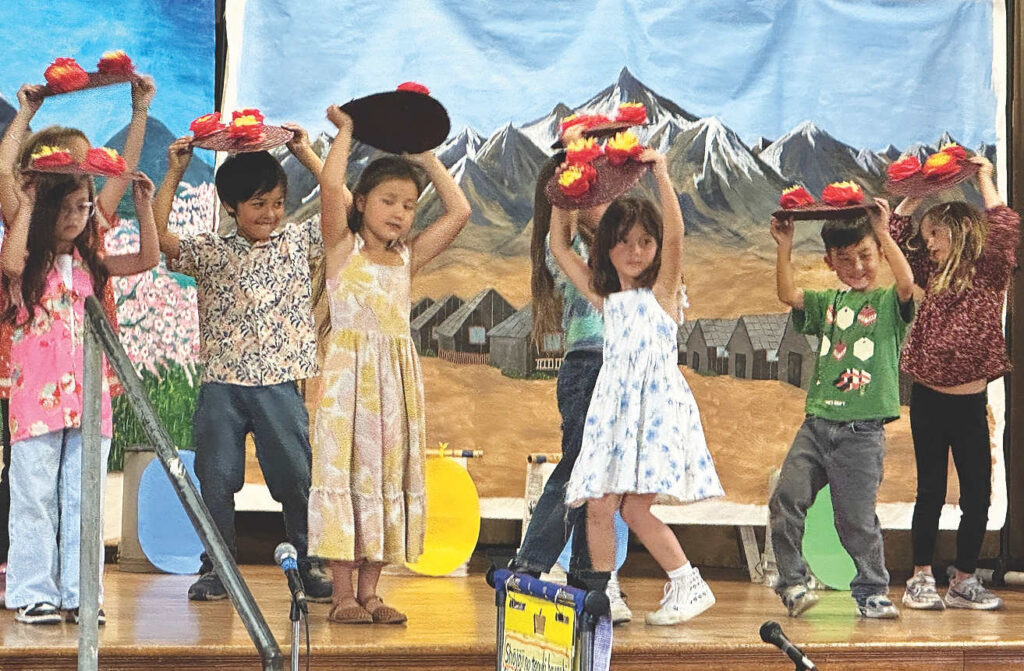 CULTURE TODAY Kindergarten students perform a Japanese dance at the close of the week-long Kokoro no Gakko classes Friday. (Tarmo Hannula/The Pajaronian)
One highlight of the course was a visit from 97-year-old Janice Tao, who—along with her family—was rounded up with Pajaro Valley people of Japanese descent and sent to a detention camp during World War II.
Around 120,000 people were relocated and incarcerated in 10 concentration prisons, with at least two-thirds of them being American citizens.
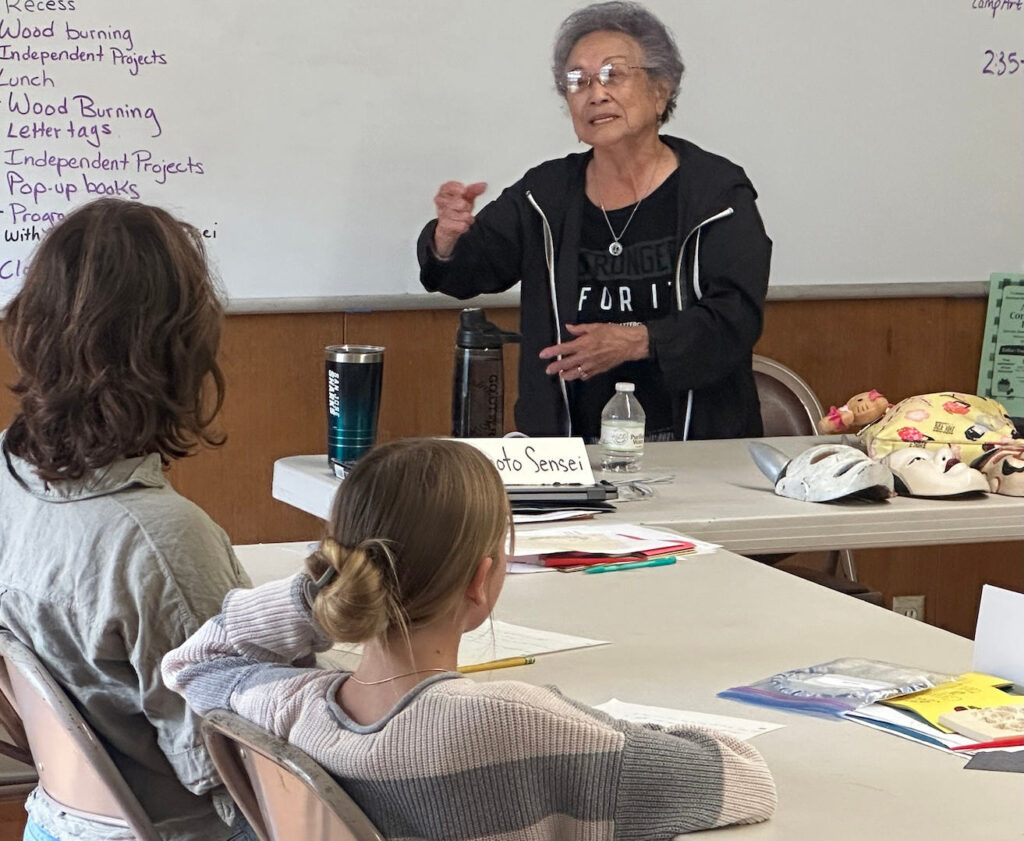 SPEAKING HISTORY Janice Tao, 97, answers questions from students about her years in a detention camp in Poston, Arizona during World War II. (Tarmo Hannula/The Pajaronian)
Tao told a group of fifth graders that she was a grade school student at Pajaro School when her family rented and ran a strawberry farm where Aladdin Nursery now stands on Freedom Boulevard.
Tao said the news of the Pearl Harbor attack was blaring over a radio on the streets of Pajaro the day after the event.
“When I went to school the kids were calling me Jap; it was one of the worst days of my life. And I know there’s some of this still going on today. One thing I’ve learned is that you have to fight for your life.”
When her family and others were rounded up and shipped off to the detention centers, she said, “We could only take what we could carry.”
In the camps she said, “There was nothing to do. My enjoyment was reading books; I love to read. There were arts and crafts; there was a lot of talent there. But overall, there was not much to do.”
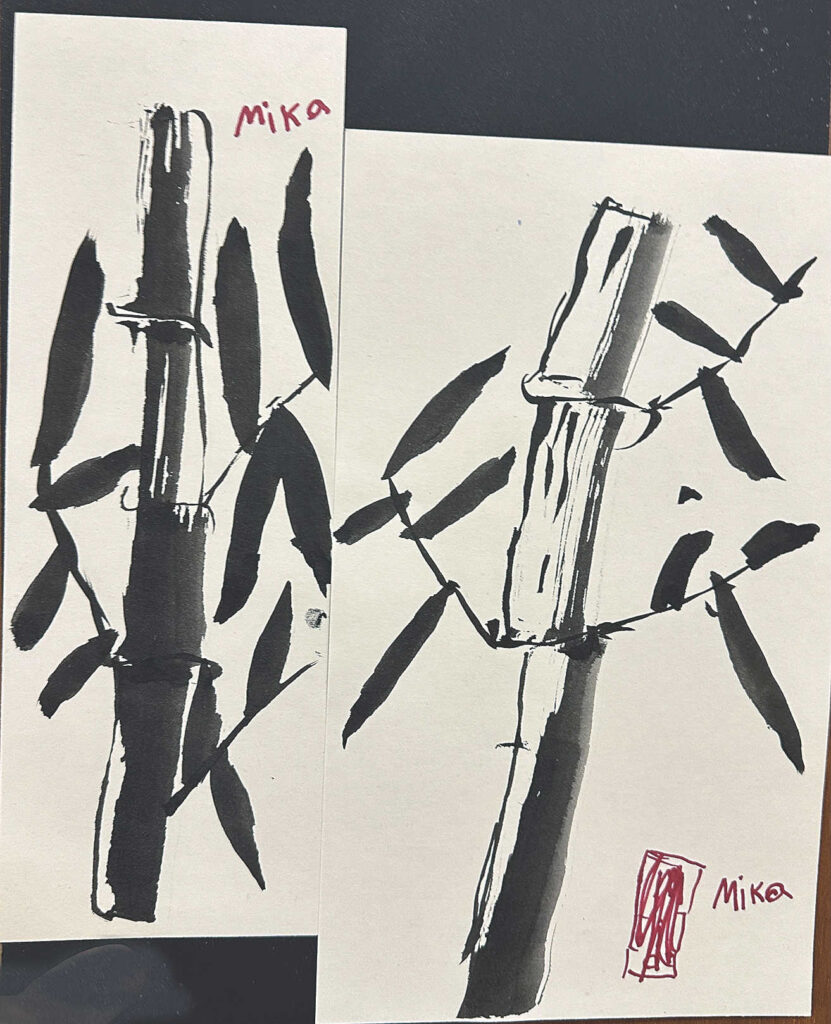 YOUNG ART A student named Mika created this traditional sumi-e, or black ink painting. (Tarmo Hannula/The Pajaronian)
After internees were released four years later, Tao’s family first moved to Los Angeles, then Watsonville.
Friday’s event treated a crowd of more than 250 people to choral works and dances punctuated with theatrics and more. The gathering, headed up by principal Melissa Eguchi-Song, included a raffle and potluck meal.
Gakko is a parent-cooperative that is largely fueled by the students’ families and facility support of the Buddhist Temple.
Performance directors Denise and Bob Gómez have taught at Gakko for years and have traveled to Watsonville’s sister city in Japan, Kawakami, seven times. The couple helped orchestrate and choreograph, through guitar playing, poetry and singing, and six stage works that represented each grade.
People Think Trump Hallucinated Teddy Roosevelt. The Truth Is Weirder.
President Donald Trump shocked Americans Wednesday when he claimed to have spoken to former President Theodore Roosevelt.
Speaking at the opening ceremony of the Theodore Roosevelt Presidential Library in North Dakota, Trump announced to the crowd that he’d just spoken with the 26th president, who died more than 100 years ago.
“I even had a conversation with Theodore Roosevelt,” Trump said. “I said, ‘What did you think about the Panama Canal? Do you consider that your greatest achievement? How do you feel about the fact that the Democrats gave the Panama Canal away to Panama for $1?”
Trump: "I even had a conversation with Theodore Roosevelt. I said, 'What do you think about the Panama Canal? Do you consider that your greatest achievement and how do you feel about the fact that the Democrats gave the Panama Canal away to Panama for $1?'" pic.twitter.com/nP0ox7ensO
— Aaron Rupar (@atrupar) July 1, 2026Despite what many people on the internet seemed to think, the 80-year-old president was not publicly sundowning. He was referring to an interaction he’d just had with an eerie, lifelike AI simulation of Roosevelt.
A video posted by Special Assistant Margo Martin showed Trump listening intently as the fake Roosevelt reminded Trump that “the nation comes first.”
“Well, I appreciate those words, those words are fantastic,” Trump said. “I just want to say it was an honor to be with you today, we are taking a little bit of a tour of some of the fantastic things you’ve done.”
.@POTUS interacts with AI President Theodore Roosevelt at the Theodore Roosevelt Library in North Dakota 🇺🇸 pic.twitter.com/4ISRo2Tsbj
— Margo Martin (@MargoMartin47) July 1, 2026There’s something deeply sad about watching the 47th president speak to a computer-generated version of the 26th. It has a similar effect to watching your elderly grandfather chat with a young, hot single on an online forum: It’s not real, grandpa. Now, go back to bed.
Trump’s fascination with AI presidents is nothing new. The president’s lackluster Great American State Fair features its own AI George Washington to chat with attendees—what few of them there are.
Trump has previously used his praise for Roosevelt to push his agenda to “take back” the Panama Canal—which, along with the threatened annexations of Greenland and Canada are at the heart of his disastrous “Don-roe Doctrine.”
Meeting explores BESS facility objection process

Around 150 people gathered June 28 at Pinto Lake City Park to learn of the next steps on a proposed Battery Energy Storage System (BESS) in Watsonville from Executive Director of the California Energy Commission, Drew Bohan.
The public meeting, hosted by Stop Lithium BESS in Santa Cruz, featured several guest speakers and members of the public who addressed concerns about what organizers described as “the proposed hazardous, flammable, explosive BESS right next to homes at 90 Minto Road.”
The project on Minto Road, a short distance from Pinto Lake, was proposed in January 2025 by Massachusetts-based New Leaf Energy. The CEC is the lead agency reviewing New Leaf’s application and will be the deciding factor in whether a BESS can be built at 90 Minto Road.
Back in May New Leaf Energy said it will bypass Santa Cruz County’s permitting process and instead seek state approval for its storage system.
In a May 1 letter to the county, the company said it would withdraw its application for the Seahawk project at 90 Minto Road and pursue the California Energy Commission’s “opt-in” permitting process under Assembly Bill 205.
“Your voice matters; don’t ever let anyone tell you it doesn’t matter,” local activist Becky Steinbruner told the crowd. “The ordinance that was written was severely flawed. We need to demand that the ordinance prohibit any BESS facility on agricultural land.”
Protesters are calling for a buffer zone of 1,000 meters between the facility and residents, schools, daycare centers and care facilities.
“This project was filed on June 8th,” Bohan said. “My staff and I have 30 days to determine whether the project is complete.” Bohan went on to explain that his team welcomes all input.
“Every comment that gets filed gets published in what we call the docket,” he said. He added that the file is typically not complete and involves a “back-and-forth process” that can take 10 or 11 months.
Once the project is complete, Bohan said he and his bosses will come to Watsonville and interview the community formally after presenting their findings about the application.
In a statement provided to The Pajaronian, New Leaf Project Lead Max Christian said that the project will meet or exceed the safety regulations included in Santa Cruz County’s draft BESS ordinance, which he described is “the strongest ordinance in the U.S., if not the world.”
Christian said that the project will include approximately 200 double-walled steel, sealed containerized batteries that will use lithium-iron phosphate (LFP) chemistry, as opposed to the more volatile, heavy-metal lithium-ion nickel-manganese-cobalt (NMC) chemistry that was used in first-generation systems like Moss Landing.
Much of the concern stems from the Jan. 16, 2025 fire at the Moss Landing Vistra Power Plant that led to hazardous toxic fallout and a thermal runaway at the edge of the Monterey Bay Sanctuary and ignited concern in Monterey and Santa Cruz counties about battery storage systems.
Santa Cruz County Supervisor elect Tony Nuñez offered words as well about assuring safety for the community.
“Public safety is what I ran on,” he said.
Organizers said the incumbent supervisor, Felipe Hernandez, was invited but was not present.
Scores of people expressed concern about why a BESS plant was being considered in a tightly packed residential area on the narrow Minto Road with one way in and out, and about lack of appropriate training for firefighters should a fire erupt inside the facility. Appropriate evacuation routes and centers were also discussed.
To file a comment, go to efiling.energy.ca.gov/Ecomment
Local author shines light on notable California woman

For years, Rose Ann Woolpert heard stories from her mother-in-law about a remarkable woman in the family’s history.
The woman was Mary Catherine “Molly” McIntyre Pacheco, a playwright and novelist who married Romualdo Pacheco, the only Latino to serve as governor of California.
But while Romualdo Pacheco’s place in history was well documented, his wife’s story had largely faded from view.
That changed this year with the release of Mrs. R. Pacheco, Woolpert’s first novel, a work of historical fiction that blends extensive research with imagination to recreate the life of a woman whose accomplishments were largely forgotten.
“I’ve always loved history,” Woolpert said. “One of the things that I’m finding at this point in my life is I’m really interested in learning about not only California history, but the people whose stories really haven’t been properly told—especially women.”
The novel follows McIntyre Pacheco as she arrives in California in 1859, marries the rising California politician and discovers her own creative voice amid the state’s rapidly changing social and political landscape.
Woolpert describes the book as family-friendly historical fiction based on real people and real events.
“It’s written for families,” she said. “It’s not written specifically as a children’s book, but it’s suitable for young people.”
The story began decades ago, when Woolpert married into her husband’s family and became intrigued by stories about his ancestors.
“My mother-in-law would talk about her great-grandmother, who came to California after she was widowed in 1859,” Woolpert said. “She had three teenage daughters, and the eldest, Mary McIntyre, married Romualdo Pacheco, who at the time was a very romantic California politician and eventually became governor of California. I just wanted to know, ‘How did this all come about?’”
That curiosity launched years of research.
Woolpert dug through books, historical articles and museum archives, including resources in San Luis Obispo and Santa Barbara, where the Pacheco family lived for a time. While there was ample material about Romualdo Pacheco, information about his wife was much harder to find.
“There was a fair amount of information about him,” she said. “But Mrs. R. Pacheco was a playwright. Her story was never really told, but there were articles written about her back in the 1800s because she was very well known at the time.”
McIntyre Pacheco wrote plays and books, and one of her works was adapted into the popular musical Three Twins.
Still, much of her life remained undocumented.
“When people’s stories aren’t fully told, you need to fill in the blanks,” Woolpert said. “That’s where fiction comes in.”
The research also uncovered lesser-known pieces of California history.
One detail that surprised Woolpert was the journey McIntyre’s family took west. Rather than crossing the continent by wagon train, they traveled by ship to Panama, crossed the isthmus by train and then boarded another ship for California—a route many travelers and the U.S. mail used before the transcontinental railroad.
“It wasn’t without danger,” she said. “But it was the way a lot of people traveled, and it was fun to learn about the adventures that could have happened that I was able to add to my story.”
The project also answered questions Woolpert had carried since childhood.
“I grew up in Southern California, and I never heard about those years between the Gold Rush and Hollywood,” she said. “I was always wondering what went on in those times. I was able to answer my own questions through this research.”
Mrs. R. Pacheco is Woolpert’s first novel, but not her first book. She has also written three children’s books: Engine Number 10, Big Bill and His Little Mixer Truck and Cauliflower Boulevard.
She said the historical novel is the first of several planned books centered on overlooked women in California’s past.
“I’ve got three more books—one getting close to finished, another in the works and a third that I’m still figuring out,” she said. “They’re all untold stories about fascinating California women.”
For Woolpert, those forgotten lives are where history becomes most compelling.
“Women were doing fascinating things, too,” she said. “They just weren’t getting their stories told. That’s what I’m really interested in right now.”
Mrs. R. Pacheco is available through major book retailers.
Booksellers, libraries, and event coordinators may order directly at bit.ly/4vHNsA5
Even FIFA and Trump Can’t Ruin This World Cup
Despite the countless problematic aspects of the 2026 FIFA Men’s World Cup—power-hungry fascists and the wealthy elite grabbing every ounce of political and monetary gain they can imagine at the expense of fans, national team players and staff, workers, and more—there are a few inspiring stories that I have been following.
Among them: A national team playing in its first World Cup, outplaying established opponents with their spirit and tactics; a friendship between residents of a Kansas town and the national team players training there; and a young player showing the world what his sister always saw in him.
As Jules Boykoff, a former US men’s national team and professional soccer player—and current politics professor at Pacific University in Oregon—told me just before the tournament started, soccer has the power to spark new connections within our communities and organizing. More simply, it can be fun.
Cape Verde’s ascent to the knockout stagesCape Verde, a nation of about 530,000 people (about the same population as Atlanta), qualified for its first World Cup last year. This year, they earned draws against their three group stage opponents: Spain, one of the favorites to win the whole tournament, Uruguay, and Saudi Arabia. Vozinha, the goalkeeper, had a star performance against Spain with seven saves and gained 14 million followers on Instagram as a result, but beyond that, the Verdean team genuinely challenged Spain during the match in ways that they had no answer to.
Against Uruguay, Cape Verde scored its first two goals—including Kevin Pina’s stunning, long-distance free kick that punished their opponents’ flimsy defensive wall—and the team created much better chances to score than Saudi Arabia.
Prior to the start of the tournament, Cape Verde was projected to have the fourth-lowest chance of making it out of the group stage behind Iraq, Curaçao, and Haiti. They beat the odds with flying colors and will play Argentina, led by perhaps the greatest player of all time, Lionel Messi, on Friday.
Lawrence, Kansas, residents connect with Algerian national team players and fansAt the start of the World Cup, a video of two Lawrence residents enthusiastically welcoming Algerians to town after the national team set up their training camp there went viral. If you didn’t get the chance to watch it, one resident explains to a reporter that he attended what appears to be a fan event because he was “so happy” that “they chose our town for their base camp.” While both he and another resident said in the interview that they didn’t know much about Algeria, they were already adopting their fan chants: “1, 2, 3, vive l’Algerie,” or “1, 2, 3, long live Algeria”—a phrase with ties to Algeria’s fight for independence from French occupation.
Local outlets have done some great reporting on the new Kansas-Algeria bond, which I highly recommend you give a read.
The friendship has led to some of my favorite videos to come from the tournament:
Bless this man, his excitement about Team Algeria and their base camp in Lawrence, Kansas, is just 
Algerian fans chanting THANK YOU LAWRENCE
— Rodger Sherman (@rodger.bsky.social) 2026-06-28T19:20:03.383Z Ivory Coast’s star winger Yan Diomande plays a great tournament for his first fanI sometimes find myself searching for the personal stories of the soccer players I enjoy watching. Diomande plays for the major German club RB Leipzig; his story in the Players’ Tribune, a platform that publishes first-person stories from athletes, really moved me.
You should take a look at it yourself—his words are so powerful that any description I come up with wouldn’t do it justice—but Diomande talks about his sister Roxanne, who believed that he would become a great soccer player, taking him to tryouts for professional teams, and about his shock and grief when Roxanne died at the age of 15 after someone spiked her drink at a party. Yan Diomande has achieved so much at just 19 and is attracting the attention of the best teams in the world.
His dribbling is mesmerizing, and his decision-making after the dribble—whether that be a pass or shot—is impressive for how early he is in his career. His Ivory Coast teammates are so cleverly organized and look to get him the ball often to cause chaos in the opposing team’s defense.
Given that, I still think about one quote from Diomande’s story, entitled “Dear Roxanne”: “Everything I do on a football pitch, it’s for you.”
Although the Ivory Coast lost 1-2 against Norway on Tuesday, he and his teammates have achieved so much, reaching the knockout stage for the first time in their World Cup history.