


Ten Years After Brexit, Every Grim Prediction Has More Than Come True
“It was Game of Thrones,” says George Osborne. The former Tory chancellor of the exchequer was talking about the fateful referendum 10 years ago, on June 23, 2016, on whether the United Kingdom should remain in or leave the European Union. Or rather, he was talking about one man in particular, and Osborne’s comparison was just right. For Boris Johnson, the referendum—in fact, all of politics, even all of life itself—was a game, although also an opportunity. The one thing it wasn’t to Johnson was a serious matter with grave implications for his country.
Just how grave we can now see. Every warning about the malign consequences of leaving the EU has been justified. This is not the place for detailed economic analysis with statistics and tables, but just to take one example, and a detached transatlantic view, a paper published last year by American academic economists, chiefly at Stanford, compares the U.K.’s performance since the referendum with those of similar countries and reckons that the U.K. economy is 8 percent smaller than it would have been had we remained inside the EU.
Our particular problems are a grossly inflated financial sector that produces a disproportionate amount of tax revenue but is particularly vulnerable to a crisis such as that of 2008, along with a larger postindustrial economy characterized by low education, low skills, low investment, low wages, low growth, and low productivity. These wouldn’t have been cured merely by remaining in the EU, but they have been patently aggravated by leaving.
One obvious and undeniable consequence of the referendum has been political chaos. In the 40 years from 1976 to 2016, there were in all six British prime ministers. In the decade since the referendum, there have also been six. And soon there will be a seventh, with Sir Keir Starmer having thrown in the towel on Monday. He will presumably be replaced by Andy Burnham in a kind of coup. It’s yet another in a series of coups, a Labour premier kicked out as a succession of Conservative premiers— Theresa May, Boris Johnson, Liz Truss—were before him. This latest change cannot be justified by any serious belief in Burnham, whose political résumé is far from stellar—a member of Parliament for 15 years (when he loyally and repeatedly voted for Tony Blair’s criminal and catastrophic invasion of Iraq); a minister for a few years; an unsuccessful candidate for the Labour leadership not once but twice; and then mayor of Greater Manchester, where his achievements were genuine but quite modest, such as improving the bus and railway services. His only real selling proposition is that he’s not Starmer.
And all of this stems from that fateful day 10 years ago. The referendum campaign remains one of the most unpleasant experiences of my life. To be clear, I say that as a Remainer, but not just because of that. One might sometimes feel like the American pol years ago who said, after losing an election, “The people have spoken, God damn them,” but one can accept defeat after a fair fight. But the Brexit referendum was anything but fair. It was a squalid exercise in demagoguery or plain mendacity.
A riveting two-part BBC program, Brexit: A Very British Civil War, is the latest in the long line of brilliant documentaries produced by Norma Percy, an American adornment of British broadcasting. Her oeuvre includes important additions to our knowledge of the bloody disintegration of Yugoslavia and conflicts in the Middle East, but my favorite may be the Watergate series, made 20 years after Richard Nixon’s resignation, which is not least a comic masterpiece, as all the old burglars and bunglers revisit, and try to explain away, their malfeasance.
There is a certain similarity in the Brexit program, even if there’s nothing at all funny about the consequences. It all came about because of the internal politics of the Conservative Party. Once upon a time it was the Tories who were the Europhiles. One Tory prime minister, Harold Macmillan, made the first attempt to join what was then the European Economic Community, or Common Market, in 1963, before he was blackballed by Charles de Gaulle. Another, Edward Heath, did join in 1973. And as is often forgotten, it was one more Tory, Margaret Thatcher (yes!), who ratified the Single European Act in 1986 establishing the single market.
After her fall, a group of Tory M.P.s began a guerrilla campaign against further European integration, and they harried John Major during his troubled prime ministership from 1990 to 1997. When David Cameron became Conservative leader of the opposition in 2005, he told his party to “stop banging on about Europe,” but his words went quite unheeded. Every poll showed, over many years, that “Europe” was one of the least important questions for most British voters, although immigration, which was sometimes connected to the EU, mattered much more. And yet for the same gang of Tory M.P.s, the EU was the one subject that dominated their lives, and they were relentless in pursuing it.
Following the 2010 election, in which the Tories won a plurality of parliamentary seats but not an outright majority, Cameron and Nick Clegg, leader of the ardently Europhile Liberal Democrats, formed what someone called the Brokeback Mountain coalition. But then, as another observer pointed out, that movie does not end happily, and so it proved.
As his next move, or misstep, Cameron tried to quiet those colleagues who were still banging on by promising a referendum on continued British membership. But he made the promise hoping that he wouldn’t have to keep it. If the coalition held after the next election, he could plead the Lib Dems’ support as a way out. In 2015, to general surprise, the Tories won an outright majority, and Cameron was impaled on his promise.
Even then, having called a referendum he didn’t want, Cameron still expected to win it—and he wasn’t alone. He tried to gain concessions from the EU, but the other European leaders, while not wanting the U.K. to depart, had almost had enough of endless British plaints and special concessions. In particular, German Chancellor Angela Merkel refused to budge from the sacred principle of free movement of people within the EU. It was unfortunate, not to say disastrous, that this coincided with the bloody strife in Syria and the consequent huge flood of refugees trying to escape from that country and get into Europe.
All Cameron could do was fall back on saying that to leave would still be economically damaging for the country. Although plainly true, and amply justified by events since, that quite missed the point. “It’s the economy, stupid” must be one of the stupidest political slogans ever coined, but it underlay the Remain campaign’s great mistake. Dry economic arguments simply didn’t cut it.
Although I would never say that we Remainers were “the best” and that Leavers were “the worst,” the rest of Yeats’s line applies all too aptly: Remainers lacked all conviction while the Leavers were filled with passionate intensity. More than that, we Remainers forgot what Raymond Aron, the great French politicologue, said toward the end of his long life: It is a denial of the entire experience of the twentieth century to suppose that people will reject their passions in favor of their interests.
And then there are the individual roles played 10 years ago. Whatever one thinks of Nigel Farage, the leader of the anti-European United Kingdom Independence Party at the time, or his gruesome sidekicks who made us shudder again as we saw them on the recent BBC show, they had always opposed British membership of the EU, so they can’t be accused of cynical calculation. And they were fighting wholeheartedly to win the referendum.
Not so some others. Important parts were played by Michael Gove and Boris Johnson, the two most prominent Tories who deserted Cameron and campaigned for Leave. Both of them had been journalists before they entered Parliament as Conservatives. In 2004, Gove wrote an essay in the Spectator, where he is now editor, on what being a Conservative meant to him, which included the enjoyable line, “Rudi Giuliani is a conservative, and a hero to conservatives like me.”
Ten years ago, Gove wrote another long and supposedly weighty essay making the case against membership of the EU, while Johnson wrote not one but two columns, one making the case for Leave and the other for Remain. He claims this was to clear his mind before coming to his decision, which really means that he was weighing up which suited his personal ambitions better. The very idea of “a principled belief held by Boris Johnson” is what logicians call a closed category, like “a square circle.”
Above all, what the BBC program confirmed was what many of us suspected at the time—that both Tories supported Leave while expecting to lose, but hoping that the campaign would strengthen their own positions within the Conservative Party. That was made clear by Johnson’s and Gove’s respective former wives, Marina Wheeler and Sarah Vine. The latter has already told us, as a supposedly amusing story, that on the morrow of the referendum, she said to her then spouse, “You were only supposed to blow the bloody doors off” (a cinematic allusion: vide Michael Caine in The Italian Job).
And all this is what Osborne, the chancellor who was a leading Remainer, meant by Game of Thrones. It was all a struggle for advantage and position, quite unrelated to any serious consideration of the national interest, and when they won the referendum they didn’t know what to do next.
Ten years on, and everyone is unhappy. Any election or referendum is potentially fraught and divisive, but that was peculiarly true of June 23, 2016, which divided the country in the harshest ways, between young and old, educated and “the poorly educated” whom Donald Trump says he loves. If the vote had been confined to citizens over 60, or those who had left school without qualifications, Leave would have won with a much larger majority; if to those under 30 or to university graduates, then it would have been an easy victory for Remain.
By what ought to be a contradiction—but then whenever has political life followed a logical course?—those who gave us Brexit with its lamentable consequences and ought to be execrated have surged ahead. That specifically means Reform UK, the latest iteration in a line of Europhobic parties led by Nigel Farage, which was recently polling around 25 percent, while the possibility of Farage becoming prime minister was seriously discussed. But the special election in Makerfield that sent Andy Burham back into Parliament saw the Reform vote collapse, and that bubble might have burst at last.
Even now the winners of the referendum are as baffled as the losers. A frankly risible ad in the right-wing Daily Telegraph has just announced a “Big Debate” to be held in London on June 29, with a panel of well-known Brexiteers, Daniel Hannan, Allister Heath, and Allison Pearson, on the question “How to Make Brexit a Success”—after 10 years! This is in itself an acknowledgment that it has been a failure so far, which is what most people now think, however they voted then. For some years past, a consistent and substantial majority in polls say that they regret Brexit, but there’s nothing that can be done about it.
Maybe we shall see the same panel discussing how to make Brexit a success in another 10 years’ time. Until then, amid economic decay and violent rioting in the streets, I keep thinking of the words “Referendums are the device of dictators and demagogues.” Who said that? Why, it was Margaret Thatcher, 50 years ago, and she never spoke a truer word.
Democrats Are Missing a Huge Opportunity to Win Working-Class Voters
Working-class Americans are worried that AI will eliminate jobs, including their own, and they want the government to step in with a massive retraining program for affected workers—funded in part by a tax on large corporations that replace workers with AI.
That’s one of several key takeaways from a new poll commissioned by Working Families Power, an organizing, advocacy, and research group that partners with the Working Families Party. The survey, released exclusively to The New Republic, also shows that people are suspicious of data centers, particularly their impact on energy costs, and they support temporary limits or even moratoriums on new centers. That isn’t so surprising given the protests against data centers around the country, but it’s yet another reminder of the huge opportunity for the Democrats in the rising populist rage against Big Tech.
So far, they’re largely missing it.
Working Families Power partnered with the Justice Research Fund to contact 2,511 working-class registered voters, oversampling in swing districts. To identify those voters, they used a rigorous definition of working-class that includes family income, education level, type of work, homeownership status, and whether someone has financial security to fall back on if they lose their job. It’s a far more exacting definition of working-class than simply sorting out voters without a college education, as many surveys and analyses do, and one that identifies voters who are suffering most from the affordability crisis.
The poll shows that 73 percent are “concerned” that AI will lead to job losses in the United States, while 62 percent worry it could “affect their own job, household income, or jobs of people close to them”; 58 percent think it will hurt working-class families overall. Among the jobs that a majority said AI would hurt are truck drivers; retail and service workers; office and administrative workers; and writers, designers, and other creative workers.
Huge majorities, 80 percent and more, want government support for retraining and education programs for those who lose jobs due to AI. They want regulations requiring corporations to give notice before replacing jobs with AI, and to be taxed to contribute to these programs. They also want to share in any benefits from AI through increased pay, shorter workweeks, and stronger benefits. Seventy-three percent agreed with this statement: “AI should work for working people, not just make billionaires richer while everyone else worries about losing their job.”
“What we’re seeing from results like this is that AI might be the biggest political realignment issue of our lifetime,” said Ravi Mangla, a spokesperson for Working Families Power and the Working Families Party. “It’s rare that you see numbers where there is 70, 80 percent agreement in a polarized country like this, and for the vast majority of people to agree that the government needs to step in and do something about AI job loss, that AI companies need to be paying for infrastructure and energy costs, and that there needs to be mass retraining, as well as benefits for workers who are laid off because of AI. That’s a level of agreement across politics that we don’t really see on anything.”
Mangla said Working Families Power doesn’t see enough candidates and officials addressing these widely held concerns. “[They] are not taking what is a political layup,” he said. “Neither party, right now, is rising to the occasion.”
Voters’ concerns extend to data centers. They’re worried that their growth would lead to increased utility costs, and 60 percent want a pause on construction to study their impacts. At the moment, only Vermont Senator Bernie Sanders and New York Representative Alexandria Ocasio-Cortez have released a comprehensive plan to address these concerns. The Congressional Progressive Caucus’s New Affordability Agenda also addresses issues like AI-driven surveillance pricing, and its chair, Texas Representative Greg Casar, supports taxing AI companies to pay for a jobs program. But the anger at Big Tech over AI is more expansive, and largely untapped on the campaign trail.
Professor Alondra Nelson, the founder and director of the Science, Technology, and Social Values Lab at the Institute for Advanced Study in Princeton, New Jersey, said these results confirm what many in her field have been arguing for a long time. “The costs of AI transformation should not be passed on to the public while profits flow exclusively to shareholders and executives. That’s not innovation—that’s extraction,” she said in an email.
Nelson said we need transparency first, because we’re still not sure how AI is affecting business and hiring practices. She said she’s encouraged by new tax policy ideas from the Center for Shared AI Prosperity, which include new taxes on wealthy people whose fortunes derive substantially from AI industries and requiring more contributions from AI firms to help affected workers.
The federal government is not pursuing such protections, and in fact the Trump administration and Republican-controlled Congress have tried to block states from regulating AI at all. “State legislatures are moving faster than Congress on some of these questions,” Nelson said. “That experimentation matters—which is precisely why we should resist any federal preemption of state-level AI regulation. Ultimately, though, we need federal standards establishing a floor of protection for working families, regardless of zip code.”
That’s especially true because the potential benefits of AI remain unclear, as tech evangelists simultaneously promise unimaginable abundance and warn of potential doom. “Even the tech CEOs and AI CEOs can’t tell you what’s going to happen,” Mangla said. “They will say this might destroy civilization or humanity. They’ll say outright that this will cause massive job loss. They are actually conceding to the massive risks and potential faults of this technology, and yet they’re resistant to commonsense policies that will actually protect people and that will allow people to continue to live their lives and earn a decent wage.”
A lot of the potential solutions, such as regulating companies like Anthropic and OpenAI, taxing them more, and providing a safety net for workers, are traditional progressive asks. But Mangla said the polled voters don’t see these as partisan solutions—just necessary ones. Working-class Americans don’t want to halt AI innovation, as the the poll shows, but they don’t want it to come solely at their expense.
Transcript: Trump Rages at Reflecting Pool Mess—and Arrests Get Darker
The following is a lightly edited transcript of the June 23 episode of the Daily Blast podcast. Listen to it here.
Greg Sargent: This is The Daily Blast from The New Republic, produced and presented by the DSR Network. I’m your host, Greg Sargent.
Donald Trump is growing angrier over the strange saga involving his plan to renovate the Lincoln Memorial Reflecting Pool, which is beset with an algae problem and with peeling paint. In a series of posts, he’s raged at a journalist for reporting on it, fulminated that vandalism is the real problem, and hailed a series of arrests that have now taken place there, which are really bizarre and raise lots of unanswered questions.
This whole sorry tale is taking on much broader significance than you might expect. It’s displaying many of the pathologies of this whole presidency and this broader moment in America—from the megalomania to the incompetence, to the corruption, to the sheer tinpot banana republic vibe that’s settled on our nation’s capital. Michael Tomasky, the editor of The New Republic, has a good new piece digging into the subtext of this saga, so we’re working through all of it with him today. Mike, good to have you back on.
Michael Tomasky: Nice to be with you, Greg. Thanks.
Sargent: So before we get to the discussion of the arrests, can you quickly sum up one point for us? You argue in your piece that the Reflecting Pool saga is a real presidential scandal. I wondered if you could just recap the story up until the arrests—how we kind of went from having the Reflecting Pool as we’ve always known it to having one full of algae and peeling paint.
Tomasky: Sure. Well, I gather that it did need work, drainage work, and that part of it is legitimate. And something was done under Obama that did cost a lot more, $35 million, and it didn’t fix the problem the way it was supposed to. So that may be part of Trump’s motivation. But his real motivation is his vanity and getting something, putting his stamp on Washington in advance of the America 250 celebrations, but just in general, for time immemorial.
So he puts his name on the Kennedy Center, he puts his name on the Institute for Peace, and of course tearing down the East Wing and putting up that ballroom without any permits, without any of the normal processes that are supposed to come into play when you do something like that to a landmark historic building. And the arch in front of the Arlington Cemetery.
So here we are. I don’t know why it had to be blue. Nobody really understands quite why it had to be blue. These people did a swimming pool for him in Virginia that was blue and he liked it, so it suddenly needed to be blue. It’s been green for a century. And now it’s become this disaster with the no-bid contracts and the massive cost overrun. He started out talking about $1.7, $1.8 million. It’s now nudging up against $15 million.
And he said it was going to take a week and now—where is it?—six weeks, two months, and it’s going to go on and on.
Sargent: And where did the algae come from? Can you just kind of take us up to the present? And I feel like that’s such a richly symbolic thing. He’s the “Drain the Swamp” president. He was talking about making this thing crystal clear, right? Making the water crystal clear, transparent, as it were. And he’s utterly failed at that.
Now, I don’t know to what degree that’s his fault. Nature’s a complex thing, in fairness to Donald Trump. But it just seems perfectly symbolic in a way that it’s now filled with this infestation.
Tomasky: Totally symbolic. And am I a marine horticulturalist? No, I am not. But I know this much just from reading about this. Until those Obama renovations, the source of the water for the Reflecting Pool, which is 18 inches deep around the edges and as deep as 30 inches in the middle, was Washington, D.C.’s drinking water supply. Then it changed, so that the source of water was the tidal basin.
The tidal basin is the smallish body of water—it’s about the size of a lake, for people who don’t know Washington—and it’s where the Jefferson Memorial sits and where the cherry blossom trees surround it. So the water comes from the tidal basin. So there’s algae. There’s algae in water that comes from nature. Go figure.
Sargent: OK, so Trump is getting angrier about the situation. In the last few days, he’s tweeted about the arrests we’ve seen at the Reflecting Pool. As of Saturday night, we’ve seen five people arrested and charged with vandalism. A number of others issued citations, according to the reporting.
But what’s going on here is really murky, as it were. One of those detained is saying he reached into the pool to feel a piece of the liner that had become detached from the pool bottom. Another person was detained after taking a piece of paint out of the water.
Mike, these don’t seem like Antifa vandals to me. Do we know anything more than this? And what does your gut tell you about what’s really going on with these arrests?
Tomasky: In the case of the first gentleman, that’s a guy named David Hearn. I wrote about his saga in my piece today. And this got quite a lot of coverage over the weekend. He was out on a bike ride. He’s a former U.S. Olympic athlete—a canoeist, a canoe racer. And he was out on a long bike ride. I saw it described variously as 50 miles, 64 miles.
I ride my bike sometimes on Saturdays too. Fifteen is a good Saturday for me, a really good Saturday. So this guy—and he’s 67 years old—so he’s in some kind of shape. And he was an Olympic athlete. I doubt he’s stealing pieces.
He said this piece of the rubberized liner was partially detached and he reached into the Reflecting Pool just to see how it felt. And the next thing he knew, he said, he was in handcuffs.
He also had the misfortune of this right-wing journalist named Emily Miller, who’s gone back and forth between One America News and The Washington Times and local Fox over the years, happened to be there, I guess, and videotaped him and maybe showed it to park police or something like that. I don’t know. It’s all, as you say, very opaque.
And why these people are being arrested—it’s just not clear yet. As far as I know, talking on Monday afternoon, the park police and the Department of the Interior haven’t commented on these arrests.
Sargent: Amazing. And CBS reports that one of the people arrested was the same individual who Trump accused in one of his tweets of using a knife to carve a 250-foot gash into the facade. Mike, 250 feet is nearly the length of a football field. And the choice of the 250 number sure sounds suspiciously like an echo of the 250th anniversary that this Reflecting Pool is supposed to be a part of. So it sort of seems like maybe that number was rattling around in Trump’s head or something.
Now, again, maybe someone did do this. I can’t seem to find evidence of it. But does it seem likely to you that someone would try to carve something that long into the facade—like a 250-foot-long line?
Tomasky: No, it doesn’t seem likely, but you never know. I could believe that there are people who aren’t fans of Trump out there who might vandalize this thing because it’s become such a symbol to him. I can believe that. But if that’s true, tell us. Show us the evidence. Give us the names and tell us what they did.
I don’t support people damaging federal government property, especially historic landmarks like that. I’m sure you don’t either. I’m sure nobody listening to us does. If somebody did that, arrest them, charge them, prosecute them, sic Jeanine Pirro on them. But show us the evidence first.
And so when Trump tweets over the weekend about vandals, I’m sorry—the man has been known to make things up from time to time. And so we’re going to regard that skeptically until there’s evidence.
Sargent: So Trump is getting angrier about the situation in a series of tweets. On Friday, he tweeted that, “Lightweight ABC reporter Jonathan Karl was seen sticking his hand into the pool and trying to rip the rubber off of the surface.” Jonathan Karl had merely been reporting on this whole fiasco.
Trump also raged that the “radical left lunatics, most likely Dumocrats who have spent their lives trying to ruin this country”—he basically said they were more or less responsible for this thing in some sense.
And then on Saturday, he tweeted that “disgraceful vandalism” has marred the project, calling this an affront to George Washington and Abraham Lincoln, while characterizing his handling of the whole thing as impeccably perfect.
One more tweet—on Monday, he said the only project of his that’s been vandalized is the Reflecting Pool. And then he talked about a “300 foot long gash” carved by vandals. So it’s apparently gotten 50 feet longer.
Mike, Trump really seems to be spiraling downwards with this stuff. What do you make of it?
Tomasky: He really is. And it’s just such a perfect Trumpy obsession. It’s a minor thing that to him is a very major thing because it’s about his self-image, his self-regard, his monstrous yet very fragile ego. All these things that he puts on display before us, the American people, constantly every day—about how he’s going to destroy a civilization, about how ICE is doing a magnificent job, about how all his enemies belong in jail, about the personal vendettas that he’s pursuing through the office of the presidency, which are totally inappropriate and completely impeachable offenses.
All of these things are just about his ego, again, which is huge, as we all know. But what’s important here is the fragility of it. And that’s why he gets so defensive. And that’s how a gash grows from 250 feet to 300 feet. The Reflecting Pool, I believe, is about 600 feet long. So if he ever posts that it was a 700-foot gash, then we’ll know that couldn’t possibly happen—unless maybe the person went up and back. This is just his psychodrama that is bananas.
It’s the same thing at work when we watch those Cabinet meetings and they go around the Cabinet table and they all have to offer praise of him, each more effusive than the last, each saying, no, you deserve two Nobel Prizes. No, three Nobel Prizes. Four Nobel Prizes and two Pulitzers, sir.
It’s just a preposterous situation to be in in a democratic country. And this is the point I’d like to make. This is the kind of thing that happens in dictatorships. It’s not supposed to happen in a democratic country, in a democratic republic. We’re not supposed to have this kind of a leader who is so fragile and breakable.
We’re supposed to have processes that are democratic, that give people input into what’s going to happen with the eastern side of the White House, that give people input into the renaming of a venerated cultural institution that’s been here in the nation’s capital for 60 years.
The people are supposed to have input into these things. And they’re supposed to go through processes. And yes, experts, the much-reviled experts, are supposed to be able to weigh in on this stuff.
But Trump, of course, knows better than everybody. And that’s just not a small-d democratic impulse or way to go about doing things.
Sargent: Yeah, and I think your piece got at that really well, the larger importance of this whole thing. And I just want to flag for people—what was really telling to me was the way Trump talked about the project. I forget at which event it was, but he was essentially talking about the contractors on the project in almost precisely the same tone and with the same posture that he would about one of his own real estate projects.
And I think that’s the essence of this, which is that Donald Trump doesn’t get on some very basic level that this stuff is not his. This is not an imperial capital. It is the capital of a republic. And as a result, he doesn’t own this stuff. He is a steward of it, a temporary steward. And as you say, there are processes. But in a way, this whole story shows somebody trying to dispense with that larger idea.
Tomasky: Right. He wants to be the czar. That’s probably the best historical analogy that we can come up with. I went to St. Petersburg once in June. And it was like 50 degrees there anyway. And I walked around the Hermitage, which of course is beautiful and magnificent, the art and all that stuff. But I also walked around that place thinking—I asked my tour guide, I said, how many people lived here? And she said, six. The czar and his family.
And it was as gilt-edged in gold as the Oval Office now is. But that’s how Trump thinks of himself. And that’s what he wants to be. He wants to be a czar. And that’s what all these things that he’s trying to do to Washington prove. And it’s really very, very distasteful.
And by the way, I only mentioned this very quickly and you just alluded to it, but we should spend a little bit more time dwelling on the no-bid aspect of these contracts. That’s sewer corruption. That’s just basic corruption 101. You can’t do that. You can’t let out no-bid contracts.
One of them was, ironically, to a place called Greenwater, which is really funny. That’s the Gafaro guy from Ohio. Then the other one was the swimming pool people from Virginia who did the pool at his golf club in Virginia. But these were both no-bid contracts.
And one of the two, I think the first one—David Fahrenthold of The New York Times reported, he’s so good at this sort of thing—is charging a 20 percent profit margin into their contract when the normal profit margins on this kind of work for the federal government are six to 12 percent. But they just padded it, and the guy’s a donor of Trump’s, a donor and a neighbor in Palm Beach, and he just padded it up to 20 percent and got the contract without any competitive bidding.
That alone is an impeachable offense right there. Boom. There’s just no question about it. I don’t know, what are they going to—if the Democrats take the House, what are they going to impeach him on? I mean, there’s 46 possibilities.
Sargent: Right. And your piece really made the point very well that if this were just an ordinary moment, that would be a huge scandal. But since we’re in this really extraordinary moment, it isn’t.
I want to close on this thought, which kind of pulls all this together, I hope. One of the consistent things in the reporting here has been that many people are just stopping by the Reflecting Pool to look at the algae and the peeling paint, to almost marvel at the spectacle of it. And you did that too, right? You stopped by and marveled at the spectacle of it.
And I think for a lot of people, what they’re actually marveling at is what Trump has done to our country—how all this didn’t have to happen, how it’s all just rooted in megalomania and incompetence and corruption and derangement.
I strongly suspect that this story, the Reflecting Pool, just like the ballroom, has immense symbolic importance to ordinary people in a way that we still haven’t gotten our heads around. And I just wanted you to talk a little bit about that.
Tomasky: The day I rode my bike down there, I took a couple photographs of it just for my own amusement. I posted one on Facebook and I said, well, this looks pretty green to me—something kind of offhanded.
I post political-ish things on my Facebook feed from time to time. And it’s interesting because it’s not my New Republic readership. This is old high school friends, many of whom are MAGA, many of whom have politics basically like mine. So it’s a mix and I get to see a mix.
Usually when I post a political kind of thing on Facebook, 50 people either give it a like or have some kind of comment. Seventy, 80 people. This one—the last time I looked—870 responses.
Sargent: I really do think it has that sort of importance for people. It really represents this presidency and what’s happening to this country under this presidency, don’t you think?
Tomasky: Yeah, it really does. And it’s just such an emotionally potent symbol for people. Most people have been to Washington when they were in eighth grade, or later they brought their families here. And you’re sitting there right in the shadow of the beautiful, tasteful, grand but not opulent or self-regarding memorial to our greatest president—and I mean Lincoln. The Washington Monument is up the way, but it’s a little farther away.
Yeah, to our greatest president and to a very humble man, and to a man who probably, if he could come back, would say, you built that for me? Why? Donald Trump will want something three times that size. As indeed the arch—it’s not quite three times, but the Lincoln Memorial is about 130 feet high at its peak and this arch is twice that.
So yeah, this is really important. And it’s why—and to conclude on a point that you often make in your writing and podcasting—this is why Democrats shouldn’t just let this one slide and just talk about affordability or whatever. No, you can walk and chew gum, Democrats. Talk about this stuff. People care.
Sargent: People really care about it. And just to underscore the point one last time, I really wonder whether this sort of thing—the tearing down of the East Wing of the White House, the piles of rubble that are on everybody’s phones all across the country, the kind of viral nature of this imagery, the viral nature of the imagery of the algae in the Reflecting Pool—I do wonder whether people are sort of in some deep sense reconsidering republican, small-r republican governance and saying to themselves, that thing was pretty cool that we’ve lost.
Do you think that’s maybe going on? Do you think that’s what’s happening?
Tomasky: I hope so. I don’t know, but I hope so. Twenty-five percent of the country is always going to support him no matter what, maybe 30, maybe a little more. But I’d like to think that the people whose politics aren’t like yours and mine, but people who aren’t terribly political, have enough of a civic impulse running through them that this bothers them. And that even if they can’t quite exactly articulate to themselves why, they know something about this isn’t right—this isn’t how stuff’s supposed to go down in the United States of America. I think they do. Enough of them anyway.
Sargent: Really well said, Michael Tomasky. It was a pleasure having you on. Folks, if you want to read what Mike wrote about this—and you should—the piece is up at NewRepublic.com. It’s called “Vandalism at the Reflecting Pool? Yes, It Was Committed by Donald Trump.” Well said, Mike. Thanks for coming on.
Tomasky: Enjoyed it. Thanks for having me.
Trump Rages over Reflecting Pool Fiasco—and Arrests over it Get Darker
Donald Trump’s renovation of the Reflecting Pool is a major fiasco, and it’s getting him angrier. In Truth Social posts, he raged at a journalist for covering the story. He fulminated that vandals had cut at 250-foot gash in the facade (which is entirely unverified). He hailed multiple arrests at the scene. He even angrily threatened 10 years in jail. Yet these arrests are only growing more questionable. One man detained is a 67-year-old former Olympian who said he just wanted to examine the peeling coating. Another person detained said she was merely pulling a piece of paint out of the water. These explanations, plus the tenuousness of Trump’s claims of vandalism, suggest a darker turn in the story. We talked to New Republic editor Michael Tomasky about his good piece on this whole mess. We discuss why Trump doesn’t deserve the benefit of the doubt on the arrests, why this story has deeper resonance for many ordinary people, and what it captures about Trump’s effort to destroy republican governance and turn Washington into an imperial capital, with himself in the role of “czar.” (After we recorded, Trump kept on raging.) Listen to this episode here. A transcript is here.
ICE Agents Do Donuts With Their Cars to Celebrate Father’s Day Raid
On the morning of Father’s Day, seven cars of ICE agents barreled through Santa Barbara, California, and detained anywhere from nine to 11 people, including one U.S. citizen.
The Santa Barbara Independent reported that three of the people detained were mariachi musicians, according to a spokesperson for an activist group that had been following the agents. The musicians may have been in the act of serenading fathers as part of a Mexican immigrant Father’s Day tradition, or on their way to do so.
As part of the action, ICE agents reportedly detained a U.S. citizen before releasing him at a nearby hospital. They also bear-sprayed a woman who was part of an ICE-monitoring organization through the rear window of her car.
Activists trailing ICE said that the agents didn’t just arrest people in the city but also sped down the streets in the early morning, and did donuts with their cars under the highway for 15 minutes. When they got on the freeway, the activists reported that the agents were going over 100 miles an hour.
Meanwhile, the Santa Barbara police chief, Kelly Gordon, had no idea ICE was in town. “We didn’t have any calls for service from 1 a.m. that were remotely close to what was being alleged on the Westside,” she said.
Republicans Ready to Give Up on Defunding Planned Parenthood
Planned Parenthood is on the path to having its funding restored thanks to Republican chaos in Congress.
The nonprofit health care organization could regain access to federal funds as soon as July 4, exactly one year after the Senate parliamentarian allowed Republicans to pass a one-year ban on national funding for the program, NOTUS reported Monday.
Amid all the chaos related to the Iran war, economic fallout, severed alliances over Trump’s midterm election endorsements, and a lapsed federal spy bill, Republicans have been unable to galvanize their party to vote to extend the limited ban.
“I think at this point, it’d be unlikely,” Montana Senator Steve Daines told NOTUS.
One possible pathway to advancing the anti-abortion agenda item would be to find a vehicle such as a third reconciliation bill to pass the ban, though Daines recognized that such bills are “hard to pass.”
Anti-abortion groups are pushing GOP lawmakers to find a way to pass a reconciliation bill regardless.
“Budget reconciliation remains the only viable legislative path to continuing to defund Big Abortion businesses like Planned Parenthood,” Marjorie Dannenfelser, president of Susan B. Anthony Pro-Life America, wrote in a letter to Senate Republicans last week.
House Speaker Mike Johnson has signaled that he intends to push for a third reconciliation bill in the near future, even as other top Republicans reject the idea. Senators Mitch McConnell and Susan Collins have already said they don’t see it happening.
“I think it’s safe to conclude there will not be another reconciliation bill,” McConnell, the chair of the Appropriations Defense Subcommittee, said during a hearing earlier this month.
Louisiana Senator John Kennedy also said he didn’t believe a third round of budgetary efforts would garner much support from the party, considering the difficulty the party faced during attempts to muster a second bill. “It’s not looking real good,” he told reporters.
Planned Parenthood is the nation’s largest abortion provider, but that’s not the only service it offers. The nonprofit provides critical services such as physicals, cancer screenings, STI testing, and birth control access, and it does not use public funds to provide abortion care. Performing abortions with federal funds is already illegal based on the parameters set by the Hyde Amendment, which became law in 1976.
Democratic States Want No Part of Trump’s “Great American State Fair”
More states are pulling out of President Trump’s “Great American State Fair,” citing financial constraints.
Connecticut, Illinois, Maine, Massachusetts, Oregon, and North Carolina—the last of which Trump won in 2024—have each declined to send a representative to the festival, which is supposed to feature a 600-square-foot themed booth on the National Mall for each state and kick off on Thursday with sixteen days of festivities. The six states all have Democratic governors.
“Given the significant costs associated with participating in the Great American State Fair, we chose to focus on supporting local efforts here in Washington state for this very important commemoration,” Washington Lieutenant Governor Denny Heck told The Hill. Fair organizer Freedom 250 has claimed that there are no cost requirements per state.
Luke Harkins, Oregon Governor Tina Kotek’s press secretary, pointed to “growing concerns that the event in Washington, D.C., is shaping up to be a more partisan affair than originally presented.” And Massachusetts Governor Maura Healy proclaimed that “everybody’s bailing on” Trump’s fair. Fellow blue states California, Colorado, and New York will be present.
This Freedom 250 festival has been a mess from the beginning, and it really hasn’t even gotten started. From the first wave of announced performers pulling out, to entire states, it’s becoming less and less clear what this event will even look like. Nevertheless, Trump is insisting that the show must go on.
“On July 4th, at The Lincoln Memorial and Washington Monument, in beautiful and safe Washington D.C., we are going to host the most spectacular TRUMP RALLY of them all, a ‘TRIBUTE TO AMERICA,’” Trump wrote on Truth Social last week. “Starting at 7 P.M. EST, this HUGE Celebration will honor our Country’s People, Spirit, Strength, Resolve, and Triumphs. With the backdrop of the Lincoln Memorial and surrounding the beautifully new Reflecting Pool, more than 300 Members of our strong and talented Military Bands, Orchestras, and Ceremonial Units, will perform Patriotic Melodies and American Classics, and my Playlist.”
Judge Blocks Trump’s “Voter Database” of Americans and Their SSNs
A federal judge has blocked the Department of Homeland Security from continuing to “haphazardly” create a database of millions of Americans it knew was “inaccurate” in order to purge noncitizens from voter rolls.
U.S. District Judge Sparkle Sooknanan on Monday sided with the League of Women Voters, who’d challenged Trump’s directive to expand the Systematic Alien Verification for Entitlements, or SAVE.
In order to update the SAVE database, U.S. Citizenship and Immigration Services obtained Americans’ Social Security numbers from the Department of Government Efficiency—where some employees were accused of misusing Americans’ sensitive information—and combined it with citizenship data that “they knew to be unreliable,” Sooknanan wrote.
“Since then, states have partnered with the federal government to access the database and are actively removing United States citizens from voter rolls based on inaccurate information,” she wrote in a 75-page ruling. “All in all, the federal government has knowingly trampled on the privacy rights of American citizens in a manner that threatens the sacred right to vote.”
Sooknanan ruled that the Trump administration had violated protections enshrined in the Social Security Act, the Privacy Act, and the Administrative Procedures Act.
Since SAVE was updated, numerous voters have been falsely declared noncitizens, threatened with removal from voter registration rolls, and in some cases, referred to the DHS for possible criminal investigations. Sooknanan found that these misidentifications qualified as, at the very least, “a lesser form” of defamation, and said the administration’s arguments to the contrary “border on absurd.”
Not So Fast: Iran Says It Didn’t Agree to Nuclear Inspections
Despite Vice President JD Vance’s claims, Iran’s state media says it will not allow nuclear inspectors into the country, complicating the agreement made between the U.S. and Iran.
“The US Vice President’s claim regarding the return of [International Atomic Energy Agency] inspectors to Iran is false.… In the Swiss negotiations, there was no discussion about the presence of inspectors in the country,” an X post from the state-affiliated Fars News Agency said in Farsi on Monday, citing an unnamed “informed source.”
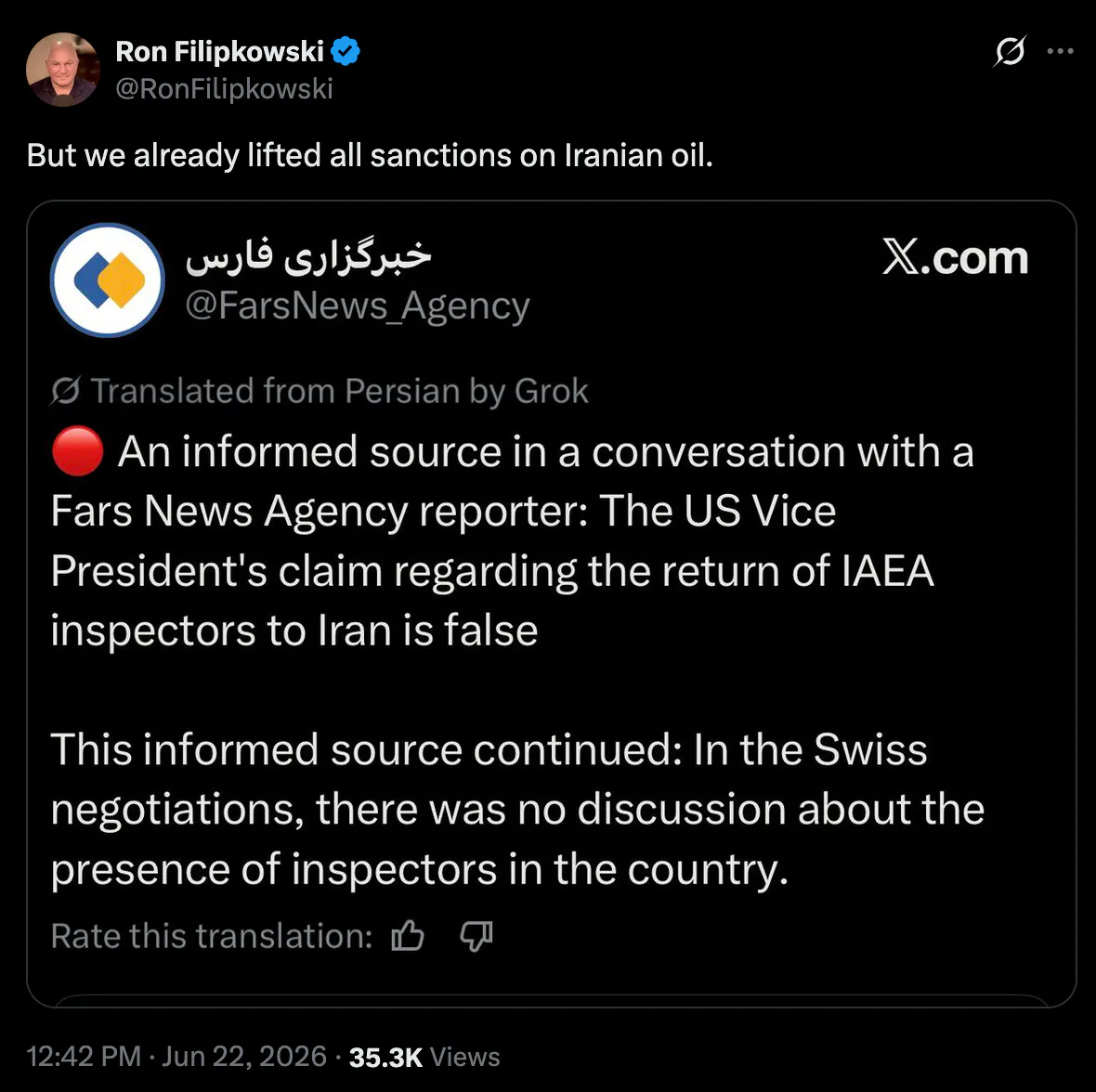
Earlier on Monday, Vance announced that as part of the ongoing peace talks between Iran and the U.S., Iran would allow IAEA inspectors back into the country for the first time since July 2025. Iran suspended cooperation with the agency after the U.S. bombed its nuclear enrichment facilities.
Alongside the opening of the Strait of Hormuz, allowing IAEA inspectors into Iran was a condition of the peace deal, according to Treasury Secretary Scott Bessent. In exchange, the U.S. planned to temporarily lift sanctions on Iranian oil.
“In line with the ongoing productive talks in Switzerland, Iran has committed to free and open transit in the Strait of Hormuz and to permit International Atomic Energy Agency (IAEA) inspectors into their country,” Bessent posted on X Monday morning. “As part of the framework, Treasury has issued a temporary 60-day general license authorizing the production, delivery, and sale of Iranian oil.”
However, the White House and Tehran don’t seem to be on the same page. According to the “informed source,” inspectors were never on the table as part of the negotiations. Meanwhile, Iran may soon be able to finally reap the benefits of selling its oil at market price after years of U.S. sanctions.
This deal was already pretty sweet for Iran—but if it doesn’t have to let inspectors in, it’s even more unbalanced. Isn’t it great to have such an accomplished dealmaker as president?
Trump Appointee Suggested Seizing Greenland to Help Out Red Lobster
The White House has insisted that acquiring Greenland is necessary for America’s national security—but it seems that some Trump officials believe it would primarily benefit American seafood buffets.
A Trump official and Texas venture capitalist, Thomas Dans, was identified by the Danish government as one of three Americans running private “influence operations” in Greenland, according to The New Yorker. (Dans is the twin brother of Project 2025 author Paul Dans.)
Dans was appointed by Trump in December to serve as the chair of the U.S. Arctic Research Commission, a federal agency founded in 1984 to establish national policy as it relates to scientific advancement in the Arctic. Dans had previously held the position during Trump’s first term, as well.
In 2024, Dans founded American Daybreak, a nonprofit promoting U.S. business abroad. He continues to run the nonprofit, according to his LinkedIn profile, and has leveraged both positions to venture to Greenland numerous times.
But the take that Dans offered The New Yorker regarding the proposed foreign takeover was less than inspiring. In a predominantly off-the-record interview, Dans offered the potential commercial benefits to seafood franchises like Red Lobster as the primary reason to take over Greenland.
“My view is that the United States could take all the seafood Greenland could produce, and cut out the middleman, and keep it from China—and you could bring back all-you-can-eat shrimp at Red Lobster,” Dans said.
Dans has been a significant fixture in MAGA world’s Greenland agenda since before Trump returned to power. He was the organizer of a “tourism trip” that sent Donald Trump Jr., far-right political pundit Charlie Kirk, and Trump administration staffer Sergio Gor to the island in January 2025, according to an analysis by Responsible Statecraft. That trek ended in several humiliating revelations, including reports from local media that Trump Jr. reportedly convinced homeless residents to wear MAGA merchandise in exchange for food.
Two months later, in March, when Greenlandic outrage stumped his efforts to send Usha Vance to a dogsled race in Sisimiut, Dans was irate.
“American Daybreak, and I personally, were very disappointed by the negative and hostile reaction—fanned by often false press reports—to the United States supporting Greenland and hoping to learn about its culture, tradition, and people,” Dans wrote in an extended missive on X at the time. “These press stories and Greenlandic officials’ overreaction are harmful to the strong relationship, based on mutual respect, shared interest, and courtesy, that the United States has long enjoyed with Greenland and hopes to expand upon.”
Days later, Greenland’s various political parties set aside their differences to unite under a singular goal: opposing U.S. aggression.
Judge Quashes Trump’s Revenge on Minnesota’s Democratic Leaders
A federal judge has killed the Trump administration’s attempt to subpoena Minnesota Governor Tim Walz, Minneapolis Mayor Jacob Frey, and other state leaders, finding that the Justice Department used the subpoena to force them to capitulate to their demands regarding Operation Metro Surge in January—which saw federal agents kill two American citizens, Alex Pretti and Renee Good.
“Initiating a criminal investigation in order to harass political opponents or to coerce them into taking official action-particularly official action that the federal government cannot directly require those political opponents to take-is a blatantly unlawful and unethical use of the grand-jury process,” Judge Patrick Schiltz wrote. “The only question, then, is whether the challenged subpoenas were issued for one of these forbidden purposes. The Court has no doubt that they were. On the other hand, the Department has struggled—without success—to identify a single plausible investigatory justification for the subpoenas.”
Walz, Frey, Attorney General Keith Ellison, and St. Paul Mayor Kaohly Her were each subpoenaed in January on the grounds that they were impeding federal agents from doing their jobs. The subpoenas also accompanied weeks of vitriolic rhetoric from the administration regarding Somali-Americans and immigrants.
“Today’s ruling is a victory for the rule of law and our democracy. A federal district judge found that the U.S. Department of Justice’s investigation into me and other Minnesota elected officials was politically motivated, unconstitutional, and meritless,” Walz wrote on X after the news. “The U.S. Justice Department is pursuing criminal investigations into the President’s political opponents. This case was just one example of that, but we are seeing daily reminders of this administration’s lawlessness - in Minnesota and around the country. We all must continue to seek justice and uphold the rule of law. I will never stop exercising my constitutional rights to stand up for Minnesotans and the American freedoms that we hold dear.”
“Subpoenaing political opponents because they spoke on behalf of their constituents violates the core tenets of our democracy and human decency,” said Frey.
The Trump administration has yet to respond to Judge Schlitz’s ruling.
Trump Moves to Make It a Whole Lot More Expensive to Become a Citizen
The Department of Homeland Security has proposed a massive increase in citizenship application fees as the Trump administration’s latest move to upend legal immigration.
The U.S. Citizenship and Immigration Services proposed a rule Monday that would raise the fee for a paper citizenship application by 75 percent from $760 to $1,330, and the fee for an online application by 80 percent from $710 to $1,280, according to Newsweek.
The proposed rule would also make it more expensive to seek a hearing challenging a denied naturalization. If adopted, the rule would raise the fee for an appeal from $830 to $1,475 by paper, and $780 to $1,425 online.
Under the proposed rule, the government would scrap fee waivers and a reduced fee option for individuals experiencing financial hardship. The changes would present a significant financial hurdle for lower-income immigrants, further transforming legal immigration into a privilege for the extremely wealthy and a money-making scheme for the federal government.
This proposed rule is yet another way the Trump administration is attempting to curb legal immigration. The government has already stacked the deck with immigration judges bent on denying asylum claims, curbed the refugee program, and imposed steep price increases on H-1B visas.
Judge Smacks Down Trump’s Attempt to Get Maryland’s Voter Rolls
President Donald Trump has struck out nine times in court in his quest to obtain voter registration data from states, reports Democracy Docket.
On Thursday, a federal judge threw out the Department of Justice’s lawsuit seeking voter data from Maryland.
“This Court joins every court to have addressed this issue in concluding that an [statewide voter registration list] is not a record or paper that a state must produce to the United States under the CRA,” District Judge Stephanie Gallagher wrote in the ruling.
The DOJ’s quest to weaponize voter registration data as part of its immigration crackdown has not been going too well. So far, it has not prevailed in a single case: The suits have been dismissed in California, Oregon, Michigan, Massachusetts, Rhode Island, Arizona, Wisconsin, Maine, and now Maryland.
And these dismissals aren’t just coming from Democratic-appointed judges. Five of the nine judges were appointed or renominated by Trump, including Gallagher.
The DOJ could still see a victory: It has sued 31 states and Washington, D.C. Outside of lawsuits, the DOJ has sent letters to all states asking for their voter rolls. At least 16 Republican-led states have complied, according to Democracy Docket.
The administration’s quest for complete, uncensored voter data is chilling—especially because they won’t provide a legitimate reason for this federal overreach, although some reporting hints at their plans. Over the course of the Maryland lawsuit, DOJ officials refused to answer the judge’s questions about what the agency planned to do with the data.
Trump Threatens to Defund States That Don’t Make His Election Changes
The Trump administration is holding millions of dollars of Homeland Security funds hostage unless states agree to stop using electronic ballots and prove voters are citizens before they vote, CNN reports.
Trump is demanding that states carry out manual election audits at the administration’s direction, use their preferred system to verify citizenship, and promise to gradually end the use of electronic ballots—all things that could lead to actual voter fraud. States that rebuff Trump would lose 20 percent of their grants, which could be millions of dollars in security funds.
These grants help states prevent terrorist attacks, support infrastructure, and ready themselves for natural disasters. DHS has granted this funding to states for years, no questions asked.
But now, as the president approaches a potentially disastrous midterm, this funding is contingent on state governments completely changing their election apparatuses so that Trump can continue to delegitimize factual polling and push his baseless claims of voter fraud. This isn’t the first time the Trump administration has dangled funding above states’ heads to make them capitulate to its agenda, and it likely won’t be the last.
“I expect [the new requirements] will be blocked in the courts,” former Justice Department lawyer David Becker told CNN.
Team Trump Quiet Over Explosive Tulsi Gabbard Cult Revelations
Former Director of National Intelligence Tulsi Gabbard may have been taking orders on political decisions from Chris Butler, the leader of a group many former members have called a cult, according to a new investigation from The Washington Post.
So far, Gabbard’s allies in the Trump administration have been largely silent about the report that the person they placed in charge of the CIA, FBI, and NSA may have been taking directives from a man many former followers view as a cult leader.
As Gabbard is no longer a part of the Trump administration, perhaps her former colleagues feel no pressure to weigh in. But conservative commentator Meghan McCain defended Gabbard on X Sunday afternoon.
“What absolute unpatriotic vile trash this attack on @TulsiGabbard is. They wont cover her releases on Fauci or bio labs—both things that threaten the safety and wellbeing of the American people, but spend time and space vomiting this washed up nonsense anti-Hindu bigoted crap,” McCain wrote, referring to Gabbard’s release of documents “exposing” Dr. Anthony Fauci for supposed actions taken during the Covid-19 pandemic on Friday, her last day on the job.
Reporter Jon Swaine gained access to a trove of emails that appeared to show memos from someone within the Science of Identity Foundation, or SIF, directing Gabbard during her time in Congress. When Swaine compared the directives to Tulsi’s voting record, legislative proposals, and media statements, he found “unmistakable parallels.”
Butler’s followers practice a form of Hinduism known as Hare Krishna, and his politics when he founded SIF did not belong squarely in one political camp: “He inveighed against Muslims, homosexuality, gun control and public schools, but also promoted environmentalism and anti-capitalism,” the Post reported.
After two months with no answers from Gabbard’s office, Swaine informed Gabbard that he would be proceeding with the story. Two days later, Fox News reported that Gabbard would be stepping down from her position as director of national intelligence.
On her last days in office, a spokesperson gave a statement: “The attacks on Director Gabbard’s faith and loyalty are not only false—they are a blatant example of anti-Hindu bigotry.”
Trump Threatens Prison Time as Reflecting Pool Disaster Gets Worse
Anyone caught tampering with Donald Trump’s Washington-area restoration projects could be on the hook for significant prison time.
The president warned against vandalizing the monuments and statues that his administration has been trying to clean ahead of America’s 250th anniversary. In a Truth Social post, Trump pledged that anyone caught will face up to 10 years in prison.
“Please remember that there is a 10 year prison sentence for the destruction, or even the attempted destruction, of such things—Which will be fully enforced!” Trump wrote Monday.
Federal law already stipulates that damage to federal property exceeding $1,000 is classified as a felony. As such, the penalties are steep, possibly including a significant fine, a prison sentence of up to 10 years, or both. Those charged with damaging federal property to the tune of less than $1,000 could face a misdemeanor and a one-year prison sentence.
At least five people have been arrested for allegedly vandalizing the pool as of Saturday night, a Trump administration official told CBS News. Five citations were also issued, bringing the grand total of post-renovation citations issued at the site to 14.
In the same message, Trump claimed that the lining of the Lincoln Memorial Reflecting Pool had suffered a “300 foot long gash”—an inexplicable jump from the 250-foot-long damage he described Saturday.
He added that “chemicals have been illegally placed in the water” and complained about the “8647” etched into the National Mall. He further suggested that the damage was “probably inspired by Dirty Cop, James Comey,” who was indicted by a federal grand jury in April for sharing a photo of seashells to his Instagram account that similarly spelled out “8647,” a tagline that Trump and his allies have claimed insinuates a desire for Trump’s death.
Trump Hands Iran Unbelievable Sanctions Win in Exchange for Promises
Trump’s Treasury Department says that Iran can now sell oil, stripping decades of U.S. sanctions policy in one fell swoop—and it’s not clear that the United States is getting anything in return.
Treasury Secretary Scott Bessent announced Monday that the U.S. had issued a “temporary 60-day general license authorizing the production, delivery, and sale of Iranian oil,” in return for the country’s commitments to maintaining “free and open transit” in the Strait of Hormuz and admitting inspectors from the International Atomic Energy Agency.
The sanctions waiver allows Iran to sell its oil at market rate, after decades of having to sell it at a reduced price to buyers willing to dodge U.S. sanctions. Shockingly, the license also allows U.S. refineries to import Iranian oil—reversing more than 40 years of strict sanctions, and giving Iran’s economy a much-needed boost.
Sanctions relief is a key component in the 14-point memorandum of understanding between the two countries. Iran has yet to actually deliver on any of its promises, however.
Over the weekend, the Iranian military briefly shuttered trade through the Strait of Hormuz, citing Israel’s continued ceasefire violations in Lebanon. While Iranian Foreign Minister Abbas Araghchi announced that mediators delivered “major progress” to end the fighting in Lebanon, neither Hezbollah nor Israel are actual signatories to the U.S.-Iran peace deal. It’s still unclear how that conflict will resolve, meaning the future of the entire agreement, and the strait, remains unclear.
As for visits from IAEA inspectors, the memorandum of understanding asserts that Iran will commit to “down-blending” its enriched nuclear material under the agency’s supervision, but details on that process have been scarce. Notably, the supposedly major milestone is something the U.S. had already won—and then lost under Trump.
Ousted Republican Senator Says Trump Likes to “Revel in Chaos”
Outbound Senator John Cornyn is getting candid about Donald Trump.
The former GOP whip described the instability fueled by the White House in a Semafor interview published Monday, lamenting about how talking with the president isn’t “particularly useful” because “he can and will” flip his opinion depending on whoever he last spoke to.
“The president seems to revel in chaos, which is so different from any other leader that I’ve ever seen. I don’t know about you, but I like to minimize the chaos in my life,” Cornyn told Semafor. “He just seems to revel in it. We’ve seen even recent evidence of it on the [Director of National Intelligence].”
Cornyn was referring to Trump’s sudden cancellation of a Senate confirmation hearing for Jay Clayton—the president’s pick to run the Office of National Intelligence—via a Truth Social post mere hours before the hearing was set to take place last week.
Trump tapped Clayton earlier this month as DNI in place of acting Director Bill Pulte.
Pulte’s leadership had sparked a maelstrom in Congress. Democrats refused to renew FISA Section 702, a federal spy bill, until Pulte was replaced by someone with legitimate national security experience, as the position requires by law.
Clayton, unfortunately, does not satisfy that requirement either. The former law professor and corporate crisis management counsel has no national security experience to bring to the role.
Yet rather than quell the furor, Trump opted to make the stalemate even more difficult for his congressional allies by tacking his dead-in-the-water voter ID bill, the Save America Act, onto negotiations over the lapsed spy statute.
Cornyn has become a more vocal critic of the president since he lost his primary runoff last month to Trump’s preferred candidate, Texas Attorney General Ken Paxton.
Cornyn’s race was a gamble and a loss for the GOP: One of the party’s most prolific fundraisers, Cornyn had done much to support other Republican candidates over the course of his 24-year legislative career, bringing in more than $400 million for auxiliary races. The lost cash flow, paired with Trump’s waning popularity and dismal economic offerings, could bode poorly for the Republican Party come November.
JD Vance Whines About Iran’s “Trash Talk” of Trump
JD Vance blamed Iran’s “trash talk” for nearly torpedoing peace talks on Sunday, after aggressive comments from President Trump caused Iran to pause negotiations.
“What we told the Iranians yesterday is that when you guys engage in what us millennials might call ‘trash talk,’ you can’t expect the president of the United States not to respond, and not to correct the record,” Vance said on Newsmax Monday morning.
JD Vance: "What we told the Iranians yesterday is that when you guys engage in what us millennials might call trash talk, you can't expect the president of the United States not to respond and not to correct the record." (Trump threatened to assassinate Iran's negotiators… pic.twitter.com/33ruf7JNZt
— Aaron Rupar (@atrupar) June 22, 2026As Vance met with Iran’s parliamentary speaker Mohammad Bagher Qalibaf and other Iranian officials in Switzerland, the president was firing off insults from miles away.
“Iran must immediately stop their highly paid PROXIES in Lebanon from causing trouble. If they don’t, we’ll hit Iran very hard again, just like we did last week, only harder!!!” Trump wrote on Truth Social Sunday.
The comments were seemingly triggered by Iran’s threats to close the Strait of Hormuz in response to Israel’s continued bombing of Lebanon, which Iran claims is a violation of the 60-day ceasefire deal.
Trump told Fox News journalist Trey Yingst Sunday morning that he spoke with Iranian officials over the phone about the closure, telling them, “You close it and you won’t have a country … you won’t even make it back to your f—ing country.”
"We'll take over the rest of your country ... I'll blow the shit out of them" -- here is Trey Yingst's entire segment about the bonkers phone call he says he had with Trump this morning that apparently included threats to assassinate Iran's leadership, impose draconian US tolls… pic.twitter.com/RLi9bos14Q
— Aaron Rupar (@atrupar) June 21, 2026In response to these comments, Iranian state media declared the talks had been paused.
“They would do better to be careful about their statements,” Qalibaf said after Trump’s comments, according to PBS. “Our armed forces are prepared to respond to them in a different manner. They may keep talking, it is we who act.”
Ultimately, Iranian negotiators did not walk away, and the talks were able to continue. Vance said the talks resulted in “a lot of good progress,” and had laid the groundwork for a final deal. But rather than acknowledge that this progress happened despite Trump’s comments, Vance blamed the Iranians for the holdup. “There was a little bit of threatening, there was a little bit of whining, but at the end of the day the talks continued and we made great progress,” he said.
JD Vance Takes Victory Lap on Iran Deal—But There’s One Big Problem
Vice President JD Vance announced Monday that International Atomic Energy Agency inspectors would be allowed back into Iran in a “major milestone and a first step in permanently ending a nuclear weapons program in Iran.” There’s just one problem.
Speaking at a brief press conference about the “great progress” made in negotiations in Switzerland over the weekend, Vance offered few details about the plan for inspections of nuclear sites.
The vice president did not offer specifics on what kind of access IAEA inspectors would be granted, or how frequently their inspections would take place. He simply said that IAEA inspectors could visit Iran “this week, maybe as soon as today.” Iran has yet to confirm, according to Axios.
The 14-point memorandum of understanding doesn’t add much clarity: The agreement asserts that Iran can not produce or acquire a nuclear weapon, and that Iran will commit to “down-blending” its enriched nuclear material under the supervision of IAEA inspectors.
Vance’s supposedly major milestone is already something the U.S. had already won—then lost under Trump.
The 2015 Joint Comprehensive Plan of Action included the “most comprehensive and intrusive IAEA weapons inspection system ever negotiated,” according to the Center for International Policy. Trump withdrew the United States from the deal in 2018, allowing Iran to resume its enrichment program. In January 2020, Iran announced it would no longer place limits on uranium enrichment after the assassination of Qasem Soleimani at Trump’s direction.
Following the U.S. and Israel’s military strikes on Iranian nuclear sites in June 2025, the Iranian parliament passed a law suspending its cooperation with the IAEA altogether. In September, Iran agreed to allow the agency’s inspectors back into the country. Inspectors had previously visited Iran as recently as December 2025, but received limited access to the country’s nuclear sites.
It’s not even clear that Vance’s announcement was the product of the weekend’s negotiations.
Last week, U.S. envoy Steve Witkoff reportedly told U.S. lawmakers that in agreeing to the MOU, Tehran had drafted a letter inviting IAEA Director General Rafael Mariano Grossi to bring inspectors into the country.