
Democrats Need a Reconstruction Agenda—Not an Affordability One
You can watch this episode of Right Now With Perry Bacon above or by following this show on YouTube or Substack. You can read a transcript here.
If they regain power, it’s not enough for Democrats to pass good economic policies and focus on affordability, says Adam Gurri, publisher of Liberal Currents. Instead, he says the party needs a “Reconstruction” agenda that drastically overhauls American government. In the latest episode of Right Now, Gurri describes some of the bold ideas that are part of Liberal Currents’ newly released “Reconstruction Papers.” Gurri says that he isn’t sure if Democratic politicians should tout these exact ideas on the campaign trail. Instead, the Reconstruction Papers are a kind of a liberal version of Project 2025, a super-ambitious governing agenda that could guide a Democratic administration in office.
Transcript: Democrats Need a Reconstruction Agenda
This is a lightly edited transcript of the June 30 edition of Right Now With Perry Bacon. You can watch the video here or by following this show on YouTube or Substack.
Perry Bacon: I’m Perry Bacon. I’m the host of Right Now on The New Republic. I’m joined by Adam Gurri. He’s the publisher of Liberal Currents, which is a great publication, a newer publication that writes about politics both in the U.S. and Britain, and a little bit abroad as well, but mainly focuses on the U.S. And we’re going to talk today about a project Liberal Currents is doing called The Reconstruction Papers. So Adam, welcome. Thanks for joining me.
Adam Gurri: Thank you for having me.
Bacon: So tell people about Liberal Currents a little bit, just because I assume that’s a publication people are not as familiar with as The New York Times or the Washington Post. So tell them about Liberal Currents and what you’re doing, first of all.
Gurri: Sure. It’s an essay publication, mostly—so more commentary than news, though occasionally we’ve done a bit of news. Our focus is obviously through a liberal perspective. One of our inspirations when we started in 2017 was Jacobin magazine, which was created on the idea that socialism had been discredited in the U.S., in its reputation. They wanted to actually say, No, this is a serious intellectual tradition, and we are its number one exponents in the U.S.
We had the reverse situation, which was that liberalism was so successful that actually people didn’t take it very seriously, in the sense that they assumed a lot. We assume that we believe in free speech, we assume that we believe in different things, in human rights and such, but not a lot of thought was actually given to why anymore.
And actually, the enemies of liberalism spent a lot more time thinking about ways to attack it than the defenders thought about how to defend it, both intellectually and otherwise. So we wanted to correct that. We wanted to be one of the foremost exponents of what liberalism is, what it should be, why the world should be more liberal, and how we should go about it.
Bacon: So talk about The Reconstruction Papers and what you’re doing.
Gurri: Yes. From our point of view—the Trump era, liberal resistance to it. The very name “resistance” implies a negative response, right? We’re trying to stop him from doing bad things. And even in talking about the extreme destruction of the second term, it’s often about, It’s bad that he’s breaking this thing. It was so great before. We need to fix it as soon as we can, or stop the destruction as much as we can.
That’s all true, but we shouldn’t fix it to be the way it was before. All of these things had problems before Trump came along. Everyone agreed, for example, that tuition was out of control in colleges and no one could quite identify the cause. That the public funding of science—which was this tremendous accomplishment in the 20th century for the U.S., and still one of the biggest ones worldwide by far, in fact I think the biggest by a wide margin—before Trump it was getting creaky, bureaucratic, sclerotic in a number of ways.
So the Reconstruction Papers is saying, we’re not just going to go back to before Trump. First of all, that’s impossible, because it’s not how things work. If you tried to do that, you would just be doing a kludge that would be worse than what we had before. But second of all, what we had before could be better. Why limit ourselves?
Now that we have this window of opportunity, where the Republicans have shot their shot—they’re trying to destroy the administrative state, the New Deal state, really and truly for the first time—let’s shoot our shot. Let’s make the best version of all of these things that we can.
And The Reconstruction Papers isn’t as comprehensive as we would like it to be in that. There’s more that we could write. We’ll continue publishing new things, obviously, on the main site—potentially a future issue of The Reconstruction Papers as well. But it covers a lot. It covers a lot of different topics.
Bacon: Do you mean to invoke Reconstruction as in the post-Civil War?
Gurri: Yeah, absolutely. So there’s a few things, right? Reconstruction, the original one, is both an inspiration and a caution, because they had the right idea. They weren’t just passing amendments to change what legal rights we had, which was obviously one thing they did do. But the whole goal of it, the whole idea of Reconstruction, was the slave power was not just a legal entity. It was an institution that had social and political power, and in order to actually destroy it, you couldn’t just outlaw slavery. You had to actually break the political arrangement, break the economic organization of the South in such a way that it wouldn’t come back.
And the caution is that they failed, right? They did accomplish a lot. But a lot of their gains were reversed, and then we had almost a century of Jim Crow. Some people—including Victor Ray, in our collection, in the Reconstruction Papers—refer to the era of civil rights reforms as the Second Reconstruction. So that would be the successful one.
The Voting Rights Act, even more than the Civil Rights Acts, I would say, being the spine of that, holding the whole thing together. That was fairly successful in actually enfranchising African Americans permanently, and other minorities as well that were disenfranchised elsewhere. And frankly, Southern whites, very disenfranchised as well. It was not just minorities that were disenfranchised there. It was also poor people, anyone that they didn’t really want having a chance at challenging the status quo.
But now we’re seeing the unwinding of that. So we need—if there are two, we need a third.
Bacon: So I read—I don’t think I read all of them, but I read many of the Reconstruction Papers. So what Liberal Currents has done is, there are, I think, dozens of people who’ve written articles—maybe four pages, maybe 15 pages, that range in length—about their subject matter. So there’s foreign policy, there’s trade, there’s higher education, there’s domestic policy. So that’s a broad sense. But give people a sense of two or three ideas that are in the document they might want to think about.
Gurri: Sure. So one to think of, in terms of what has just happened in the Supreme Court, would be Anna Law’s contribution on immigration law. I think probably even more ambitious programs are possible, but our immigration status quo is so bad right now—even before, again, the Trump second term, it was so bad—that there’s a lot of low-hanging fruit. And her approach essentially was to say, Let’s take the low-hanging fruit. And the low-hanging fruit is essentially what she calls normalizing immigration law.
Right now, Congress has failed to pass any kind of bill for 20 years. There’s a lot of things that bipartisanly they have more or less agreed on for most of that time that would make the situation better off, including for people like us who believe that immigration is good. And we should just do it. And it should be reauthorized on a regular basis through Congress, so that it will normalize the process of actually revisiting how many people are here on TPS, just the different levels and numbers of each, and—
Bacon: Just to be clear, and make sure people understand—every year Congress should intentionally think through and pass legislation about how many people are entering the country new, not as a sort of—there should be a global number, right?
Gurri: I forget the exact cadence. I don’t think it’s every single year. But for example, the Voting Rights Act itself was reauthorized multiple times.
Bacon: Yes.
Gurri: And each time they reauthorized it, one of the things they would say is, We’ll reauthorize it again in this number of years. So after the Reagan one, I think it was quite a long time. Before that, they did it a couple of times relatively close together. And this is one of those inside-baseball, Congress things that a lot of people don’t know about. Having legislation be reauthorized like that gives Congress a more central role.
I would say a theme across the Reconstruction Papers is many of the problems of our system are downstream of the dysfunction of Congress. So the more you can do to force Congress to actually step up and fill the role it’s supposed to, the more that out-of-control presidencies and out-of-control courts will be reined in, almost just by happenstance. So making Congress regularly reauthorize some basic things about immigration law, according to Anna Law, will help a lot of things.
So that’s one—tied to the TPS, because TPS itself is a kludge, right? It’s like this, Oh, presidents can discretionarily give it to some people. Maybe we don’t make it quite so discretionary for them to revoke it—though it is discretionary for them whether or not they’re going to renew it. It’s just a mess in terms of how it works.
Bacon: What are the Supreme Court reforms in the document? I’ve forgotten now. What are the Supreme Court reforms themselves?
Gurri: Yeah. We actually don’t talk about it that much. One reason being that I actually am pretty optimistic that all the ideas are out there, for the most part. This has been discussed to death, and it’s really just a matter of having the will to do it. Nick Grossman, in his first essay—which is about the short-term things we need to do to get out of the immediate crisis, rather than the long-term vision stuff—says just outright that we should just expand the Court, straight up.
In my essay, which is on federalism, I mention that any and all of the things—almost everything we’re talking about that’s in any way ambitious—is going to require a Supreme Court to go along with it, which means we should just make one that will. Whether it is through a one-time expansion or—like Senator Wyden a few years ago had a court reform plan already that would work fine. It essentially would just create a fixed number of appointments per presidential term.
In theory, you need to pass an amendment to set term limits. What they wanted to do in practice was to just create a new seniority status, where you’re on the Supreme Court still, but you’re not actually seeing any cases after a certain number of years. So even doing that, and then immediately putting the older Republican nominees on the retirement path, and making sure that the number of nominees per term is such that the first Democratic president is going to create a Democratic majority immediately—just stuff like that, I think, will be good enough.
Bacon: The federalism essay is about giving states more power. That was very striking to me, so talk about federalism.
Gurri: Yeah. It’s three things, right? So the one that I think is relevant to what’s happened the past year and a half, mostly, is the guaranteeing-the-Republican-form-of-government component. So I strongly believe that a lot of the problems in our system—and it’s not very timely to talk about right now, with the federal government going out of control, but most of the problems are local.
A lot of local governments—when we talk about police reform, for example, the worst police in our country are just random localities that aren’t very populous. They don’t have a big tax base. They engage in very predatory behavior. They’re not very professionalized. But whenever we want to do police reform, you can’t do it very systematically, because you kind of do it county by county or locality by locality.
So I’ve always believed that one path forward is: make state governments more democratic, A. B, make state governments stronger than local governments. And then C, do better fiscal federalism, the way that Canada does, for example, where we’re not putting a lot of strings attached to the block grants the federal government gives to states. We’re just trying to make sure that state budgets per person are more or less equalized, regardless of whether you have a lot of poor people in your state or a lot of rich people in your state, to summarize it very—
Bacon: I’m a little worried, because as I read what Ron DeSantis and Greg Abbott each day—I’m a little worried about this idea. So talk about your idea a little bit.
Gurri: Yeah. So the Constitution, in theory, guarantees the Republican form of government for each state. We’ve never actually done anything with this. Even the Voting Rights Act has nothing to do with it. It just invokes the 14th and 15th Amendments—mainly the 15th, which is about not denying people the right to vote on the basis of race.
But I think we should actually just use that, and we should use that to authorize legislation that is very prescriptive about what is allowed as the form of government at the state level. And at minimum, that should mean one chamber—because almost every state now is bicameral, with two chambers like the federal government, and then a separately elected governor. So at minimum, the minimum-level change should be one of those chambers has to be done by proportional representation, meaning that whatever party gets 30 percent of the votes gets 30 percent of the seats, et cetera.
So that’s one thing. The other thing is, if you are going to have separately elected executives like the governor, like the attorney general in many states, a lot of these positions, they have to be either a runoff or ranked-choice vote, so that you don’t get a situation where someone has a lot less than a majority of the vote and wins. In both cases, you are pushing against minority rule.
And in the case of proportional representation specifically, you’re breaking up what a lot of people call our two-party system. I would call it a two-at-most-party system. Because most state governments are just one party. And then primaries are treated like, OK, we have primaries. You can just vote in those instead. But those rarely have the same level of turnout as a general election. Plus, they make elections a lot more expensive—you have to have two elections that you’re running in.
So proportional representation creates actual multi-partyism in every single state, actual party competition in every single state. In a state like Texas or Florida, what that probably means is the Republican Party mainly cracks up, and the different wings of it are competing with each other directly, but they’re not spoilers necessarily. Then they have to coalition with each other in the legislature to actually work. But it opens up the space.
The fact of the matter is, everyone right now is spitting mad on the liberal side of the spectrum, and many on the independent side as well—they’re spitting mad about a lot of what the administration has done. But the approval rating of the Democratic Party itself is still in the gutter, even though the Republican Party is doing so badly. And it’s because the Democratic Party brand is kind of terrible, frankly. It’s a combination of, obviously, Republicans hate them, but then Democrats feel like they’re just not doing anything. They’re not accomplishing anything, so they also don’t approve.
Having actual multi-party competition would open up the possibility of new liberal parties to run that don’t have the baggage of the Democratic Party, but can still coalition with them when they win. So in general—again, if you force it at the federal level, you say to state governments, You have to do this, or your elections don’t count under our authority implementing the Constitution—then gerrymandering is no longer a problem, and we’ve seen how big a problem that can quickly become.
Proportional representation makes that impossible. You can’t gerrymander governors, so you just make sure that there’s no spoilers where someone’s winning with 40 percent or less of the vote, or something insane like that. Or what we actually have now, which is just one party wins every single time. So you have actual multi-party competition. You don’t have minority rule in any case.
And at that point, those are the strings, in order to get the support of the federal government to consolidate power at the state government level. Because state governments, if they were actually democratically responsive, would be a far better way to govern than local governments, for the most part.
Bacon: All right. That was helpful, because that was a far-reaching idea that would be much different than... But I want to get people to understand that what you all are calling for in many areas of policy is just much different than where we are now.
Gurri: Yes. Oh, yes.
Bacon: It is reconstruction. It is not reform. It’s not tinkering. And so I wanted to get that. So now I want to talk less about the ideas and more about kind of where we are.
So I think—and a lot of people I agree with, Jamelle Bouie’s writing in this direction, you guys are doing good stuff in this direction—a lot of people who are thought leaders I think of are describing a big we need to have a big reconstruction-style of June 2029.
But the Democratic Party, I would say both wings of it, are not there. And I’m going to start with the Zohran, DSA, Bernie Sanders wing—and they might reject me framing it so directly here—but I think their agenda seems to be, If we do a lot of economic policies that help the working class, we will win elections, and that will be the way to restore democracy. I’m dubious of that, and I assume you are too. So talk about why we can’t just do working-class affordability and that’ll solve every problem.
Gurri: Yeah. I want to do those things, obviously.
I think they’re good policy and such. But for Biden, I think he did a lot of really good things, and what we just saw is he didn’t get any credit for them, right? The CHIPS Act and the IRA were both incredible policies—just great stuff that we should have been doing—and a ton of money was poured into red states, mostly because it was easier to build there, frankly. No other political reason than that. And those states all went super-majorities for Trump anyway. It didn’t matter. They voted for the guy that came in and immediately killed all that stuff.
So I just think that theory of change clearly does not work, and that we actually have to do something more fundamental. So yes, for example, the original Reconstruction Republicans in the 19th century believed that they needed to change the actual plantation economic system, but they very much believed you had to change the institutions and the incentives and all that stuff as well.
And I think it’s just clear that rural areas right now have a way disproportionate influence on our politics. If you actually were to force a lot of states, and the House, for example, to really be proportional—if you were to get us out of the two-party frequent-switching situation in the House—I think that the situation will change considerably.
I don’t necessarily think the DSA would be against it, though. I get that most of their talking points are—
Bacon: But it’s not that they’re just there. They don’t talk about it very much.
Gurri: Yeah. No, I agree, they’re not. I do think that just from a self-interest point of view, their success—I was talking to this political scientist, Jack Santucci, who’s written a lot about proportional representation in his work. And he was saying that the situation with the DSA rising right now, like in the past primaries that they had, where they were successful, is very akin to the situations where European countries that got proportional representation actually finally did it. And it is because they wanted to institutionalize the factions of their parties, rather than have this within-a-party competition thing.
The DSA—like a future DSA-type party in a multi-party system—could still coalition with the Democratic Party, but it might be better for both of them to stop competing for the same voters internally and consolidate themselves a bit, and then just coalition with whatever they get in the general election.
Bacon: All right. So you answered one part of my question, which is, for one faction, affordability will solve everything—we’re dubious of that. I think that both the center-left and the left in the Washington, the official party—they both believe that to win an election, you have to talk about economic issues. People don’t care about democracy, they don’t care about institutions. Hillary and Harris lost because they said democracy too much, and all people care about is prices.
So in a campaign sense—in other words, the question might be: do we want President Buttigiegto read your agenda and do it in office, but maybe not talk about it? Or do you think talking about it—is it bad politics, good policy? Do you think that’s the conventional wisdom in Washington, that institutions, democracy reform is good policy, bad politics? Do you agree with that?
Gurri: Yeah. So I try to be pretty humble about talking about what works in a campaign. Because I’ve never run or won one.
Bacon: Only person in the world that feels that way. Good for you.
Gurri: Yeah. No, I really just don’t like armchair doing it. What I can say, just from the sense of perceptions—again, having no authority whatsoever on the subject—is, for example, our trade proposal, Steve Randy Waldman’s trade proposal. Everyone has said, How the heck are you going to explain this to voters? It’s very technocratic. But I think it’s easy.
His trade proposal is essentially an old idea at the top level, which is free but balanced trade. And I think that’s relatively easy to sell now of all times, because Trump is just all about tariffs—and of course he’s done the worst possible version of them, but that’s a good way to discredit just bluntly doing tariffs. But no one wants to go back to the neoliberal trade regime, mostly because it resulted in deindustrialization and trade imbalances, which were very related to each other.
So I think, like, campaigning on a top level—we want free but balanced trade, the tariffs don’t work—you could say to the people who care about this stuff, which is some, it’s not no voters—you could say, Look, Trump did all these tariffs and our trade imbalance got worse, and China’s trade surplus got better, so clearly that’s not working. Here’s an alternative where we get the best of both, essentially. And that actually is true in this case, for his policy.
Not all the things we go into are like that, though. Like Moira Berstein’s essay is about climate-risk mitigation for housing, specifically. And that’s a super-detailed technocratic thing.
Bacon: This is, in other words—this is not a campaign guide.
Gurri: Exactly. It’s really not. I would like for Democrats, especially ones running for office for the next two years, to see this, have it in mind, and think about how they can position themselves so that if they implement these things, they haven’t been misleading. I want them to talk about the spirit of the thing, or the high-level public-facing elevator pitch for it. I don’t want them to just say, Oh, we won’t do that, and then do it. I don’t want that, obviously. I want honesty. The level of sheer dishonesty in the Trump era has been mind-boggling.
Not encouraging that by any means. But it’s definitely not a campaign guide. It’s more of a governing philosophy, I would say, even more than a policy document.
Bacon: And that leads me to the next question. So there are two views of the Republican Project 2025, and I think it’s worth putting both of those. One view is that it unified the party’s elite class around a set of goals. They worked out what they’re going to do, and they did it. So that’s a thing the Democrats might want to emulate.
On the other hand, if Harris won the election—and Harris almost did—it would’ve helped that the Republicans put out a bunch of radical-ish stuff in a document that she gets to run against. So in a certain sense, how do we view this enterprise itself? Is it important that the Democrats put out some detailed agendas in this, or they look at yours, look at what CAP does? Is it important that these documents are broad and ambitious, or is it important that they don’t include anything that the other side will use during the campaign?
Gurri: I think you can’t avoid the latter anyway. As we saw with the Harris campaign, she was very minimal, right? She didn’t necessarily push a bunch of big, bold plans. She was very USA is great, we stand for more than this. Frankly, she ran the campaign that everyone’s been asking Democrats to run.
Bacon: Yes.
Gurri: And some of the people who think that didn’t—who want to defend that style—will say it’s because she had history. She didn’t just appear out of nowhere that year. But every candidate is going to have history. They’ll find something, or they’ll make something up.
Bacon: In other words, she ran the populist, poll-tested, economic—move to the right on social issues—campaign these guys, the David Shor crowd, all want, and she just lost.
Gurri: Yeah. No, exactly. I don’t even think she moved to the right, right? But she was very patriotic, and she was not very divisive. She wasn’t very woke, in terms of the stuff—like, whatever. So I don’t think you can shrink from that kind of thing.
I also think part of the game with The Reconstruction Papers, and things like it, is even if it’s not a campaign document, we are sending it to people that are not just policy and media insiders. We are actually trying to make the case for a vision of liberalism that we think is good, and that we should persuade people to want to have. And I don’t necessarily think an election campaign is the place to do that, except at maybe a very high level. But we’ve got a couple of years—let’s proliferate this. Let’s try and get this as popular as it can be, or things like it.
A lot of politics is not just the campaign, but consolidating what your side is on—which, I agree, Project 2025 was probably more focused specifically on elites, but there was some broader conservative-world discourse about it as well.
Bacon: Because you said earlier that adding justices to the Supreme Court, you think, has almost been socialized enough in the party. So do you want Buttigieg, do you want Gavin Newsom or Whitmer or Slotkin to talk about that kind of reform even—adding justices to the Supreme Court? Do you think that we’re already there? Do they have to talk about that? Where do the ambitious-but-controversial ideas go, you think, during the campaign?
Gurri: I think you can’t run to do the specific reform, probably. Again, this is just speculation. But I think you probably don’t run on, I’m going to expand the Court, so much as you run on the corruption of the Court. And that’s what gives you the door to, Here’s what we’re going to do, whatever they end up deciding to do.
And if you’re going to do the Wyden plan, for example—because a one-time expansion, that’s just obviously, we’re redressing a specific wrong. But the Wyden reform, or something like it—which I think is a good idea, and we should do regardless of whether we do the one-time expansion—is saying, Look, the way we’ve been doing this isn’t working.
The stakes of every single judicial nominee have gone through the roof, especially Supreme Court ones. Often it’s not about election results, it’s about who happens to die with what timing and who happens to be in office at that time. The connection to actual elections is zero, pretty much, except that you have to win as often as possible to get your chance whenever it happens to appear.
Let’s tie it to elections. They won’t be these existential, once-in-a-generation affairs. But they’ll still have independence. They’ll still have whatever 10-year we end up giving them. So it’ll be like the Fed. The Fed gets appointed on a regular basis, not lifetime. No one thinks the Fed is not independent. We can keep the Supreme Court independent without having it be like an appointed kingship or something for life.
So I think you can run on that. Running on a Wyden-plan-type thing, I don’t think, is a bad idea. If you’re going to do the one-time expansion, I would say you probably don’t want to run on that. You just want to run on: the Supreme Court is out of control and lawless and corrupt, and we need to do something about it.
Bacon: OK. Project 2025 was done by the Heritage Foundation, a well-known conservative think tank. A lot of the things that are happening now in the Democratic Party are happening from either candidates themselves, politicians, or Center for American Progress, Roosevelt Institute. These are all think tanks that are very tight with the party.
How does Liberal Currents—you all are not trying to be really tight with, you all are not a party or affiliated think tank in a certain way. You’re not in office. How are you going to socialize your ideas in a way, the way that... Because you’re not in the party, you don’t really want to be. So how do you get your ideas moved within the party without this sort of being-inside-of-it sense?
Gurri: Yeah, we are moving into it more, I would say. So it’s, like, how—as you were implying, I would think—we need to change the party if we want them to do the right things in 2029—if they have a trifecta. Part of changing the party is not just changing the elected officials in it. It’s also changing the overall—I don’t know—the intellectual environment, the policymaking environment around it.
And we had a fundraiser at the end of last year in order to grow much larger. Part of it was to promise to produce the Reconstruction Papers as well. I’m having conversations with people like yourself to try and spread awareness of it, with people who are watched by policymakers as well. We’re reaching out to some policymakers directly, inasmuch as some of our writers are connected to that world. Long story short, just like we’re trying to transform the Democratic Party through primaries, we’re also trying to transform the media and think-tank environment around the Democratic Party. And we want to be a big part of that. That’s what we’re trying to do.
Bacon: That leads me to my last question, which will be—so talk about where you, Liberal Currents, see last week. In other words, the New York primaries—I perceive you all as being not necessarily where DSA is, but not necessarily where Hakeem Jeffries is either. And I perceive that to be a place where actually a lot of Democratic voters are, too.
My sense is the average Democrat that I talk to is not a hardcore socialist who is for Medicare for All at all times—I’m not against, I’m for that, but I’m just saying—nor are they Israel is great, we must defend Israel at all times. My sense is most of them are, “Trump is bad. We should win elections, fight him, and make sure there’s not another Trump again.” That seems to be where—now, I’m not sure they would call that liberalism. They would just call that logical. But is that where you all are, in a certain sense?
Gurri: Oh, yeah, definitely. Chance Phillips wrote something about last Tuesday for us, and he called it the Democratic Tea Party, which everyone hates. We got 100 replies that were like, Don’t call it that. The Tea Party was terrible, and they were astroturf. Fair enough. But anyway, that’s what everyone calls it.
And his point was, the DSA was, like, the single biggest winner, because they were well-organized—they’d benefited from about a decade of socialism becoming less of a terrible, scary word on the left. But also they weren’t the only ones. Outside of New York City, there were a lot of not even left, but, like you were saying, candidates—
Bacon: Outliers.
Gurri: —that were not Hakeem Jeffries, who were not strongly pro-Israel, and who just are running on, I’m pissed off about Trump, and I’ll do something about him, because I know you’re pissed off about him. And Chance lists a few of those who are not DSA. Even Lander himself—Lander used to be DSA, obviously. He’s my district, by the way. And I voted for him.
The way I interpret it is, we’re still just starting to see—so you see polls that say Trump’s approval rating is the lowest it’s ever been, but more interesting than that even is, even before it dipped that low, on the disapproval side, it’s almost 100 percent strongly disapprove, where they show disapprove or strongly disapprove. People are very mad.
And I was talking to an elected official who goes to a lot of union events. And for years, those union events always had tons of people with MAGA hats. But last year—this was like June or July last year, even, not even that late—she went to one, and none of them were. They were all pissed off. So there’s a lot of anger to channel into.
And like you said, it’s not let’s do socialism in America anger. It’s, We have to stop this. This is outrageous. And like you said, they don’t even think of it as liberalism or socialism or something. It’s just like a politics of, We reject this, and we want something better. And so candidates that come in and are like, We will make it our number one thing to reject it, are coming in.
Bacon: You said something about the media environment that intrigued me a little bit, because I worked at FiveThirtyEight, and that was a smaller publication, but at that point there was Twitter, and that was very easy. Everybody was on Twitter. You could really socialize your ideas. So I’m curious—you were talking very openly, which is rare of people, about how we want to change the idea structure, we want to change the intellectual environment in the party.
I’d be curious how you do that. Because I learned about you all through Bluesky, and that’s how I’ve come to see you all, but that is not necessarily reaching the average Democrat the way Twitter was. A lot of elite commentators will refuse Bluesky as too left or too Dem—whatever it is, they won’t join it. So is that a big barrier? What is your strategy to reach people who are not?
How do you shift the environment when—because I don’t perceive you all to be on MSNBC a ton either, and none of you have a New York Times column, as far as I know. What do you do to reach the—how do you influence the party if you’re only on Bluesky and things like that? So talk about how you’re trying to reach the party.
Gurri: Yeah. So Bluesky was very helpful, because a lot of, like you said, the left flank of the party world is in there. It also is one of the few feed-based, not video-based, sites—
Bacon: That’s a good point.
Gurri: —that will actually let you link to things—
Bacon: Yes.
Gurri: —and doesn’t tank that. We’ve done well in terms of just pure views, because you can actually link to things there still.
Perry Bacon: Because Twitter suppresses anything that has a link on it now. So does Facebook. So it’s very hard, very bad for written content.
Gurri: I’ve heard that even LinkedIn does—not that LinkedIn would be the place.
Bacon: I’ve heard that too, actually, yes.
Gurri: Yeah. So there’s that. We’re growing our email list a ton, so we do newsletters. We are seeking to grow in video a lot. We’re investing a lot in that effort on YouTube in particular, but everywhere, really. The Reconstruction Papers itself is in print. It’s not yet shipped out, but getting it out into the print world and mailing it to people, bringing it to conference events and things like that, is another channel.
And then again, conversations like I’m having with you. Again, I live in New York City. We fundraised a lot last year, partly so that I could take this all on and do a lot more media promotion of us. So, getting on MS NOW, we’re getting on other things like that. That’s the goal. We’re still getting there, but that’s certainly something we want to do.
Bacon: Because I think of Hasan Piker as having a lot of—if I was going to take up two news things that I’m reading more than I did last year—Hasan Piker’s done a really great job post-2024 in making himself prominent, and I think you guys have too. He’s more on Twitter, you guys are more on Bluesky. He’s more in video, you guys are more on text. And I know you don’t have the same policy views exactly, but the critique of the Democratic Party is similar from both outlets, I would say.
Gurri: Yeah, makes sense.
Bacon: All right. Anything else? So tell people where they can find you and where they can find Liberal Currents’s work.
Gurri: Yep. There’s liberalcurrents.com, where you can subscribe to us. You can see all our social media there. I am on Bluesky. Adam Gurri—a very easy-to-Google name. I am literally the only Adam Gurri, so it’s very easy to find me.
Bacon: Adam, thanks for joining me. And the Reconstruction Papers are on Liberal Currents’s website, obviously.
Gurri: Yep. I encourage people to check those out. There’s a big link at the top to get to them.
Bacon: Thank you for joining me. Good to see you. Take care. Bye-bye.
Gurri: Thank you. Bye.
Trump Shows Off His Qatari Jet as He Dodges Key Question on Costs
President Donald Trump took some time out of his morning to announce his very first trip on the Qatari jet he was gifted last year, bragging about the Air Force One replacement he claims was “free” while dodging questions about how much it actually costs.
“Air Force One was 35, 36 years old. It would be parked next to the new [jets] like this, and it didn’t look appropriate for our country,” Trump told reporters outside Joint Base Andrews on Wednesday morning. “The country is very proud of it.… You can low-key it, or you can show it. And I think the country should be very proud of it.”

“What’s your favorite upgrade to the new plane, and how much did it cost American taxpayers to upgrade the plane?” a reporter asked.
“Very little relative to what it would cost if we did it a different way. This was a gift from a country that’s treated us very well, they’re an ally of us over in the Middle East—Qatar. And I went to Boeing, I said ‘who has the best one?’ Qatar, there’s never been a plane like it,” Trump replied, not actually answering the question. “The Emir [of Qatar], Tamim [bin Hamad Al Thani], who’s a great gentlemen, he said, ‘No, no, I’d like to make a contribution to the country.’ So it was very nice. We were able to do it in about five months, bring it up to the presidential standard—meaning security-wise. You’re gonna get a kick out of it.”
Q: How much did it cost American taxpayers to upgrade the plane?
TRUMP: It cost very little relative to what it would cost if we did it a different way. This was a gift from a country that's treated us very well. pic.twitter.com/JNd27YeGpR
The jet—one of the largest presidential gifts ever—is valued at $400 million. The Air Force said it spent around $400 million on renovating the plane, changing the cabin layout, communications system, and security upgrades. That doesn’t account for the taxpayer-funded, continued maintenance of the plane, either.
Trump refuses to move on after massive fail on birthright citizenship
President Donald Trump failed to get the Supreme Court to throw out birthright citizenship, a constitutional right for more than 150 years. So now of course, Trump is calling on Congress to undo the law. But abolishing birthright citizenship is widely opposed by the American public. In a 6-3 vote, the Supreme Court voted to uphold birthright citizenship, rejecting Trump’s executive…
What SCOTUS’s Campaign Finance Ruling Means for Democrats
“This is Citizens United 2.0,” Representative Greg Casar said Tuesday about the Supreme Court’s ruling allowing political party campaign committees to coordinate directly with campaigns without a cap on spending. Republicans praised the decision, while Democrats issued dire warnings about the fate of democracy.
But behind the partisan divide, there’s an interesting disagreement about what, exactly, the ruling will do: Some analysts say this decision could weaken the power PACs have over elections, making political parties the dominant spending force. Unfortunately for Democrats, though, the decision will probably heighten a fundraising advantage Republicans already have this year.
Then-Senator JD Vance, then-Representative Steve Chabot, the National Republican Senatorial Committee, or NRSC, and the National Republican Congressional Committee, or NRCC, first brought National Republican Senatorial Committee v. Federal Election Commission to federal court in 2022. They argued that the court should overrule its 2001 decision restricting the amount of money political parties can spend in coordination with candidates—particularly via committees like the Democratic National Committee, Republican National Committee, or House and Senate campaign committees. The petitioners argued that these limits violated the First Amendment.
Due to Tuesday’s ruling in favor of Vance and his associates, political parties can now both coordinate with candidates and raise unlimited funds—giving them an advantage over PACs, which can raise unlimited funds but cannot coordinate directly with candidates.
Super PACs have become a dominant force in campaign spending since 2010, when the Supreme Court struck down caps on independent spending by corporations in Citizens United. That decision gave corporations immense power to influence elections, but with the important caveat that super PACs aren’t able to coordinate with campaigns. (Campaigns have found creative ways to get around this, namely by putting “red boxes” on their websites that instruct PACs how to spend their money without directly communicating with them.) Super PACs will remain important forces in elections. But after Tuesday’s decision, political parties may once again have an advantage over super PACs.
Democrats are concerned about both the short- and long-term impacts of the decision. In the short term, they say, this could deal a blow to vulnerable House and Senate candidates, since the RNC has a major fundraising advantage over the DNC. At the end of May, the RNC reported its highest-ever cash-on-hand total, $125 million. In comparison, the DNC had just $14.4 million on hand and was $18 million in debt.
On the Senate side, candidates in competitive races like Mary Peltola in Alaska and Sherrod Brown in Ohio may face better-funded opponents this fall. The Democratic Congressional Campaign Committee’s “frontline” candidates, incumbents running in swing districts, could face a similar challenge from their Republican opponents. The ruling could throw a wrench into the Democratic Party’s confidence that they will be able to retake the House, and perhaps the Senate, this fall.
In a statement, Democratic Senatorial Campaign Committee, or DSCC, Chair Kirsten Gillibrand, Democratic Congressional Campaign Committee, or DCCC, Chair Suzan DelBene, and DNC Chair Ken Martin downplayed the threat to Democratic candidates. “In November, voters will reject Republicans’ toxic agenda and efforts to rig the system and weaken our democracy by electing a Democratic House and Senate majority,” they wrote.
In the long term, Democrats say the ruling will make elections more corrupt and flooded with dark money. Casar called the decision an example of the “hyperpartisan donor-purchased Supreme Court” reversing one of the landmark campaign finance wins of the post-Watergate era. “It’s essentially legalizing corruption in our political system,” he said.
Senator Sheldon Whitehouse, the ranking member of the Senate Judiciary Subcommittee on Federal Courts, had a similar view. “Republicans would get laughed out of Congress if they tried to repeal the few remaining guardrails against dark money and special interest influence,” he wrote in a statement. “So instead, Republicans run to their captured Supreme Court to do the democracy-damaging work for them.”
Trump’s Financial Disclosure Reveals Just How Far His Corruption Goes
President Trump’s 927-page 2025 financial disclosure shows that he made over $2 billion during his first year back in the White House, thanks to cryptocurrency, foreign real estate, stock trading, and more.
The disclosure, released on Tuesday by the U.S. Office of Government Ethics, revealed that more than half of those earnings come from the president’s various cryptocurrency endeavors. He took in $526 million in token sales from World Liberty Financial, the crypto group run by his sons Eric and Donald Jr., and $635 million from a license agreement with a company connected with his $TRUMP meme coin.
Critics noted that the wealth from the meme coin in particular wasn’t trickling down to any of the regular people who invested in it.
“If you invested $10,000 in Trump coin on January 20th, 2025, it would be worth $415 today,” liberal podcaster Chris Mowrey wrote Tuesday on X. “You lost everything. He made half a billion.”
Trump also raked in nearly $60 million from licensing fees for foreign real estate projects in the United Arab Emirates, Saudi Arabia, Qatar, India, Bucharest, Vietnam, the Philippines, Oman, and Scotland. He saw nearly $80 million in earnings last year from his Mar-a-Lago resort.
The president made money in the stock market as well, buying or selling a whopping 21,000 times with companies he talks about publicly like Nvidia and Intel. His initial self-reporting of his trading last year showed only 800 transactions—way less than what he actually did. He also received over $350,000 in “gifts and travel reimbursements”—Super Bowl tickets, World Cup tickets, NASCAR tickets—from wealthy individuals trying to curry favor with him.
The president maintains that he has no active role or conflicts of interest in managing his ever-increasing wealth. He was asked to respond to criticism that he was “profiting off the presidency” on Wednesday morning.
“Well, you know why I’m profiting? Because the stock market’s going up. Everybody’s profiting,” he said. “I’m profiting because I have a lot of money, and a lotta cash, and I give it to institutions.”
Q: Critics say you're profiting off the presidency
TRUMP: I'm profiting because the stock market is going up. Everybody is profiting. Thank you President Trump. pic.twitter.com/3KrZsB1yJc
The Left Wins in Colorado—and It’s Not Because of Gaza or Socialism
The primaries on Tuesday in Colorado weren’t a sweeping victory for the Democratic left like last week’s in New York, where three very progressive candidates won, knocking out two incumbent members of Congress along the way. But the defeats of Representative Diana DeGette and Senator Michael Bennet in his gubernatorial bid and the strong challenge to incumbent Senator John Hickenlooper are the latest signs of a shift happening across the country: It’s no longer enough for Democratic politicians to just vote the right way on key issues. The party base is looking for fighters and disrupters—and will cast aside solid politicians who they don’t think will aggressively battle Donald Trump, MAGA, and right-wing billionaires.
Unlike New York, where there were three House candidates backed by Mayor Zohran Mamdani and effectively running as a slate, Colorado’s primaries were more ideologically complicated. Melat Kiros, a democratic socialist who was backed by the Democratic Socialists of America, Senator Bernie Sanders, and other progressive leaders and groups both in Colorado and across the country, fairly easily defeated DeGette, who has represented the Denver area since 1997. Kiros will likely defeat the longtime incumbent by double digits, a result no one would have anticipated a few months ago.
State Senator Julie Gonzales, who was not endorsed by the DSA but had the support of many progressive groups in the state, lost to Hickenlooper but received more than 45 percent of the vote, an unusually high number when facing an incumbent senator.
Attorney General Phil Weiser won comfortably in the gubernatorial primary over Bennet, who had been considered the heavy front-runner until recently. Weiser isn’t much more liberal than Bennet but positioned himself as more anti-Trump. He hammered Bennet for his votes to confirm several of Trump’s executive branch nominees last year and won the backing of the state’s Indivisible chapter.
It’s normal to have multiple candidates seeking an open governorship (incumbent Jared Polis is term-limited), so Weiser’s decision to take on Bennet wasn’t unusual or surprising. But House Democratic incumbents rarely face strong primary challenges, and Democratic senators almost never do. And it’s not as if Hickenlooper or DeGette are Joe Manchin–style centrists. They strongly backed Joe Biden’s agenda and have opposed most of Trump’s. DeGette is a member of the Congressional Progressive Caucus. While neither of them has been a leading critic of Israel, they haven’t been vocally pro-Israel like Representative Dan Goldman, who was defeated last week in New York.
So why did DeGette and Hickenlooper get primary challengers, and why were those challenges so popular with voters? How did a man (Bennet) who has voted against nearly all of Trump’s proposals in Washington lose a contest over who would be the most anti-Trump?
For the same reasons Mamdani won the Democratic primary in New York last year, Graham Platner won in Maine earlier this year, Abdul El-Sayed has surged in Michigan Senate polls, and other progressive candidates are gaining ground and winning around the country. Democratic voters are mad at party leaders for not defeating Trump in 2024 and then last year having to be coaxed by the base into aggressively opposing him. They are also curious if newer politicians will do a better job than those from the party establishment in fighting MAGA. Those two factors provide an opening for challenges to incumbents and front-runners, even those with fairly liberal voting records.
“A big difference in this race is, what’s your approach to the Trump administration? Are you committed to fighting back, standing for our rights? Or, as Sen. Bennet has said, do you want to support some of these Trump administration Cabinet picks because you think maybe it’ll get you a better relationship?” Weiser told Deseret News in a preelection interview.
I know there’s a lot of talk about how Democratic voters increasingly like socialism and hate the Israeli government. The left-wing candidates have something of a playbook: Call for Medicare for All and abolishing Immigration and Customs Enforcement; declare what Israel has done in Gaza a genocide; bash the outsize role of billionaires and corporations in American politics.
But these primaries are not simply ideological referendums. Many insurgent candidates don’t identify themselves as socialists or even progressives. The Denver DSA chapter is nowhere near as organized and powerful as the one in New York City. The Gaza war isn’t a huge issue in some races that upstarts are winning, such as the Maine primary.
I suspect that Kiros (and New York’s Claire Valdez and Darializa Avila Chevalier) won many voters who aren’t die-hard democratic socialists but rather are traditional Democrats who want to see if a fresh face in Washington might be more effective than the kind of people they’ve been sending to Congress for a long time. And politicians like Hickenlooper, DeGette, and New York’s Adriano Espaillat are vulnerable both because they have been in office for a long time and because they haven’t been fighting the right in high-profile ways like Sanders or Senator Elizabeth Warren.
If you were trying to cast for traditional liberals who vote the right way on most issues but are entirely forgettable and rarely lead on progressive causes, it would be hard to choose a better trio than DeGette, Bennet, and Hickenlooper. In writing this article, I struggled to recall anything particularly good or bad that any of them had done on Capitol Hill. Do you remember that Bennet ran for president in 2020? I had forgotten.
My guess is that many liberals in very blue Denver feel they can have a representative like Alexandria Ocasio-Cortez, not just a progressive but a prominent, fiery one. In the run-up to the primary, DeGette emphasized her support for Medicare for All and abolishing ICE. But she hasn’t been a high-profile advocate of those ideas—or really anything else.
“A scandal-free and reliably Democratic-voting incumbent losing in her primary basically for being too ‘establishment’ and not being strident enough against Republicans would strike me as an important moment, suggesting that what happened in New York last week is a national phenomenon,” University of Denver political scientist Seth Masket wrote in his Substack newsletter on the eve of the election.
The boring normalness of Bennet, DeGette, and Hickenlooper (and the lack of Mamdani-like progressive presence) is why these primaries were so important. They are more representative of how the Democratic Party is changing than New York’s races last week. The Democratic base is angry. Democratic politicians can channel that anger against Trump—or it will be channeled against them.
Forecasters warn of ‘dangerous’ heat conditions across US
Nature’s oven was on high Tuesday for millions of people in the Midwest and Great Lakes states as intense heat and humidity baked the regions with no immediate relief before the misery shifts to the eastern U.S. The National Weather Service was blunt: Conditions were “dangerous” as the heat index, a combination of air temperature and humidity, exceeded 100 degrees Fahrenheit (37.8…
E. Jean Carroll Moves to Collect the Millions That Trump Owes Her
E. Jean Carroll is wasting no time collecting the $5.8 million President Trump has to pay her after the Supreme Court refused to hear his effort to overturn his defamation verdict.
Following the court’s decision Monday, Carroll immediately moved to collect from the bond Trump deposited in the court’s registry. Carroll is requesting the $5 million ordered in the jury verdict in the defamation case, as well as nearly $800,000 in interest due to the delayed payment.
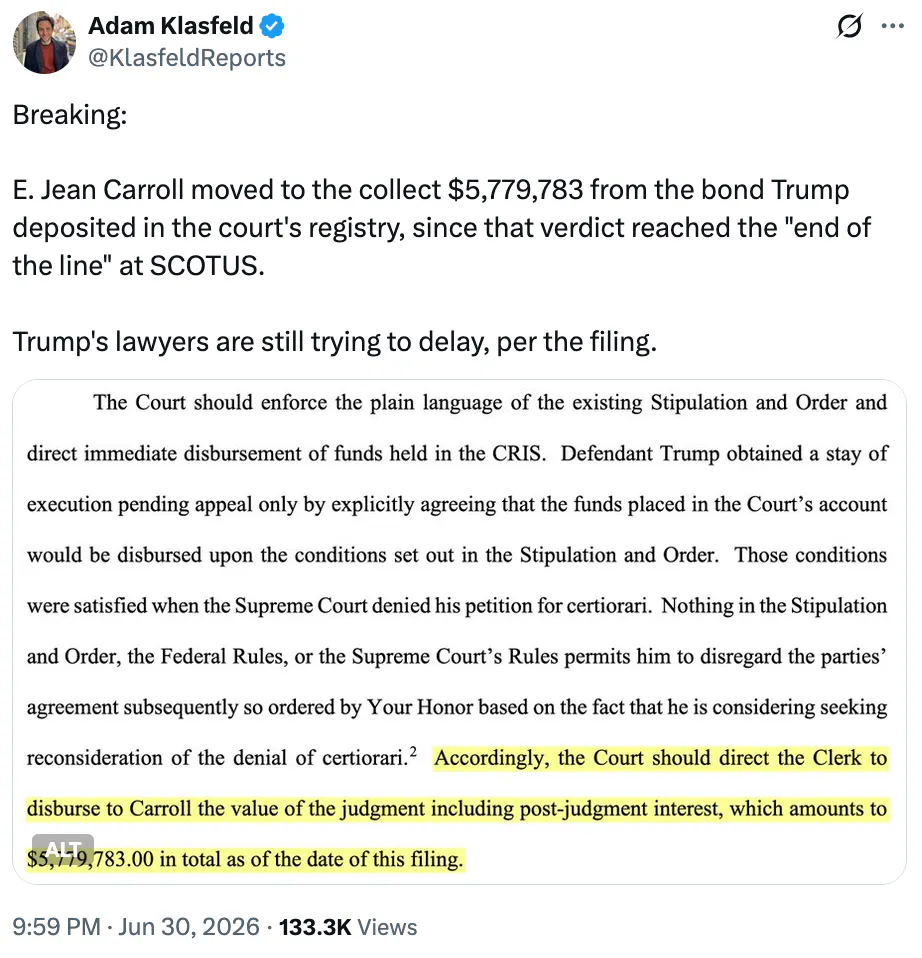
But even though the Supreme Court is supposed to be the end of the line, the president is still trying to delay paying up.
Trump should have no ability to delay the court decision, as not a single justice registered a dissent. But he has difficulty accepting when things don’t go his way, especially in his second term as president. After the court turned him down Monday, Trump crashed out on Truth Social.
“Surprisingly, the Supreme Court declined to ‘review’ a Fake Case brought against me by a woman I never met (Decades old celebrity photo line, standing with her husband, does not count!),” Trump posted.
“This Case is really against the United States of America, and all it stands for, and should never be allowed to happen to another President, or Candidate to be!” Trump added.
Future presidents and candidates hopefully won’t have a long, dragged out case of sexual assault against them where they refuse to admit wrongdoing and repeatedly defame their accuser. Trump has made history in multiple ways as president, including a refusal to just take the L and move on. It’s not like he can’t afford the payout, anyway.
Slop-henge
Follow me on Bluesky or Mastodon Related | Police use of artificial intelligence grows as rules lag behind…
Trump’s War in the Middle East Has One Clear Winner: China
This story was originally published by the Guardian and is reproduced here as part of the Climate Desk collaboration.
China has emerged as the sole winner in Asia from the strait of Hormuz crisis, according to a report published on Tuesday.
The report by the geopolitical consulting firm Asia Group concluded that China had weathered the storm of the global commodities crisis resulting from the closure of the Middle Eastern waterway, and also stood to gain from the economic and geopolitical trends sparked by the wider conflict.
“China weathered the initial shock better than any regional peer.”
Iran virtually closed the strait, a vital waterway through which much of the world’s oil and gas flows, after the US and Israel launched joint strikes on February 28, targeting government and military sites and killing Iran’s supreme leader, Ali Khamenei. The ensuing crisis has sent global energy prices soaring, with Asia particularly exposed.
The report noted that before the strait’s closure, roughly 80 percent of the oil and nearly 90 percent of the liquefied natural gas transiting the waterway was destined for Asian markets, along with a significant share of other critical commodities.
The report looked at Asia’s largest economies—China, India, Japan, and South Korea—as well as emerging markets across south-east Asia. The researchers mapped the economic and political repercussions of the crisis and its impacts across key sectors including manufacturing, energy, and agriculture.
They concluded that China was a clear winner from the crisis caused by Donald Trump’s foray into the Middle East.
The country’s large stockpiles of oil and the hugely ambitious rollout of renewable energy mean it has been less exposed to the energy shock than other countries.
China has long maintained strategic reserves of energy, and last year took advantage of cheap prices to build up even bigger stockpiles. Its crude imports grew from 11.1 millin barrels a day to 11.6 million in 2025, with over 80 percent of that increase being sent to stockpiles, according to analysis by Erica Downs, a senior research scholar at the Centre on Global Energy Policy. As of January, China had enough stockpiled to cover 104 days of imports at the 2025 level.
The country has also been building massive amounts of renewable energy infrastructure in recent years. Last year it installed 315GW of new solar capacity, more than half of the world’s new solar. The year before, it added 277GW. Beijing is aiming for half of China’s energy to come from non-fossil sources by 2030, with the share from wind and solar reaching 30 percent, up from 22 percent in 2025.
Although China’s energy mix is still largely based on coal, which accounts for more than 50 percent, renewables’ share is increasing rapidly.
“It’s tempting to see any loss of credibility in the US as a benefit for China, but that’s not necessarily the case for Beijing.”
The Asia Group’s report said: “With 1.4 terawatts of operating renewable capacity already online and a reported 90-110 days of crude import cover in reserve, China weathered the initial shock better than any regional peer.”
China has also benefited from other countries reacting to the crisis by accelerating its clean energy buildout. Beijing dominates the global supply chain in solar and other clean technology industries and in recent years has been pushing much of this production overseas at low prices, to the chagrin of western leaders worried about their own industries.
China’s electric vehicle exports soared by more than 110 percent in May compared with the previous year, while solar shipments in April increased by 60 percent.
Beijing has called for a ceasefire in the Middle East, and when Trump visited in May and met China’s president, Xi Jinping, he claimed the two countries were united in wanting to find a settlement. But the Asia Group report noted: “The crisis allows Beijing to cast the United States as the destabilizing actor whose Middle East entanglements impose costs on the world.”
There are some risks to China from the instability. Drew Thompson, a senior fellow at the S Rajaratnam School of International Studies in Singapore, said: “It’s tempting to see any loss of credibility in the US as a benefit for China, but that’s not necessarily the case for Beijing, which does not want to supplant Washington as a Middle East hegemon or provider of security for the region.”
Wen-Ti Sung, a non-resident fellow with the Atlantic Council’s Global China Hub, based in Taiwan, said the crisis could also make Beijing think twice about a future military assault on Taiwan because it showed the difficulty of navigating ships through hostile territory.
The Asia Group’s report concluded: “Ultimately Beijing views the pain points not as existential threats, but as challenges to be managed and even opportunities to be exploited.”
Transcript: Trump-MAGA Rage at Birthright Loss Erupts in Dark Threats
The following is a lightly edited transcript of the July 1 episode of the Daily Blast podcast. Listen to it here.
Greg Sargent: This is The Daily Blast from The New Republic, produced and presented by the DSR Network. I’m your host, Greg Sargent.
Donald Trump lost a big one when the Supreme Court upheld birthright citizenship in a blockbuster ruling on Tuesday. But the way the ruling came down strongly suggests we’re heading into a much longer battle over this going forward. In that regard, MAGA’s furious reaction to the ruling was deeply unnerving. As many pointed out on social media, getting rid of birthright citizenship is going to become akin to Roe v. Wade for the right, especially the MAGA right. How should liberals and Democrats proceed?
We’re talking about all of it with Raul Pinto, deputy legal director at the American Immigration Council. Raul, good to have you on.
Raul Pinto: Thanks, Greg. Good to be on. Quite a day.
Sargent: So the Supreme Court ruled by six to three against Trump’s executive order ending automatic citizenship for anyone born on U.S. soil. Five justices upheld the Fourteenth Amendment guarantee of birthright citizenship. Brett Kavanaugh voted with them, but not on the constitutional argument—he effectively said Congress can theoretically change this with legislation. So only five justices are with us on the constitutional argument. Good, but not good enough. Raul, what’s your immediate reaction to how this happened?
Pinto: Yeah, I would put it as a five-four decision, because it’s a razor-thin margin, right? And as you’re saying, five justices actually said that this was enshrined in the Constitution, that birthright citizenship is actually part of the Fourteenth Amendment. And it’s very discouraging to see that four other justices didn’t agree with that, and that at the end of the day, we may have to battle this again.
Sargent: So Trump and MAGA absolutely exploded in rage over this. Trump said that Congress can now act to end birthright citizenship, which is false, since five justices say it’s protected by the Constitution. But I want to read what MAGA personality Matt Walsh said:
“Now that SCOTUS has opened the floodgates for foreign invaders to flock across our borders and spawn, the only choice we have is to triple down on immigration enforcement, militarize the border, mass deportations, round every illegal up. Don’t pull back when the lesbian activists start screeching about it. Use whatever force is necessary.”
Whatever force is necessary—Raul, that’s a straight-up threat of mass violence, is it not?
Pinto: Yeah. And I do think that the concept of birthright citizenship as established in the Constitution—it’s historical. The decision today was based on historical principles and how the Fourteenth Amendment came about. And so I do find that those views are very extreme, and hopefully cooler heads prevail. But we know that that hasn’t always been the case—i.e., January 6.
Sargent: Right. I think Matt Walsh is essentially saying pretty explicitly that MAGA doesn’t give a shit about the Constitution, and especially the Fourteenth Amendment. They really have special disdain for the Fourteenth Amendment for all sorts of reasons. He’s essentially saying, screw the Constitution, let’s just use mass violence to, quote-unquote, protect the country against invaders.
Pinto: It’s sad that it’s being approached in this particular way. The decision today is rooted in historical precedent as to how the Fourteenth Amendment was drafted, as well as trying to correct some of America’s darkest periods, like the Dred Scott decision. It allowed—the descendants of slaves to become U.S. citizens, as well as Wong Kim Ark, the decision which allowed a descendant of Chinese immigrants to become a U.S. citizen as well.
Sargent: Well, here’s Stephen Miller:
“One of the most destructive and outrageous decisions in the long history of the Supreme Court. American citizenship is not the birthright of the world. It belongs only and solely to Americans. No provision of the Constitution can be read to require our national self-obliteration.”
Let’s talk about how deranged that is. Immigrants are not obliterating us. He treats that as a given. It’s complete fantasy. How does he think people become Americans? He personally is descended from people who immigrated here and were attacked with very similar language.
But, Raul, most important, I think this sets the stage for drastic action. Remember, Miller was already urging Trump to defy the courts if this situation is tantamount to national self-destruction. Surely Miller will expect Trump to do that here, yes?
Pinto: I don’t want to get into Stephen Miller’s head. I really don’t. But what I can say, right, is that immigrants are definitely not ruining the United States. And as a matter of fact, birthright citizenship was still a thing in the first Trump administration and the world didn’t end. And immigrant contributions continued throughout the darkest periods of the administration and beyond.
And so one of the interesting things that it’s important to know is the impact that this decision has on those children that would have been targeted by the executive order. It would have created a second-class system for them.
They wouldn’t have been eligible for Social Security numbers, passports, or any proof that they actually belong to a certain nation. And that’s also something that’s addressed by Justice Roberts.
Sargent: And it’s really good that he addressed that. Because I think at bottom, what MAGA really wants is that two-tiered system. They really want to end the Constitution’s guarantee of equality. That to them is really the big kahuna—ending equality. They want a hierarchical system.
What they want is a large subpool of stateless and rightless people that they can target with state violence. I think that’s the essence of this. And I think it’s good that Justice Roberts made it clear that that was off the table.
Pinto: It is why I think it’s important that the court today said that it is a constitutional right. And as you’re saying, that comes with certain weaknesses. And yes, it was a flimsy majority, but we do have decades of precedent that would have to be overturned for that to happen. I’m still worried. But today’s decision was important, and I think it was positive.
Sargent: One of the core tactics that this administration is using, that MAGA is using to try to ethnically cleanse the country, is to use whatever legal lever they can to make life fundamentally unlivable for immigrants. What they were really hoping for was to be able to create this new second-class caste that could then be subjected to all sorts of maltreatment and discrimination, and wouldn’t have any legal protections of pretty much any kind. Let’s listen to MAGA personality Tim Pool.
Tim Pool (voiceover): Kagan, Sotomayor, Ketanji Brown Jackson—we know exactly what they think, and they want to burn this country to the ground. Unfortunately, Trump won’t make the moves needed, Congress won’t make the moves needed, and Republicans should pack the court right now. Thirteen federal district circuits, thirteen Supreme Court justices. And Trump can add a good old four more conservative court members, which guarantees we will never lose another ruling again. But he won’t. So I can only say this: without men of action, your nation be damned. We do not have men of action.
Sargent: Note how he says they want to burn the country down—meaning you and me want to burn the country down, because we want to uphold birthright citizenship as a constitutional mechanism. And note how he says only men of action can save us. He’s basically saying we need Caesar, isn’t he?
Pinto: It’s such a dog whistle, right? But it is also extremely important to point out that many of the children of immigrants who would have been subject to the executive order—America is all they’re going to know as a home. And they are going to be rooting for the U.S. in the World Cup and part of the social fabric of this country.
And so I find it troubling that that is the rhetoric that happens on the other side, because they can become as patriotic as you and I and uphold those American values that we hold here.
Sargent: Right. America is the only country that many of these kids are ever going to know.
Pinto: Absolutely. Absolutely. And not only that, but ending birthright citizenship would have again left them without a real home, despite the fact that their parents may have been in the country for a long period of time. The Fourteenth Amendment is very clear. And Justice Roberts says, we are grounding this decision on the Constitution. And that’s important.
Sargent: Yes, it was really important that he said that. I just want to return to something that you said earlier, which really resonated with me, which is that Donald Trump has actually succeeded in, quote-unquote, securing the border. He’s used a lot of tactics that I think are obviously heinous and indefensible. But what’s interesting to me is that MAGA can’t even accept that as a victory.
Trump constantly says he’s reduced border crossings to zero or whatever—that’s a bit of an exaggeration, but it’s true that he’s gotten them way down. And MAGA can’t say to themselves, well, we won on that, we got what we wanted, because they need to feel like they’re being invaded by immigrants at all times.
And here’s why. Their movement isn’t actually just about securing the border. It’s about ethnically cleansing the country. They want mass removals. They want to roll back the demographic evolution of this country and reverse-engineer it in some sense. And that’s why they can’t accept Trump securing the border as a victory, because it doesn’t count as ethnic cleansing, which is the thing they really want.
Pinto: Well, you also have to remember that this decision comes on the heels of two other immigration decisions that went in the Trump administration’s way. One of them limited access to asylum at the border, and the other allows the Trump administration to end temporary protected status for hundreds of thousands of people.
So the general rhetoric that the world is going to end because we have birthright citizenship is just incorrect. Or that this court is by any means sort of favorable to immigrants because of a birthright citizenship decision that is actually rooted in the Constitution—that’s just incorrect.
Sargent: Right. They can’t even accept the ending of TPS in effect as a victory, and the ending of asylum in effect as a victory. They want those things, but they don’t constitute the dramatic mass removals, the enormous ethnic purging that they really want. I think that’s the essence of this.
Pinto: Yeah. And I would say that, exactly what you’re saying—if you’re ending birthright citizenship, there are thousands of children who would have been undocumented and potentially subject to immigration enforcement with their family members. And so that is obviously problematic, because now you’re expanding the universe of folks who would be subject to removal.
Sargent: That’s exactly what they want to do. So let’s just close this out. What do Democrats and liberals do now? I mean, if you look at this situation, it’s now clear that this is going to take on the cast of a major cause—something like targeting Roe v. Wade the way the right did for decades. They are clearly going to set in their sights the ending of birthright citizenship. Do you think that that’s a major thing that we should take seriously, and how should we proceed?
Pinto: Yeah, as we said at the top, it’s concerning that the margin of victory was that small. I do think that precedent and history is on our side, and it will be going forward. But obviously we are concerned, and there are concerns with that.
I would say that ending birthright citizenship is not popular among the American population. Most Americans support birthright citizenship. So I take some solace in that. I take some solace in the fact that Justice Roberts, who sided with the majority on the other cases that went the other way on immigration—I would say that if he’s able to think through this issue and see it as a constitutional matter, I think that’s important. And if precedent continues to be important to the U.S. Supreme Court, then we will continue to get good rulings on this issue.
That doesn’t mean that we won’t see attempts to try to do this through legislative action. But it is a constitutional issue now. Granted, I will give you the fact that there could be a different interpretation and someone can come in and agree with the other four judges.
But it is important, then, for that majority of individuals who is in favor of keeping birthright citizenship for children born on U.S. soil, that we are expressing those views to Congress so that that doesn’t happen. Because I do think that at the end of the day, Americans are not going to stand for that.
Sargent: I’m going to choose to be optimistic about this as well. We won today, and that’s a big deal. Raul Pinto, great to talk to you. Thanks for coming on.
Pinto: Likewise, Greg. Thank you.
Space, “Star Trek,” and Social Justice
Growing up in Los Angeles in the 1980s and ’90s, a daughter and granddaughter of social justice activists, Chanda Prescod-Weinstein fell in love with math and the physical sciences and developed a profound curiosity about the cosmos (though the smoggy night sky of her childhood blocked her view of the stars). She soon developed a detailed plan for her life that led to a career writing and teaching about physics and gender studies at the University of New Hampshire.
jQuery(document).ready(function(){prx("https:\/\/play.prx.org\/e?ge=prx_149_72095ec7-3401-4fe3-8953-73404272499e&uf=https%3A%2F%2Ffeeds.revealradio.org%2Frevealpodcast", "prx-1", "embed")});Subscribe to Mother Jones podcasts on Apple Podcasts or your favorite podcast app.
Today, Prescod-Weinstein’s work stands out for the ways she weaves her identity as queer, Black, and Jewish into her work. In her latest book, The Edge of Space-Time: Particles, Poetry, and the Cosmic Dream Boogie, Prescod-Weinstein brings a Black feminist lens to cosmology, quantum physics, poetry, and popular culture to help unlock the mysteries of the physical universe.
“The Edge of Space-Time is a much more intimate book because this is my brain,” Prescod-Weinstein says. “This is how I see the universe. These are the things that I am passionate about in my quiet moments.”
On this week’s More To The Story, Prescod-Weinstein talks about the need for diversity and inclusivity in the sciences and puts science fiction’s various hypotheses for space travel to the test with host Al Letson.
Find More To The Story on Apple Podcasts, Spotify, iHeartRadio, Pandora, or your favorite podcast app, and don’t forget to subscribe.
The Supreme Court Declares War on Woodrow Wilson
This week’s Supreme Court ruling giving President Donald Trump a free hand in firing government regulators is less about Trump than it is about President Woodrow Wilson. In the text of Trump v. Slaughter and its various concurrences and dissents, I count 15 Trump mentions compared to 23 for Wilson. Partly that’s because no brief to enlarge presidential power will benefit from too close a look at the crazy bastard slumped in the Oval Office today. But mostly it’s because the high court wants to repudiate a set of good-government principles associated with the Progressive era and articulated in some detail by the twenty-eighth president. In the right’s political typology, Wilson is the snake in the garden of limited government who proffered the shiny red apple of the administrative state. Trump v. Slaughter is meant to drive a stake through Wilson’s undead heart.
These days, liberals aren’t too crazy about Woodrow Wilson, either, because of his appalling white supremacist views and his 1913 directive to segregate Black and white employees in the federal workforce, which led to wholesale firings and demotions of Black employees and was a catastrophe for Washington’s fledgling Black middle class. Princeton took Wilson’s name off its School of Public and International Affairs in 2020, and in 2022 the District of Columbia took Wilson’s name off a high school built atop the ruins of Reno City, a Black neighborhood that federal authorities wiped off the map in the 1930s. I can’t quarrel with either decision. But life is complicated, and Wilson also helped bequeath a valuable legacy of government policy that drew on expertise and dispassionate analysis. Liberals take that legacy for granted, but conservatives have lately made that hard to do.
Liberal distaste for Wilson pales in comparison to conservatism’s loathing of the man. Wilson “ushered in a new view of government,” Charlie Kirk said in a February 2025 podcast. “That we’re gonna have these in-de-pen-dent agencies that exist regardless of political pressure.… He wanted to have these agencies be permanent. A tech-no-cratic class untouchable by the sovereign, untouchable by we the people.” The right’s Wilson-hating cult is about 20 years old and was first popularized by the former Fox News commentator Glenn Beck. “I have to tell you,” Beck said at the 2010 Conservative Political Action Conference, or CPAC, “I hate Woodrow Wilson with everything in me.… He gives us the Fed.” (True.) “He gives us the income tax.” (That was really more President William Howard Taft, a Republican.) “Prohibition. So, he took away the alcohol.” (False. Wilson vetoed the Volstead Act, and then Congress overrode him.)
Wilson did much less to invent the administrative state than his enemies profess. Only two major agencies were created on his watch. By contrast, Theodore Roosevelt, a Republican, created the U.S. Forest Service, the Bureau of Corporations (forerunner to the Federal Trade Commission), the Food and Drug Administration, the Labor Department, and the Agriculture Department’s Food Safety and Inspection Service. In truth, the administrative state evolved, starting in the nineteenth century, alongside the growing power of industry, as a necessary check on that power.
What makes Wilson a favored target is that, as a political scientist, he wrote favorably about such developments. In his 1886 essay “The Study of Administration,” Wilson observed that democratic governance “does not consist in having a hand in everything, any more than housekeeping necessarily consists in cooking dinner with one’s own hands.” (Before you call this aristo presumption, recall that Wilson was writing at a time when middle-class families frequently employed full-time cooks.) “The cook must be trusted with a large discretion as to the management of the fires and the ovens.” In much the same way, civil servants with expertise in various technical matters should be given leeway to make regulatory decisions, with political appointees and the public, of course, looking over their shoulders.
Trump v. Slaughter repudiates that notion as antidemocratic. Previously, a subset of regulatory agencies called independent agencies, acting in quasi-judicial fashion and with top presidential appointees (typically a five-person panel) affiliated with both political parties, was protected from excessive partisan interference by legislative language stipulating that the president could remove these top officials only for cause. Nobody, including the high court, thought these independent agencies acted independent of politics. Because a majority of top slots were reserved for the president’s party, a Democratic Federal Trade Commission or National Labor Relations Board or Merit Systems Protection Board ruled differently than a Republican one. But the differences were somewhat muted and these independent agencies operated within an atmosphere of comparative professionalism; outright partisan hackery was frowned upon. And because the members had fixed (usually five-year) terms, there were no opportunities for empire building along the lines of J. Edgar Hoover’s half-century reign at the FBI.
That world is now gone, because under Trump v. Slaughter the president can fire any of these officials if he opposes their politics or suspects them of disloyalty. The same groveling demonstrations of loyalty to Trump that we see Cabinet secretaries put on nauseating display in photo ops will now be required of agencies tasked with protecting consumers, workers, investors, voters, and so on.
What has this got to do with Woodrow Wilson? Justice Neil Gorsuch—the biggest Wilson-hater on the high court—explains in his concurring opinion to Slaughter that Wilson belonged to a group of scholars who, inspired by what Gorsuch sneeringly describes as “the perceived competence of the Prussian bureaucracy,” called for bringing to American government “the utmost possible efficiency.” Central to this project was the hiring of scientific and technical experts and shielding them from excessive political control. But “those in charge of these new agencies often became very difficult to dislodge.”
No, they didn’t. They served fixed terms, and whenever a president of the opposite party came in, they lost majority status. Gorsuch’s real beef with independent agencies isn’t that they operate beyond presidential control but that they exist at all:
Independent agencies today hold tremendous sway over the Nation’s affairs. They regulate our businesses, and our financial markets. They set the rules for the internet and airwaves. They decide how we light our homes, how we run our elections, and the manner of our employment. They determine what toys our children will play with and how we interact with each other at work.… Often, these agencies do all this with hardly any statutory guidance, based on broad grants of legislative authority.
Translation: Repeal the Progressive era!
The majority opinion in Trump v. Slaughter, written by Chief Justice John Roberts, mentions Wilson by name only to acknowledge Wilson’s firing of a Portland, Oregon, postmaster, which occasioned the Supreme Court’s decision in Myers v. United States (1926), which voided a statutory requirement that Wilson had to secure Senate approval for such dismissals, which the high court argues should have prevented independent agencies from enjoying the job protection the Supreme Court now invalidates. But Wilson and the Progressive movement are doubtless what Roberts has in mind when he writes, “Placing the power to administer laws in officers who enjoy ‘freedom from Presidential oversight (and protection)’ does not deliver us to a promised land of technocratic governance [italics mine].” The high court wants you to know that no such techno-paradise exists. It’s uniquely galling to be lectured on the phoniness of expertise by a legal expert whom the president cannot fire.
But it would be untrue to say the high court rejects Wilson’s vision of technocratic governance in every nonjudicial context. On the same day it handed down Trump v. Slaughter, the Supreme Court also handed down Trump v. Cook, which says the president can’t fire Federal Reserve Governor Lisa Cook because … I still can’t understand why not. I draw some comfort from the fact that Justice Sonia Sotomayor, in her dissenting opinion to Trump v. Slaughter (joined by Justices Elena Kagan and Ketanji Brown Jackson), can’t understand it, either:
For most agencies, the majority here says, removal protections like the FTC’s make the President’s job “impossible” and so are unlawful. For [the Fed], however, the Court recognizes that the Founders were acutely aware “of the calamities that could arise from even the ‘suspicion’ of political manipulation of monetary policy” and that they therefore “guaranteed [such agencies] independence from Presidential control.” … What is unclear is why these principles should be limited only to agencies, like the Federal Reserve, that in some respects influence “monetary policy.”
Justice Amy Coney Barrett, coming from the opposite ideological direction, writes in her dissent to Trump v. Cook that she too can’t figure out this inconsistency:
The Court’s holding is in serious tension with Trump v. Slaughter, which we also decide today. Slaughter announces a categorical rule: Whenever “an agency ‘executes’ a congressional mandate against private parties, it exercises executive power” and must be subject to plenary executive control—“no ifs, ands, or quasis about it.” Yet here, the Court claims a special exception “sanctioned by history” and based on the Federal Reserve’s role in setting monetary policy. How can history support both a categorical rule and a carveout?
Answer: It can’t. As is so often the case, it falls to the women to call bullshit on the men. But Wilson gets the last laugh because, as Glenn Beck rightly pointed out, Wilson signed into law the legislation that created the Federal Reserve. When it comes to protecting your 401(k), we’re all Wilsonians.
This Is the Week for Democrats to Start Saying “Climate Change” Again
The United States is bracing for another heat wave. More than 180 million people across the Plains, Midwest, and Southeast were under “major” or “extreme” heat warnings as of Tuesday morning. Temperatures are expected to peak above 100 degrees on the East Coast over the holiday weekend as a high pressure “heat dome” traps hot, humid air in place. The heat index, which takes humidity into account, is predicted to hit as high as 115 degrees in some places.
The elephant in the room here—the force making record-breaking heat a more common occurrence—is climate change. Last week’s deadly European heat wave would have been “virtually impossible” without the greenhouse effect of fossil fuel emissions, concluded a group of researchers from Europe and the U.S. But coverage of that heat wave in U.S. media barely mentioned climate change, referring only vaguely to the fact that the European continent is “warming faster than any other,” per CBS’s evening broadcast. The media watchdog FAIR noted that NBC, CBS, and ABC news reports all “failed to mention climate change even in passing.”
This is not just a media failure. Fearing backlash from swing voters and Republicans, Democrats have largely stopped mentioning climate change too. A recent analysis by the nonprofit newsroom Inside Climate News found that mentions of climate change in congressional Democrats’ press releases started to taper off in 2022, following the by now received wisdom among party pollsters and pundits that talking about rising temperatures is a political death wish certain to turn off would-be Democratic voters. As I’ve written before, this approach is somewhat baffling considering that Democrats talked a lot about climate change in an election they won, in 2020, then lost an election four years later where they mostly avoided the subject.
Climate-fueled heat waves, storms, fires, droughts, and floods are becoming an unavoidable reality for tens of millions across the United States. Refusing to talk about climate change in that context means refusing to engage with the world as it is. If left-of-center politicians and ostensibly fact-based news organizations aren’t willing to accurately interpret our climate-changed reality, however, the right will be more than happy to do it for them.
Over the last few years, GOP politicians have chalked up deadly wildfires to Democratic mismanagement and Jewish space lasers. After flash flooding in Valencia, Spain, killed 229 people in 2024, the far-right party Vox capitalized on widespread frustration with the “political class” to pin the disaster on the country’s center-left governing coalition in Madrid. Much of the blame, meanwhile, lay with Valencia’s regional government, where Vox had just recently served as part of a governing coalition that undermined disaster response and emergency planning. During the recent European heat wave, when an estimated 1,300 people died from heat-related causes, right-wingers rushed—without evidence—to blame “degrowth” and climate concerns for the continent’s lack of air conditioning. Degrowth is, notably, not the law of the land in Europe, where air conditioning is not illegal and where the European Commission has recently dismantled several of its modest climate policy commitments.
People are baking to death in Europe for the same reason that whole towns are being zapped off the map by wildfires in California, and that home insurance is becoming a luxury in places now being regularly inundated by floods that should only happen every thousand years: Our societies are navigating a climate-changed world with last century’s infrastructure. That’s not the result of some surplus of climate policies but of a profound lack of them. A few years ago, it wasn’t impossible to imagine a more climate-conscious European Union embarking on a bloc-wide mobilization to create millions of jobs installing reversible air-to-air heat pumps, which cool homes efficiently too; readying the grid to meet increased summer electricity demand with as little imported oil and gas as possible; and retrofitting old housing stock built primarily to retain heat in the winter. That never happened because European politicians, like their counterparts in the U.S., decided that preparing for and mitigating the climate crisis just wasn’t worth the the hassle.
Widespread air conditioning will thankfully help the U.S. withstand this week’s brutal temperatures. But our country is no closer than Europe to having a plan for how to live with the climate crisis. Blasting the A.C. won’t keep roads and tarmacs from melting, droughts from lowering crop yields, coastal Louisiana from becoming uninhabitable, or Malibu from burning. Because the right has no intention of protecting most people from climate-fueled destruction, it’ll blame these things—like all things—on Democrats and leftist conspiracies. As they did during last week’s European heat wave, right-wingers will even go so far as to blame climate policy itself for climate-induced deaths.
There’s good evidence to suggest that mentioning climate change won’t kneecap Democrats politically. And as warming continues to destabilize our world, it certainly isn’t in anyone’s interest to let Republicans control the narrative. That way lies more inaction, and more deaths.
The Great American State Fair Is a Great Trumpian Disaster
“There are tons of people here,” said Dr. Mehmet Oz, the former TV quack who now runs Medicare and Medicaid, at the Great American State Fair on Monday. He was speaking with Dean Cain, another former TV man—he played Superman on ABC in the 1990s—who has acted as a kind of hype man for the event, ostensibly a celebration of America’s 250th birthday, that is currently taking place on the National Mall.
Oz seemed to know he was lying—there were not tons of people there. “This is a huge space and it’s just going to be more and more crowded as the week goes on,” he added. He’s right that it’s a huge space, but videos showed he was speaking to a sparse crowd of maybe 100. Cain later shared a picture from the top of the Ferris wheel where you can literally count the attendees. There are a few hundred.
Dr. Oz on stage with Dean Cain talks about how great the crowd is at the Great American State Fair... so @hicharliecotton pans his camera to reveal quite the opposite. https://t.co/vZ3exnGWS3 pic.twitter.com/4e1ugj7AVw
— TMZ (@TMZ) June 29, 2026Just as President Trump insists his lackeys dress like him, he also demands they adopt his Norman Vincent Peale–inspired embrace of positive thinking—which is to say, the refusal to acknowledge politically inconvenient truths. But it’s hard to argue with the wealth of video and photographic evidence of the Great American State Fair. It may very well get more crowded, but right now it’s a flop. That’s no surprise to anyone who’s been paying attention to this administration, which is itself a total failure—a group of losers and buffoons so incompetent they … well, can’t even put on a state fair. If they can’t even manage a corn maze, no wonder they’re losing a war.
But the Great American State Fair is also failing because it’s the reflection of a president who has no substantive story to tell about the country he leads. While the U.S. is meant to be celebrating its semiquincentennial, Trump can only tell a story about himself. The centerpiece of the fair, after all, is a cheap scale model of a massive triumphal arch Trump hopes to build near Arlington National Cemetery. What triumph does that arch celebrate? When CBS News’s Ed O’Keefe asked Trump whom the 250-foot-tall structure is for, he pointed at himself and said, “Me.” The same could be said of the fair, the war, and so much else that this administration has done—while the World Cup offers a fitting counterpoint.
History, at least in an abstract sense, has always been a part of Trump’s political project. He did not invent the slogan that gave the name to his movement—Ronald Reagan used “Make America Great Again” in his 1980 campaign—but he now owns it. Of course, the genius of those four words for Trump is that they don’t really mean anything. They harken back to an earlier, supposedly rosier period without actually saying what period that is. It’s not hard to extrapolate, given Trump’s long history of racism, xenophobia, and misogyny, that he is gesturing at a past when white supremacy went unquestioned. But the statement’s utility as a political slogan is entirely dependent on its vagueness. Trump wants to return America to greatness. When was it great? Let’s not get into specifics.
Trump, of course, has no genuine interest in history, not even America’s. Although some observers have floated supposed models for his presidency—Andrew Jackson in Trump’s first term, William McKinley in his second—he has never expounded knowledgeably on Jackson’s populism or McKinley’s protectionism, only gesturing at them half-heartedly in an attempt to explain his own xenophobia and imperial ambitions. No, Trump is only interested in history to the extent that he will feature prominently in it. He wants to be seen as a “great man” who changed the world.
This unbridled narcissism is how you get a fiasco like the Great American State Fair and the larger project of which it is a part, Freedom 250—an organization that Trump created despite the fact that Congress had already created an organization, America250, for the purpose of celebrating the country’s anniversary. The primary purpose of Freedom 250, which is not subject to congressional oversight and does not have to disclose its donors, is the elevation of Trump and his political movement. That’s why so many musicians withdrew from performing at the Great American State Fair, and organizers had to turn to Kash Patel’s girlfriend. With just a few days to go before America’s “birthday,” Freedom 250’s most notable event so far was the UFC fight held on the White House lawn on Trump’s actual birthday.
Under a different administration—one helmed by Kamala Harris, say, or even a doddering Joe Biden—it’s not hard to imagine a different, nonpartisan celebration of America’s 250th. The textbook narrative of American history has been increasingly contested on the left, so such a celebration would not have been without minor controversy, whether genuine or manufactured. But it would have actually reckoned with this nation’s history. It also would have featured much better music, and perhaps wouldn’t have attempted to gouge visitors with $25 pretzels.
Of course, there is another celebration happening in America at the same time as the debacle that is Freedom 250: a World Cup that’s primarily being hosted by blue cities. That tournament has, like everything else, been marred by the Trump administration’s incompetence and maliciousness. But it has largely been what the Great American State Fair ostensibly wants to be: a mass celebration where people come together in a spirit of unity and togetherness.
Of course, the tournament’s attendees—in spite of the Trump administration’s best efforts—aren’t just coming from all over America, but the world too. Still, if you look at stadium audiences or fan fests—or even just videos of fans celebrating in the street after their team wins, as happened with Morocco supporters in Queens last night—you can see a different story about America than Trump is trying to tell. This is not the story of an egomaniacal, fascist president who dreams of an all-white America, but of a country that embraces foreigners with generosity and respect. This July 4, that’s the only story we should be celebrating.
MAGA Rage Takes Unnerving Turn as Birthright Loss Rattles Trump Badly
After the Supreme Court upheld the Constitution’s guarantee of birthright citizenship, Trump and MAGA lost it. Trump threatened to get Congress to end the guarantee, which it can’t do, and he lamely claimed it was a “WIN” for China: The sheer haplessness of his response hinted at how disoriented the ruling left him. But MAGA exploded: One personality called on the masses to “use whatever force is necessary” to repel “invaders,” a clear threat of violence. Another one, flagged by Media Matters, accused the liberal justices of wanting to “burn the country to the ground” and suggested “men of action” must stop them, also a dark, veiled threat. And Stephen Miller absurdly described the ruling as “national self-obliteration,” which would seem to justify anything in response. We talked to Raul Pinto, deputy legal director of the American Immigration Council. We discuss why the ruling was too close for comfort, how that’s inviting MAGA to wage a longer war to overturn birthright citizenship, how that might unfold, and why there’s cause for cautious optimism about what’s next. Listen to this episode here.
Left-Wing Challenger Melat Kiros Upsets 15-Term Incumbent in Colorado
Melat Kiros, a 29-year-old democratic socialist, has won the high-profile primary for Colorado’s first congressional district, the Associated Press and other outlets projected Tuesday. With more than 90 percent of votes counted, Kiros leads Diana DeGette, Colorado’s longest-serving Democratic member of Congress, by a comfortable 51-42 margin.
DeGette—who has held her position since before Kiros was born—was seeking a 16th term in the House. She leads Colorado’s congressional delegation.
I covered Kiros’ outsider challenge to DeGette as part of a wave of young congressional candidates running in part to challenge the Democratic establishment on Gaza:
And in a primary taking place Tuesday in Denver, Melat Kiros, a 29-year-old democratic socialist who calls herself a “recovering lawyer,” is running against incumbent Democratic Rep. Diana DeGette, who has held her seat since 1997.
Two years ago, as a new lawyer in New York, Kiros wrote an open letter defending law students who organized for Palestine. “I myself am from the northern region of Ethiopia, where a genocide had also taken place a few years ago,” Kiros, whose parents immigrated to Colorado when she was a baby, said.
Her employer asked her to take the letter down. Kiros refused, was fired, and moved back to Colorado within a week. She took a gig as a barista (“the best job I’ve had”) to make ends meet, and is now running on a familiar progressive platform: Medicare for All, universal childcare, AI regulation, ICE abolition and an arms embargo on Israel.
The only poll in the race, by progressive firm Data For Progress, showed Kiros up by five points earlier in June.
“Every single thing that you care about, from social justice to economic justice to environmental justice, all of these things are intertwined with who has the money and the influence to wield power over our government,” Kiros said to me in an interview June 10.
In the final weeks of Kiros’ race, millions of dollars flooded in to support her DeGette. The largest outside group spending on DeGette’s behalf, Pro-Choice Majority Action, has ties to the American Israel Public Affairs Committee, or AIPAC. The biggest spender backing Kiros has been the super PAC of the progressive group Justice Democrats, which endorsed her in December.
Kiros is also backed by the Democratic Socialists of America and high-profile supporters like Bernie Sanders and streamer Hasan Piker, who was urging voters to get to the polls in Denver minutes before they closed. (“What do you guys think about the data center that just popped up over here?” Piker told audiences. “Diana DeGette, who’s represented this district for 30 years in Congress, is saying nothing about the data centers, because she’s in the pocket of big corporations.”)
Kiros will join a group of left-wing insurgent candidates who have upset the Democratic establishment by winning decisive primary victories on unapologetically progressive platforms. Only half an hour after polls closed, with the race not yet called, Republicans were already treating Kiros as the presumptive winner. Democrats are “showing their true colors and saying we want socialism, inevitably we want communism,” said Republican Colorado Rep. Lauren Boebert on Colorado’s News9. “You’re seeing this in New York—you have the Mamdani allies, who won their candidacy.”
Two politicians aligned with Mamdani—former New York City Comptroller Brad Lander and socialist Darializa Avila Chevalier—knocked out incumbents; a third, Claire Valdez, will replace retiring Democratic veteran Nydia Velázquez.
Kiros says she will work with them to push the Democratic Party leftward. “If enough of us share that commitment to Medicare for All, to ending corporate capture, to an arms embargo [on Israel], we should absolutely say: here are our conditions,” she told Axios. “If you want our votes on leadership, on appropriations, this is what it costs.”
Trump crowned himself the crypto president. Then crypto collapsed.
When Donald Trump returned to the White House, one industry was convinced it had finally elected its champion: crypto. Trump didn’t just promise lighter regulation on cryptocurrency. He declared himself America’s “crypto president.” He vowed to make the United States the crypto capital of the world. He appointed a White House crypto czar, David Sacks. He hosted crypto executives at an…
Megyn Kelly is triggered by superhero, and right-wing families try Russia
A daily roundup of the best stories and cartoons by Daily Kos staff and contributors to keep you in the know. Remember the right-wing families who moved to Russia? Here’s where they are now. Spoiler alert: It’s not going well. Supreme Court’s leader doesn’t care about the Constitution The justices’ pocketbooks are sacred, but anything else is up for grabs.